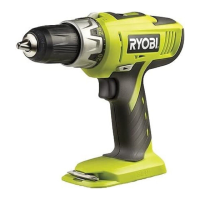
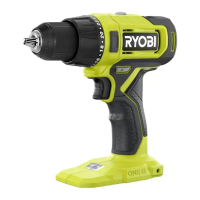
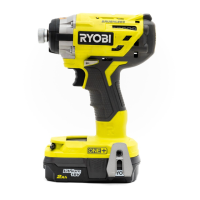
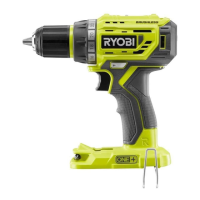
3
Slide depth guide clamp into notch in collar. Clamp
holds depth rod firmly in place.
When properly installed, the teeth on the depth
stop rod should be aligned with the teeth indicator on the
depth stop rod clamp.
Thread auxiliary handle onto screw and secure tightly.
Be sure the auxiliary handle is securely tightened
against the depth stop rod clamp. This secures the depth
stop rod at the desired depth of cut. It also secures the
auxiliary handle.
Voltage 18 V
Chuck 2-13 mm
Switch Variable speed
No load speed (Drill mode):
-Lo speed 0-400 min
-1
-Hi speed 0-1500 min
-1
Hammer speed (Blows per minute):
-Lo speed 0-5200 min
-1
-Hi speed 0-19500 min
-1
Max. torque 49 Nm
Weight (not incl. battery pack) 1.68 Kg
(not included)
(not included)
BID1821
Do not allow familiarity with products to make
you careless. Remember that a careless fraction
of a second is sufficient to inflict serious injury.
Always wear safety goggles or safety glasses
with side shields when operating products.
Failure to do so could result in objects being
thrown into your eyes, resulting in possible
serious injury.
Do not use any attachments or accessories
not recommended by the manufacturer of this
product. The use of attachments or accessories
not recommended can result in serious personal
injury.
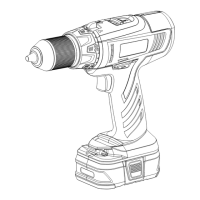
You may use this product for the purposes listed below:
Drilling in all types of wood products (lumber,
plywood, panelling, composition board, and hard
board)
Drilling in ceramics, plastics, fiberglass, and laminates
Drilling in metals
Driving screws
Hammer drilling in brick, or other masonry
This product will accept RYOBI One+ 18 V lithium-ion
battery packs and RYOBI One+ 18 V nickel-cadmium
battery packs.
RYOBI 18 V lithium-ion batteries are designed with
features that protect the lithium-ion cells and maximise
battery life. Under some operating conditions, these
built-in features may cause the battery and the tool it is
powering to act differently from nickel-cadmium batteries.
During some applications, the battery electronics may
signal the battery to shut down, and cause the tool to
stop running. To reset the battery and tool, release the
trigger and resume normal operation.
To prevent further shut down of the battery, avoid
forcing the tool.
If releasing the trigger does not reset the battery and
tool, the battery pack is depleted. If depleted, the battery
pack will begin charging when placed on the lithium-ion
charger.
See Figure 3.
Lock the trigger switch by placing the rotation selector
in the center position.


 To Next Page