6
English
Cutting warped or wet lumber.
Operating the tool incorrectly or misusing the tool.
To lessen the chance of kickback, follow these safety
practices.
Keep the blade at the correct depth setting. The
depth setting should not exceed 6.35mm. below the
material being cut.
Inspect the workpiece for knots or nails before
cutting. Never saw into a knot or nail.
Make straight cuts. Always use a straight edge guide
when rip cutting. This helps prevent twisting the
blade.
Use clean, sharp, and properly set blades. Never
make cuts with dull blades.
Support the workpiece properly before beginning a
cut.
Use steady, even pressure when making a cut. Never
force a cut.
Do not cut warped or wet lumber.
Hold the saw firmly with both hands and keep your
body in a balanced position so as to resist the forces
if kickback should occur.
WARNING
When using the saw, always stay alert and
exercise control. Do not remove the saw from the
workpiece while the blade is moving.
SAW BLADES
The best of saw blades will not cut efficiently if they are
not kept clean, sharp, and properly set. Using a dull
blade will place a heavy load on the saw and increase
the danger of kickback. Keep extra blades on hand, so
that sharp blades are always available.
Gum and wood pitch hardened on blades will slow the
saw down. Remove saw blade from the saw and use
gum and pitch remover, hot water to remove these
accumulations. DO NOT USE GASOLINE.
BLADE GUARD SYSTEM
See Figure 9.
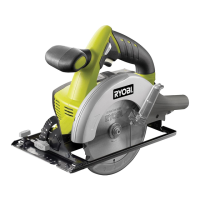
The lower blade guard attached to the circular saw is
there for your protection and safety. Do not alter it for any
reason. If it becomes damaged, do not operate the saw
until you have the guard repaired or replaced. Always
leave guard in operating position when using the saw.
DANGER:
When sawing through work, lower blade guard
does not cover blade on the underside of work.
Since blade is exposed on underside of work,
keep hands and fingers away from cutting area.
Any part of your body coming in contact with
moving blade will result in serious injury.
CAUTION:
Never use saw when guard is not operating
correctly. Check the guard for correct operation
before each use. The guard is operating correctly
when it moves freely and readily returns to the
closed position. If you drop the saw, check the
lower blade guard and bumper for damage at all
depth settings before reuse.
STARTING/STOPPING THE SAW
See Figure 10.
To start the saw:
Depress the lock-off button.
Depress the switch trigger.
Always let the blade reach full speed, then guide the saw
into the workpiece.
WARNING
The blade coming in contact with the workpiece
before it reaches full speed could cause the saw
to “kickback” towards you resulting in serious
injury.
To stop the saw: release the switch trigger.
After you release the switch trigger, allow the blade to
come to a complete stop. Do not remove the saw from
the workpiece while the blade is moving.
LOCK-OFF BUTTON
See Figure 10.
The lock-off button reduces the possibility of accidental
starting. The lock-off button is located on the handle
above the switch trigger. The lock-off button must be
depressed before you pull the switch trigger. The lock
resets each time the trigger is released.
NOTE: You can depress the lock-off button from either
the left or right side.
ADJUSTING BLADE DEPTH
See Figure 11.
Always keep correct blade depth setting. The correct
blade depth setting for all cuts should not exceed
6.35mm below the material being cut. More blade depth
will increase the chance of kickback and cause the cut
to be rough. For more depth of cut accuracy, a scale is


 To Next Page
 Loading...