RESIDUAL RISKS
Even when the product is used as prescribed, it is still
impossible to completely eliminate certain residual risk
factors. The following hazards may arise and the operator
should pay special attention to avoid the following:
■ Injury caused by dust
– While using the product, considerable dust and fine
particles will be produced. Use the dust port and
connect a dust extraction vacuum during use.
– Wear eye protection at all times.
– Wear respiratory protection masks containing filters
appropriate to the materials being worked. Ensure
adequate workplace ventilation.
– Do not eat, drink or smoke in the work area.
■ Injury caused by noise and vibration
– Wear ear protection.
– Do not operate the product for long periods of time.
See “Risk reduction”.
■ Risk of electrocution if electric cables are cut
– Always hold the product by designated handles. Do
not touch the cutting blades or metal parts of the
product.
RISK REDUCTION
It has been reported that vibrations from handheld tools
may contribute to a condition called Raynaud’s Syndrome
in certain individuals. Symptoms may include tingling,
numbness and blanching of the ngers, usually apparent
upon exposure to cold. Hereditary factors, exposure to
cold and dampness, diet, smoking, and work practices
are all thought to contribute to the development of these
symptoms. There are measures that can be taken by the
operator to possibly reduce the effects of vibration:
■ Keep your body warm in cold weather. When operating
the product, wear gloves to keep the hands and wrists
warm. It is reported that cold weather is a major factor
contributing to Raynaud’s Syndrome.
■ After each period of operation, exercise to increase
blood circulation.
■ Take frequent work breaks. Limit the amount of
exposure per day.
If you experience any of the symptoms of this condition,
immediately discontinue use and see your doctor about
these symptoms.
WARNING
Injuries may be caused, or aggravated, by prolonged
use of a tool. When using any tool for prolonged periods,
ensure you take regular breaks.
OPERATION
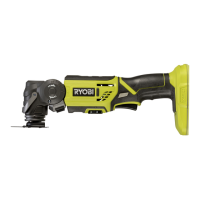
The product is supplied with an extra adapter for use with
other brands of cutting, scraping, and sanding accessories.
Do not use the adapter with the latest generation of RYOBI
accessories supplied with your tool. For example, use
the adapter with the letters “R&F” facing outwards if you
wish to use earlier generation RYOBI, RIDGID or AEG
accessories. The adapter may be turned over for use with
other brands of accessories.
■ Secure workpieces that can move with a clamp
to prevent movement during sanding or cutting
operations. Do not hold the workpiece by hand. An
inadvertent slip while operating the product may cause
serious personal injury.
■ When making a plunge cut into soft materials like wood
and plasterboard using the cutting accessory, gradually
bring the vibrating blade to the workpiece. Do not push
the vibrating blade hard into the material to be cut. Let
the product do the work and concentrate on keeping the
product and the cutting accessory stable in the position
you wish to make the cut.
■ Use the depth/ height gauge to help set your depth of
cut or prevent cutting too deeply into the material.
■ Take extra care when cutting in non-ferrous metals.
The vibrating cutting blade may skip around before
beginning the cut. If necessary, drill some holes along
the line to be cut before you start cutting.
■ If the cutting accessories become jammed in the
workpiece, switch off the product and disconnect from
the power supply. If the cutting accessory cannot
be removed easily, allow the cutting accessory to
adequately cool before releasing the cutting accessory
from the product. Wear gloves and use hand tools, such
as pliers or wrench, to remove the cutting accessory
from the workpiece.
OVERCURRENT PROTECTION
When overcurrent is detected, the product will automatically
switch off.
If the product stops working, release the trigger and then
apply again. The product should again start working.
MAINTENANCE
WARNING
The product should never be connected to a power supply
when you are assembling parts, making adjustments,
cleaning, performing maintenance, or when the product
is not in use. Disconnecting the product will prevent
accidental starting that could cause serious injury.
■ When servicing, use only original manufacturer’s
replacement parts. Use of any other parts may create a
hazard or cause product damage.
WARNING
For greater safety and reliability, all repairs should be
performed by an authorised Ryobi service centre.
GENERAL
Avoid using solvents when cleaning plastic parts. Most
plastics are susceptible to various types of commercial
solvents and may be damaged by their use. Use clean
3


 To Next Page
 Loading...