PRODUCT SPECIFICATIONS
Cordless power washer
Model R18XPWS10
Rated voltage
18V d.c.
Weight
1.93 kg
Maximum pressure
55 bar (800 psi)
Rated pressure (High mode)
41 bar (600 psi)
Rated pressure (Medium
mode)
20 bar (290 psi)
Rated pressure (Low mode)
7 bar (100 psi)
Dilution ratio
1:20
Rated ow
160 L/hr
Maximum ow
270 L/hr
Maximum inlet water
pressure
10 bar (145 psi)
Maximum suction height
1.8 m
Minimum garden hose inner
diameter
8 mm
Sound pressure level (L
PA
)
(in accordance with EN
60335-2-79)
69 dB(A)
Uncertainty
3 dB
Sound power level (L
WA
)
(in accordance with EN
60335-2-79)
83 dB(A)
Uncertainty
3 dB
Vibration value (in
accordance with EN 60335-
2-79)
<2.5 m/s
2
Uncertainty
1.25 m/s
2
BATTERY AND CHARGER
Model R18XPWS10 R18XPWS14
Battery pack
- RB1840C
Charger
- RC18120
Compatible battery
packs
RB1815C, RB1820C, RB1825C,
RB1840C, RB1840X, RB1850C,
RB1850X, RB1860X, RB18L15,
RB18L15A, RB18L15B, RB18L20,
RB18L20A, RB18L25, RB18L25A,
RB18L40, RB18L40A, RB18L50,
RB18L50A, RB18L13, RB18L60A,
RB18L90A
ACCESSORIES
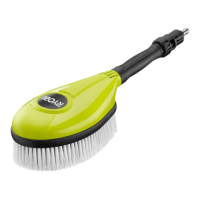
REZ1 Wheel brush
REZ2 Detergent bottle
REZ3 Straight brush
REZ4 Bottle adapter
REZ5 7 Spray nozzle
REZ6 Pivoting adapter
REZ7 Nozzle kit
WARNING! The declared vibration total
values and the declared noise emission values
given in this instruction manual have been
measured in accordance with a standardised
test and may be used to compare one tool with
another. They may be used for a preliminary
assessment of exposure.
The declared vibration and noise emission
values represent the main applications of the
tool. However, if the tool is used for dierent
applications, used with dierent accessories,
or poorly maintained, the vibration and noise
emission may dier. These conditions may
signicantly increase the exposure levels over
the total working period.
An estimation of the level of exposure to
vibration and noise should take into account
the times when the tool is turned o or when
it is running idle. These conditions may
signicantly reduce the exposure level over the
total working period.
Identify additional safety measures to protect
the operator from the eects of vibration and
noise, such as maintaining the tool and the
accessories, keeping the hands warm (in case
of vibration), and organising work patterns.



 To Next Page