Need help?
Do you have a question about the Ryobi RCS36 and is the answer not in the manual?
Safety precautions and steps for felling trees.
Instructions for making the directional notch cut in a tree.
Instructions for making the final cut opposite the notch for felling.
Procedure for adjusting and checking the tension of the saw chain.
Steps for removing and installing a new guide bar and saw chain.
Instructions for filling the oil tank for chain lubrication.
Procedure for sharpening the saw chain to maintain cutting performance.
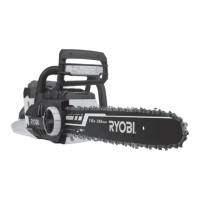
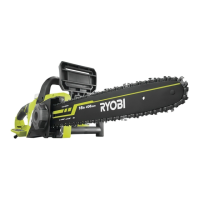
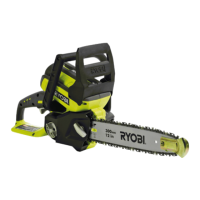
This document is an operator's manual for the RYOBI RCS36/RCS36B 36V Cordless Chain Saw, providing essential information for its safe and effective use.
The RYOBI RCS36/RCS36B 36V Cordless Chain Saw is engineered for cutting branches, trunks, logs, and beams of diameters determined by the guide bar's cutting length. It is specifically designed for cutting wood in outdoor, domestic applications by adults. This chainsaw is not intended for professional tree services or use by children or individuals without appropriate personal protective equipment.
The chainsaw is designed for ease of operation, but users must adhere to all safety warnings and instructions to prevent electric shock, fire, or serious injury. It is crucial to use personal protective equipment, including eye and hearing protection, a dust mask, non-skid safety shoes, and a hard hat. The tool should always be held with both hands, with the right hand on the rear handle and the left hand on the front handle, ensuring a firm grip with thumbs and fingers encircling the handles.
Before starting, ensure the battery is charged and correctly installed. To operate, pull the safety lock-out button (item 4) and then the switch trigger (item 5). Releasing the switch trigger will stop the chain saw. Always maintain proper footing and balance while operating.
When felling trees, an escape path should be planned and cleared before cuts begin, extending back and diagonally to the rear of the expected line of fall. Consider the tree's natural lean, the location of larger branches, and wind direction to determine the fall direction. Remove any dirt, stones, loose bark, nails, or staples from the tree. The notching undercut, which directs the fall, should be 1/3 of the tree's diameter, perpendicular to the direction of fall, with the lower horizontal cut made first to prevent pinching. The felling back cut, made on the opposite side, should be at least 50mm higher than the notching cut and parallel to it, leaving enough wood to act as a hinge to control the tree's fall. If the tree begins to fall, remove the chainsaw, release the trigger, and follow the retreat path.
Limbing involves removing branches from a fallen tree. Leave larger lower limbs to support the log off the ground. Small limbs can be removed in one cut. Branches under tension should be cut from the bottom up to avoid binding the chain saw.
Bucking a log involves cutting it into lengths. Ensure firm footing and evenly distributed weight. Logs supported along their entire length are cut from the top (over buck). If supported on one end, cut 1/3 of the diameter from the underside (under buck) and then finish from the top. If supported on both ends, cut 1/3 from the top (over buck) and finish from the bottom. When bucking on a slope, stand on the uphill side of the log. Release cutting pressure near the end of the cut without relaxing your grip. Do not let the chain contact the ground.
The integral spiked bumper assists cutting by providing a stable pivot point when forced against the log.
Regular maintenance is crucial for the chainsaw's performance and safety. Always remove the battery pack before checking chain tension or making adjustments. Wear protective gloves when handling the chain, bar, or surrounding areas.
To adjust chain tension, slightly un-tighten the sprocket cover securing knob (item 15) counterclockwise. To increase tension, turn the chain tensioner adjustment knob (item 13) clockwise; to reduce tension, turn it counterclockwise. The correct tension allows the chain to be lifted 3mm-4mm from the guide bar in the middle of the lower side. After tensioning, tighten the sprocket cover securing knob (item 15) clockwise. If a new saw chain is fitted, run the saw for 2-3 minutes before starting a job, then re-check and re-tighten the tension.
For lubrication, unscrew and remove the oil tank cap (item 6), pour oil into the tank, and monitor the oil level gauge (item 7), ensuring no dirt enters. Replace and tighten the cap. One full oil tank provides 20-40 minutes of use.
To replace the bar and chain, place the saw on a flat surface. Unscrew the sprocket cover securing knob (item 15) counterclockwise until the sprocket cover (item 14) is loose. Remove the sprocket cover, bar, and saw chain. When replacing the bar, unscrew the safety tip nut, mount the tip on the new bar, and tighten the nut. Ensure the new chain is oriented correctly (as shown in figure 7) and its drive links are aligned in the bar groove (figure 5). Attach the bar to the chainsaw and loop the chain around the drive sprocket (figure 3). Replace the sprocket cover (item 14), tighten the sprocket cover, and then the knob (item 15). Finally, follow the chain tension adjustment steps.
For sharpening the saw chain, put the chain under tension and fasten the bar in a vice so the chain can slide. Fasten the file to the file holder and place it on the cutter at a 35° angle. File with forward strokes only until worn parts of the cutting edge are removed. Count the strokes for one cutter and apply the same number to all others. If the depth gauge protrudes after sharpening, reset its level with a flat file and round off the depth gauge. It is recommended to have deep or important sharpening done by a service agent with an electric sharpener.
For guide bar maintenance, clean the groove and oil passages with a scraping hook after use. Periodically trim the sides of the rails with a flat file to prevent feather edges from breaking. If one rail is higher, even it with a flat file and smooth with a fine grain abrasive paper.
Before each use, inspect the product for damaged, missing, or loose parts. Tighten all fasteners and caps. Do not operate until all missing or damaged parts are replaced. Avoid using solvents on plastic parts; use clean cloths to remove dirt, dust, oil, and grease.
For storage, remove the battery pack, clean all foreign material, and store it in a child-inaccessible place, away from corrosive agents. Store and charge batteries in a cool area (below 27°C) and away from moisture, in a 30%-50% charged condition. If storing for long periods, charge the pack every six months to prolong battery life.
Disposal of the product and battery should follow local regulations. Power tools and accessories contain recyclable materials and should not be disposed of with household waste. Lithium-ion batteries must be removed and disposed of separately at a facility that accepts them.
 General
| Chain speed | 4 m/s |
|---|---|
| Blade length | 300 mm |
| Product color | Black, Green |
| Power source | Battery |
| Battery capacity | 2.6 Ah |
 Weight and Dimensions
| Weight | 4300 g |
|---|

 To Next Page