EasyManua.ls Logo

Saito FG-19R3 - User Manual

Saito FG-19R3
2 pages
Print Icon
To Next Page IconTo Next Page
Loading...
1.Fuel
●Thefuelisamixtureofregulargasolineorhigh-octanegasolineandhigh-quality2-strokeengineoil.
●[Exampleofoilrecommendation]
KlotzKL-200OriginalTechniplate・DeluxeMaterialsPowerModel2T-SENEOSRACINGSPECPRO-2T(SAITOSTANDARD) etc.
Ifsuchoilsarenotavailableinyourcountry,thenpleaseasktheofficialSAITOdistributorinyourcountryforanalternative.
NEVERuse“cheapoil”designedforutilityenginesforbrushcutter,lawnmower,orchainsawetc.
●Besuretousethemixture“gasoline:oil=15~20:1”byvolumeratio.(Ex.1000mlofgasolineshouldbemixedwithmorethan50mlofoil).
●Duringthebreak-inprocess,use15:1mixedfueltoensurethebestlubricationforinitialrunning.
●Anydamagecausedbythefuelused,inwhichtheoilratioislowerthan20:1willnotbecoveredbywarranty.
●Donotusegasolinecontainingethanol.Itmaycausenotonlypowerlossbutalsocorrosioninsidetheengine.
FuelTank
FuelLevel
ToOutsideoftheplane
Ventline
Fuelsupplytocarburetor
Fuelfillerline
Ventline
Gasoline-compatible
tankstopper
Gasoline-compatibletubing
Filterwithweight
Setthecenterofthecarb
slightlyabovethefuellevel
Closeaspossible
Hollowout
3.Propeller
●RecommendedpropellerisAPC14x6.
●Useareliablepropwhichbringsmaximum9,000~10,000rpminconformitytoyourplane.
●Useawell-balancedprop.Neveruseapropthathasbeenscratchedordamagedevenifslightly.
●Neveruseexcessivelylightorheavyloadedprop.Theymaycauseenginefailure,bigaccident,oreveninjury.
●Asthepropelleriscompressedslightly,tightenthepropellernuteveryhourofoperation.
4.Break-inMOSTIMPORTANT!!
●Beforestartingtheengine,injectasuitableamount(approx.20〜30cc)ofengineoilintothe
lubricationnippleonthecrankcaseusingasyringeorpumpwhileturningthepropellerbyhand.
Afterthat,plugthisnipple.Asexcessisdischargedfromthebreathernipple,attachatubetothe
breathernipple.
●Prop-recommendation:APC14x6.
●Use15:1fuel:oilratioforbreak-in.
Nevermakethefuelmixtureleanduringbreak-in.Itcouldcauseseizureevenduringidlingor
low-speedrunning.
●Beforestartingtheengine,openthemainneedleApprox.1+1/2turnsfromfullyclosed.
Throttle
Fullopen
CCWtomake
rich
Main
Needle
CW→Lean
CCW→Rich
CW→Lean
CCW→Rich
CCW→Rich
CW→Lean
Mainneedle
Slow(Idle)Needle
(Adjustwith⊖screwdriver)
Slow
High
Throttlelever
5.Adjustmentofcarburetorafterinitialbreak-in.
◇Needlereferenceposition(Setafterinitialbreak-in)
●Starttheengineafteradjustingtheneedletothefollowingreferencevalue.
●MainneedleApprox.1turnCCWfromfullyclosed
●SlowneedleApprox.7~8turnsCCWfromfullyclosed(Thenthrottlevalve
shouldbefullyclosed)
●Actually,thebestpositionoftheneedlesvarydependingontheprop,
temperature,humidityandsoon.Pleaseadjustasnecessaryafterobserving
theengineperformanceduringflight.
Peakadjustment
●Afterstartingtheengine,warmupforapprox.30secondsatlowspeed.
●Achievethepeakatfullthrottle.
→TurnthemainneedleCWgraduallytothepositionwheretheRPMisgreatest(thepeak).ContinuingtoturntheneedleCWpastthepeak
couldleadtoseizuresoturnitslowlyandcarefully.IftheRPMsuddenlydecreasesafterpassingthepeak,instantlyturnthemainneedle
CCWtoagainincreasetheRPM.Otherwiseitcoulddamagetheengineseriously.
●OnceachievingpeakRPM,returnthethrottletolowspeed.Makeanoteofthepositionofmainneedleatthepeakatthattime.(Howmany
turnsyoudidCWbasedonthereferencevalue.)
SlowneedleAdjustment
AfterachievingpeakRPM,nextisslowneedleadjustment.OpenthethrottlefromlowRPMtofullthrottlequickly.
●IftheenginehesitatesforamomentorstallsbeforetheenginereachesmaxRPM,Itʼsbecausethemixtureistoolean.Thenturntheslow
needleCCWslightly.
●IftheengineisslowtoreachpeakRPM(fullthrottleset),itʼsbecausethemixtureistoorich.ThenturntheslowneedleCWslightly.
●AdjusttheslowneedleasaboveuntiltheRPMfollowsthethrottlemovementsmoothly.Theimportantpointistoadjusttheslowneedle
AFTERthemainneedlehasbeenadjustedtoitspeak.
●Nowbreak-inatgroundlevelisdone.Adjusttappetsbythemethoddescribedlater.
Pre-flight/Flightadjustment
Whentheslowneedleadjustmentisdone,checktheresponsebyrevvingupfromlowspeedtofullthrottlequicklyseveraltimes.
●OpenthethrottlefullyandturnthemainneedleCCWapprox.60〜90degreesfromthepeakposition.Thisistomakethefuelmixturericher
intheairwheretheRPMgethigherthanontheground.
●Afteralladjustmentsaremade,flyyouraircraftandfinetunetheengineaccordingtothesituation.Basicallytuningshouldbedonewiththe
mainneedle.Readjustmentoftheslowneedleisrarelyneededifthefirstadjustmentoftheslowneedlehasbeendonesuccessfully.
CorrectGap
Mustnotbeinserted
Closeto“0”withnolimit
Limitgauge
(0.1mm)
Loosenthelocknut
Adjustthegapturning
thesetscrew
   TopDeadCenter
(Thestatebothvalvesareclosed)
Tightenthelocknut
tofixthesetscrew
6.Tappetadjustment
Thevalveclearanceshouldbecheckedandadjustedafterbreak-inandeverytimeaftertwohourswhiletheengineiscold.Beforeadjusting
tappetgaps,tightenthescrewsaroundcylindersetc.
1.Removethesparkplugand
rockerarmcoversof#1
cylinder.Thenturntheprop
CCWbyhandtoplacethe
pistonatTDCofcompres-
sionstroke.
2.Loosenthelocknutand
adjustthegapbyhexago-
nalwrenchuntilyouget
thecorrectgap(belowpic)
forbothofintake&
exhaust.
3.Oncethegapisset,tighten
thelocknutandattachthe
plugandcovers.Dothesame
adjustmentforthe#3-#2
cylindersinorder.
4.Turnthepropbyhandtocheckif
thecompressionisenough.Ifthe
gapislessthan0,thevalveis
alwaysopenedslightlyandwill
losecompression.Thenadjust
again.
Note:
●Asitusesoil-mixedfuel,theplanemaysometimesgetdirtyfromtheexhaust.
●Useareliableandwell-balancedprop.Otherwiseitmaycauseanabnormalvibrationandcouldresultinaseriousaccident.
●Duringoperation,allenginescrewscanloosenduetometalheatexpansion.Checkandtightenoccasionally.
●Whentheexhaustvalvegetsdullbycarbonorsludgeespeciallyincoldatmosphere,removetherockercoverandapplysomeanti-rust
spraytotheexhaustvalvetohelpthevalvetomovesmoothly.
●Payattentiontothesurroundingssoasnottodisturbothersbynoiseandexhaust.
●Alwayskeepspectatorsbehindtheenginewhenoperatingtheengine.
●Asexhaustsmokeisharmful,becarefulnottobreatheinorotherwiseexposeyourselftoitsharmfuleffects.
●Payattentionnottotouchtherotatingpropellerwhenstartingengine,andmovetorearsideoftheaircraftoncetheengineisstarted.
●Allresponsibilitiesfortheuseoftheengine,andotherobligationsandresponsibilitiesbasedonlaws,regulations,etc.arebornebythe
purchaserandtheuser,andSAITOSEISAKUSHOCO.,LTD.isexemptfromanyresponsibilities.
・Filterwithweight[G36-154]・Rubbertubeforgasoline(1m)[G36-155]
・Aluminumspinnernut[50-30]・Tappetadjustingkit[30-161]・Digitaltachometer[G17-167]
Ø22.4mm 16.2mm 19.18cc
APCD13”xP9”~D15”xP6”
Bore
Body:950g/Mufflers:60g/Ignitionsystem:195g
Stroke Disp.
Weight(Approx.) RPMRange
Approx.1,800-10,000rpm Maxonground Approx.9,000-10,000rpm
Propeller
1/4-32sparkplug
SP-1
Plug
Optionalparts
Glow2st60/4st90classApplications
Batteryforignitionsystem Voltage:6-12V,greaterthan1,500mA
Specifications
FG-19R3InstructionManual
Standard
accessories
ver.June,2021
・Limitgauge(0.1t)fortappetadjustment 1pc ・Plugwrench 1pc
・Wrenchfortappetadjustinglocknut 1pc ・Hexagonalwrench1.5mm 1pc
・Sparkplug[SP-1](Attachedtotheengine) 3pcs ・Mufflerset 1set
・Ignitionsystem(w/sensor) 1set
※IfyouuseaLi-Po,werecommendthespeclessthan2,500mAcapacityand
 lessthan30Cdischargerate
2.Ignition
●Placethemainunitasfarfromotherelectricaldevicesaspossible.
●PlacethetwoswitchesoftheignitionandtheRCreceiverasfarfrom
eachotheraspossible.
(1)Plugcord(meshedhightensioncord)
Inserttheplugcapof(1)Plugcorddeeplyontotheplugof#1cylinder
tomakesureitwillnotcomeoff.Theothercapsandplugsshouldbe
installedbythesameway.(Refertocylinder#onthereverseside)
(2)Sensorcord
Connectwiththecordfromthesensorattachedtotheengine.
(3)Batterycord(black/redcord)
Useafullychargedbatterythathasadequatespec.(6-12V,morethan
1500mAisrecommended.).Betweenthebatteryandmainunit,make
suretoinstallaheavydutyswitchwhosecapacityishigherthan3A.
(4)Tachometercord(optional)
Connectthedigitaltachometer(Option).Otherwisetheconnectorisnormallyvacant.
●Starttheengine(usingastarterisrecommendedforsafety).
●Runfor15~20secondsatlowspeedtowarmup.
●Openthrottlegraduallyuptofull.InthemeantimeturnthemainneedleCCW.ContinuetoturnthemainneedleCCWuntiljustbefore
enginestopskeepingthethrottleopenedfully.
●Runinthisveryrichconditionfor1literoffuel.
●Now“initial”break-inisdone.
PlugCap
SwitchCapacity:3A〜
Sensor
(2)Sensorcord
Battery
Voltage:6-12V
Capacity:1,500mA〜:
(
1)PlugCord
MainUnit
(3)BatteryCord
(4)TachometerCord
Question and Answer IconNeed help?

Do you have a question about the Saito FG-19R3 and is the answer not in the manual?

Summary

Fuel Requirements

Ignition System Setup

Propeller Recommendations

Engine Break-in Procedure

Carburetor Adjustment

Needle Reference Position

Set initial needle positions for main and slow needles before starting adjustments.

Peak Adjustment

Adjust main needle for maximum RPM at full throttle, then return to low speed.

Slow Needle Adjustment

Adjust slow needle for smooth throttle response after main needle is set.

Pre-flight;Flight Adjustment

Enrich main needle slightly for flight to prevent lean conditions at higher RPM.

Tappet Adjustment

Tappet Adjustment Procedure

Steps for checking and adjusting valve clearance when the engine is cold.

Warranty Information

Overview

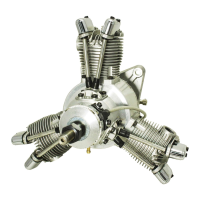
This document describes the SAITO FG-19R3, a 3-cylinder gasoline engine designed for model aircraft. It provides detailed instructions for its setup, operation, and maintenance.

Function Description

The SAITO FG-19R3 is a 19.18cc, 3-cylinder, 4-stroke gasoline engine with an ignition system, intended for use in model aircraft typically requiring a glow 2-stroke 60 class or 4-stroke 90 class engine. It operates on a mixture of gasoline and 2-stroke engine oil, providing power for flight. The engine features a carburetor for fuel mixture control and an ignition system for reliable starting and running. It requires careful break-in and subsequent adjustments to achieve optimal performance.

Important Technical Specifications

  • Bore: Ø22.4mm
  • Stroke: 16.2mm
  • Displacement: 19.18cc
  • RPM Range: Approximately 1,800-10,000rpm
  • Max RPM on Ground: Approximately 9,000-10,000rpm
  • Weight (Approx.): Body: 950g / Mufflers: 60g / Ignition system: 195g
  • Recommended Propeller: APC D13" x P9" ~ D15" x P6" (APC 14x6 is specifically recommended)
  • Spark Plug: 1/4-32 spark plug (SP-1, 3pcs included)
  • Ignition System Battery: 6-12V, greater than 1,500mA (Li-Po batteries are recommended with specifications less than 2,500mA capacity and less than 30C discharge rate)
  • Fuel Mixture Ratio: Gasoline:Oil = 15-20:1 by volume ratio (15:1 recommended for break-in)
  • Standard Accessories: Limit gauge (0.1t) for tappet adjustment, wrench for tappet adjusting lock nut, spark plug (SP-1), ignition system (w/ sensor), plug wrench, hexagonal wrench 1.5mm, muffler set.
  • Optional Parts: Filter with weight (G36-154), rubber tube for gasoline (1m) (G36-155), aluminum spinner nut (50-30), tappet adjusting kit (30-161), digital tachometer (G17-167).

Usage Features

1. Fuel:

  • Uses a mixture of regular or high-octane gasoline and high-quality 2-stroke engine oil.
  • Recommended oils include Klotz KL-200 Original Techniplate, Deluxe Materials PowerModel 2T-S, and ENEOS RACING SPEC PRO-2T (SAITO STANDARD). Users are advised to consult their local SAITO distributor if these are unavailable.
  • Crucially, "cheap oil" designed for utility engines (brush cutter, lawn mower, chain saw) must NEVER be used.
  • The fuel mixture ratio is 15-20:1 by volume. For break-in, a 15:1 ratio is mandatory to ensure optimal lubrication. Damage from oil ratios lower than 20:1 will void the warranty.
  • Gasoline containing ethanol must not be used as it can cause power loss and internal corrosion.
  • Fuel System Setup: The fuel tank stopper should be gasoline-compatible. The fuel filler line, vent line, and fuel supply tubing should be correctly routed. The center of the carburetor should be set slightly above the fuel level (approx. 30mm). A filter with weight should be used at the end of the fuel supply line inside the tank.

2. Ignition:

  • The ignition main unit should be placed as far as possible from other electrical devices.
  • The ignition and RC receiver switches should also be kept separate.
  • Connection Procedure:
    • Plug cords (meshed high tension) must be deeply inserted onto the spark plugs of each cylinder to prevent detachment.
    • The sensor cord connects to the engine's sensor.
    • The battery cord (black/red) requires a fully charged battery (6-12V, >1500mA) and a heavy-duty switch (>3A).
    • An optional tachometer can be connected to the tachometer cord; otherwise, the connector remains vacant.
  • Cylinder Identification: Cylinders are numbered #1, #3, #2 from the front, with a firing order of #1-#3-#2.

3. Propeller:

  • The recommended propeller is APC 14x6.
  • Users must select a reliable, well-balanced propeller that allows the engine to reach 9,000-10,000rpm in conformity with the aircraft.
  • Damaged, scratched, excessively light, or heavy-loaded propellers must NEVER be used as they can cause engine failure, accidents, or injury.
  • The propeller nut should be tightened slightly every hour of operation, as the propeller compresses.

4. Break-in (MOST IMPORTANT):

  • Before the first start, inject 20-30cc of engine oil into the lubrication nipple on the crankcase using a syringe or pump while turning the propeller by hand. Then, plug the nipple. A tube should be attached to the breather nipple to collect excess oil.
  • Use a 15:1 fuel:oil ratio for break-in.
  • The fuel mixture must NEVER be lean during break-in, as this can cause seizure even during idling or low-speed running.
  • Start with the main needle approximately 1.5 turns open from fully closed.
  • Start the engine (using a starter is recommended for safety).
  • Warm up for 15-20 seconds at low speed.
  • Gradually open the throttle to full, simultaneously turning the main needle CCW. Continue turning CCW until just before the engine stops, keeping the throttle fully open.
  • Run the engine in this very rich condition for 1 liter of fuel. This completes the "initial" break-in.

5. Carburetor Adjustment after Initial Break-in:

  • Needle Reference Position:
    • Main needle: Approx. 1 turn CCW from fully closed.
    • Slow needle: Approx. 7-8 turns CCW from fully closed (throttle valve fully closed).
  • Actual needle positions vary based on prop, temperature, and humidity, requiring adjustment during flight.
  • Peak Adjustment:
    • Warm up the engine for approx. 30 seconds at low speed.
    • Achieve peak RPM at full throttle by gradually turning the main needle CW. Turn slowly and carefully; turning past the peak can cause seizure. If RPM drops after passing the peak, immediately turn the main needle CCW to increase RPM.
    • Once peak RPM is achieved, return to low speed and note the main needle's position.
  • Slow Needle Adjustment:
    • After achieving peak RPM, adjust the slow needle.
    • Open the throttle quickly from low to full speed.
    • If the engine hesitates or stalls, the mixture is too lean; turn the slow needle CCW slightly.
    • If the engine is slow to reach peak RPM, the mixture is too rich; turn the slow needle CW slightly.
    • Adjust until RPM follows throttle movement smoothly. This adjustment must be done AFTER the main needle has been adjusted to its peak.
    • This completes ground-level break-in. Tappets should then be adjusted.
  • Pre-flight/Flight Adjustment:
    • After slow needle adjustment, check response by revving up from low to full throttle several times.
    • At full throttle, turn the main needle CCW approx. 60-90 degrees from the peak position to enrich the mixture for higher RPMs in the air.
    • Fine-tune the engine in flight. Tuning should primarily involve the main needle. Readjustment of the slow needle is rarely needed if the initial adjustment was successful.

Maintenance Features

  • General:
    • The engine uses oil-mixed fuel, so exhaust may cause dirt on the aircraft.
    • During operation, engine screws can loosen due to thermal expansion. They should be checked and tightened occasionally.
    • If the exhaust valve becomes dull from carbon or sludge, especially in cold weather, remove the rocker cover and apply anti-rust spray to help the valve move smoothly.
  • Tappet Adjustment:
    • Valve clearance must be checked and adjusted after break-in and every two hours of operation, when the engine is cold.
    • Before adjusting, tighten the screws around the cylinders.
    • Procedure:
      1. Remove the spark plug and rocker arm covers of #1 cylinder. Turn the prop CCW by hand to place the piston at Top Dead Center (TDC) of the compression stroke (both valves closed).
      2. Loosen the lock nut and adjust the gap using a hexagonal wrench until the correct gap is achieved for both intake and exhaust.
      3. Once the gap is set, tighten the lock nut and reattach the plug and covers. Repeat for #3 and #2 cylinders.
      4. Turn the prop by hand to check compression. If the gap is too small, the valve will always be slightly open, leading to compression loss. Adjust again.
    • Correct Gap: Close to "0" with no limit. The 0.1mm limit gauge must not be inserted.

Safety Notes

  • Always keep spectators behind the engine when operating it.
  • Exhaust smoke is harmful; avoid breathing it or exposing oneself to its effects.
  • Do not touch the rotating propeller when starting the engine. Move to the rear of the aircraft once the engine is started.
  • All responsibilities for the use of the engine, and other obligations based on laws and regulations, are borne by the purchaser and user. SAITO SEISAKUSHO CO., LTD. is exempt from any responsibilities.

Saito FG-19R3 Specifications

General IconGeneral
BrandSaito
ModelFG-19R3
CategoryEngine
LanguageEnglish

Related product manuals