This document is a service manual for the Samsung System Air Conditioner, specifically covering models AC035JNMCEH, AC071JNMCEH, AC100JNMCEH, and AC125JNMCEH, along with their corresponding outdoor units AC035JXSCEH, AC071JXSCEH, AC100JXSCEH, and AC125JXSCGH. The manual provides comprehensive information for service personnel, including precautions, product specifications, disassembly and reassembly procedures, troubleshooting guides, PCB diagrams, wiring diagrams, and reference sheets.
Function Description:
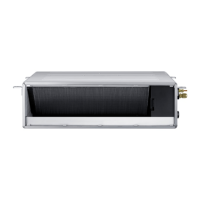
The Samsung System Air Conditioner is designed as a built-in duct type unit, allowing for harmonious integration with room interiors after installation. It utilizes advanced BLDC inverter technology to provide efficient cooling and heating, contributing to high performance and energy saving. The system supports long piping lengths and heights, offering flexibility for installers and enhancing the reliability of the air conditioner. It also features long ambient operation capabilities, particularly in low temperatures, which further improves reliability and capacity. The product is eco-friendly, being lead-free, RoHS compliant, and WEEE compliant.
Important Technical Specifications:
The manual details specifications for various models, including:
- Power: All listed models operate on 1Ø, 220-240V/50Hz for indoor units. The AC100JNMCEH/AC100JXSCGH and AC125JNMCEH/AC125JXSCGH outdoor units also have a 3Ø, 380~415V/50Hz option.
- Dimensions (WxDxH):
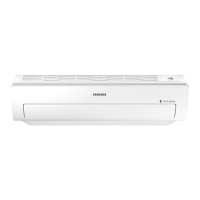
- AC035JNMCEH/AC071JNMCEH Indoor Units: 850x700x250 mm
- AC100JNMCEH/AC125JNMCEH Indoor Units: 1300x700x300 mm
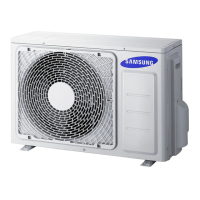
- AC035JXSCEH Outdoor Unit: 790x285x548 mm
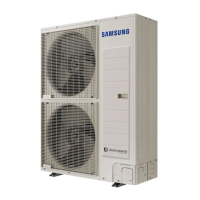
- AC071JXSCEH/AC100JXSCEH/AC100JXSCGH/AC125JXSCGH Outdoor Units: 940x330x1420 mm
- Weight (Net):
- AC035JNMCEH Indoor Unit: 25.0 kg
- AC071JNMCEH/AC100JNMCEH/AC125JNMCEH Indoor Units: 32.0 kg (AC071JNMCEH) / 36.0 kg (AC100JNMCEH/AC125JNMCEH)
- AC035JXSCEH Outdoor Unit: 37.0 kg
- AC071JXSCEH/AC100JXSCEH/AC100JXSCGH/AC125JXSCGH Outdoor Units: 96.0 kg
- Capacity (Cooling/Heating ISO):
- AC035JNMCEH: 3,500/4,300 W
- AC071JNMCEH: 7,100/8,000 W
- AC100JNMCEH: 10,000/11,200 W
- AC125JNMCEH: 12,500/14,000 Btu/h (equivalent to 3,663/4,103 W)
- Power Input (Cooling/Heating ISO):
- AC035JNMCEH: 940/1,180 W
- AC071JNMCEH: 1,920/2,050 W
- AC100JNMCEH: 2,740/2,470 W (1Ø) / 2,740/2,630 W (3Ø)
- AC125JNMCEH: 3,790/3,580 W
- Operation Current (Cooling/Heating ISO):
- AC035JNMCEH: 4.7/5.4 A
- AC071JNMCEH: 8.7/9.3 A
- AC100JNMCEH: 12.0/11.8 A (1Ø) / 4.4/4.3 A (3Ø)
- AC125JNMCEH: 6.0/5.6 A
- Noise (Indoor/Outdoor in strongest air blow): Ranges from 40/40 dB(A) for indoor units to 54/54 dB(A) for outdoor units (AC035JNMCEH/AC035JXSCEH) and up to 60/62 dB(A) for larger models.
- Refrigerant (R-410A):
- AC035JNMCEH: 1270 g
- AC071JNMCEH/AC100JNMCEH: 2900 g
- AC125JNMCEH: 2900 g (R22)
- Connecting Pipe (Liquid/Gas):
- AC035JNMCEH: 1/4"(6.35) / 3/8"(9.52) mm
- AC071JNMCEH: 3/8"(9.52) / 5/8"(15.88) mm
- AC100JNMCEH/AC125JNMCEH: 3/8"(9.52) / 5/8"(15.88) mm
- Additional Refrigerant (R-410A): 25 g/m
- Extension Length (Standard/Total/Elevation): Standard 5m, Total 20m (AC035JNMCEH)/75m (AC071JNMCEH, AC100JNMCEH, AC125JNMCEH), Elevation 15m (AC035JNMCEH)/30m (AC071JNMCEH, AC100JNMCEH, AC125JNMCEH).
Usage Features:
The air conditioner is controlled via a wired remote control. Users can set various options and addresses for the indoor unit. The remote control displays error codes to aid in troubleshooting. Key settings include:
- Option Setup Method: Allows configuration of indoor unit options, including external static pressure (ESP) settings for the phase control motor, which adjusts fan speed based on duct length and pressure.
- Indoor Unit Address and Installation Option: Enables setting unique addresses for indoor units and configuring installation-specific options. This is particularly important in multi-unit installations.
- Error Display: The wired remote control displays specific error codes (e.g., E102 for communication error, E121 for room sensor error, E154 for fan motor error) to help diagnose issues. The indoor unit's LED lamps also indicate error conditions through flickering patterns.
Maintenance Features:
The manual provides detailed guidance for maintenance and troubleshooting:
- Precautions: Emphasizes safety measures such as using standard parts, securely repairing harness disconnections, working on a cloth to prevent scratches, removing dust, tightening service valves, and checking assembly status. It also highlights precautions for static electricity and general safety, like not pulling electric wires, replacing damaged power cords, and proper grounding.
- Disassembly and Reassembly: Step-by-step instructions with images are provided for disassembling and reassembling indoor and outdoor units. This includes procedures for components like the motor, blower, drain pan, evaporator, cushions, control case, frame, fan, heat exchanger, compressor, and control assembly. Tools required include a screwdriver and monkey spanner.
- Troubleshooting: A comprehensive section covers fault diagnosis by symptom and error code. Flowcharts guide technicians through checking various components and conditions, such as power supply, sensor connections, fan operation, communication errors, and compressor issues.
- PCB Inspection Method: Details pre-inspection notices, including discharging capacitors and avoiding electrical shock, and outlines inspection procedures for indoor and outdoor unit PCBs, identifying components like MICOM, relays, fan motor driving circuits, line filters, and inverter components.
- Main Part Inspection Method: Provides instructions for measuring resistance values for key components like indoor unit temperature sensors, BLDC fan motors, outdoor temperature sensors, discharge temperature sensors, and 4-way valve solenoids to identify open or short circuits.
- Wiring Diagrams: Includes detailed wiring diagrams for both indoor and outdoor units, showing connections for power, communication, sensors, and other electrical components.
- Refrigerating Cycle Diagram: Illustrates the refrigeration cycle, explaining the functions of the condenser, compressor, evaporator, service valve, and accumulator. This helps in understanding the system's operation and diagnosing refrigerant-related issues.
The manual is intended for service professionals and explicitly states that repairing products by consumers is strictly prohibited due to potential dangers.

 Need help?
 General

 To Next Page