
 To Next Page
D
Donald CarrollAug 21, 2025
What to do if my Samsung Heat Pump shows an over current error?
- DDonna JacobsAug 21, 2025
To address an over current issue in your Samsung Heat Pump, reduce the load on the system and inspect all electrical connections.

What to do if my Samsung Heat Pump shows an over current error?
To address an over current issue in your Samsung Heat Pump, reduce the load on the system and inspect all electrical connections.
How to fix current sensor error on Samsung RD160PHXEA?
To resolve a current sensor error on your Samsung Heat Pump, replace the current sensor.
What to do if my Samsung Heat Pump displays discharge temp sensor error?
To fix the discharge temperature sensor error (short/open) on your Samsung Heat Pump, replace the discharge temperature sensor.
What to do if my Samsung RD160PHXEA Heat Pump displays cond temp sensor error?
To fix the condenser temperature sensor error (short/open) on your Samsung Heat Pump, replace the condenser temperature sensor.
What to do if my Samsung Heat Pump displays outdoor temp sensor error?
To fix the outdoor temperature sensor error (short/open) on your Samsung Heat Pump, replace the outdoor temperature sensor.
What to do if my Samsung RD160PHXEA Heat Pump shows over temperature of OLP thermistor?
To address the issue of an over temperature of the OLP thermistor in your Samsung Heat Pump, allow the system to cool down before checking the thermistor.
Why Samsung Heat Pump is in prohibited cooling mode?
If your Samsung Heat Pump is in a prohibited cooling mode due to outdoor temperatures being under 10°C or inlet water temperature being out of range (5°C ~ 55°C), switch to heating mode or wait for the outdoor temperature to increase.
What to do if my Samsung RD160PHXEA Heat Pump shows an over-load prevention control error?
To resolve an over-load prevention control issue with your Samsung Heat Pump, allow the system to cool down before restarting it.
Why is my Samsung Heat Pump in prohibited heating mode?
If your Samsung Heat Pump is in a prohibited heating mode due to outdoor temperatures being over 35°C or inlet water temperature being out of range (5°C ~ 55°C), switch to cooling mode or wait for the outdoor temperature to decrease.
Additional safety measures and warnings for installation and operation.
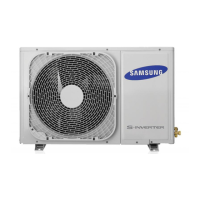
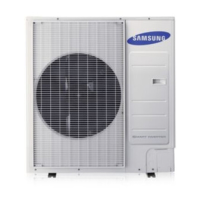
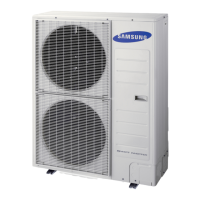
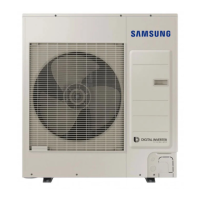
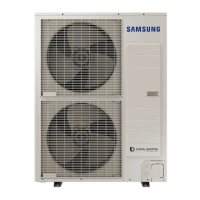
Visual representation and identification of different outdoor unit models.
List of supplied accessories with quantities for installation and use.
Guidelines for selecting an optimal installation location for the outdoor unit.
Specifies necessary clearances and dimensions for outdoor unit ventilation.
Lists the essential tools needed for the installation process.
Steps to remove the base and secure the outdoor unit for installation.
Details on mounting the unit base and anchor bolt placement.
Instructions for correctly installing the unit's drain pipe.
Warning about potential damage to copper pipes during cover installation.
Guidelines on pipe lengths and system configurations.
Guidance on choosing appropriate refrigerant pipes based on unit capacity.
Procedure for selecting Y-joints based on outdoor unit and indoor unit capacities.
Steps for properly cutting and flaring refrigerant pipes.
Instructions for selecting and applying pipe insulation for optimal performance.
Detailed steps for insulating refrigerant pipes and joints.
Procedure for brazing pipes, emphasizing nitrogen gas usage.
Guidance on installing Y-joints either horizontally or vertically.
Instructions for connecting pipes to the outdoor unit.
Method for conducting a gas leak test using nitrogen.
Process for removing moisture and air from the refrigerant system.
Calculation method for additional refrigerant based on pipe length.
Procedures and specifications for charging refrigerant into the system.
General instructions for adding refrigerant to the system.
Detailed steps for adding refrigerant in cooling and heating modes.
Procedure for closing the valve stem on service ports.
Procedure for opening the valve stem on service ports.
Diagrams illustrating power cable connection for the entire system.
Details on power and earth cable specifications for outdoor units.
Guidance on routing and securing power and communication cables.
Steps for connecting power cables to the terminal board.
Instructions for proper installation of the earth wire for safety.
Overview of the main PCB option switches and their functions.
Explanation of the functions assigned to the keys on the outdoor unit PBA.
Detailed display contents and functions associated with key K4.
Settings for indoor unit addresses and capacities.
Configuration settings for various dip switches related to system operation.
Purpose of the pump down operation for refrigerant recovery.
Important warnings and limitations during pump down operation.
Steps to reduce refrigerant quantity before pump down.
Procedure for recovering refrigerant when it is difficult.
A checklist of final steps and checks after completing installation.
Checks to perform on cables and power supply before trial operation.
Steps to run and inspect the unit's operation after installation.
Table of error codes displayed on the outdoor unit PCB and their meanings.

 General