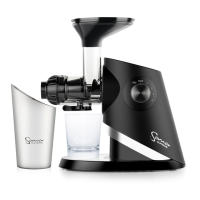
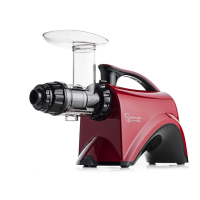
The Sana 868 is a vertical, cold-pressed juicer designed for household use, offering an efficient way to extract juice from various fruits and vegetables. Its patented slow-speed masticating technology ensures optimal juice extraction and preserves nutrients.
Function Description:
The Sana 868 operates by slowly masticating ingredients to extract juice, minimizing oxidation and maximizing nutrient retention. It features a versatile design that allows for different juicing functions through interchangeable screens. The standard juicing strainer is used for most fruits and vegetables, while a blank screen is provided for processing frozen ingredients into smoothies or sorbets. A coarse strainer is also included for juicing ingredients that yield a thicker, pulpier juice. The juicer is equipped with a juice tap that allows for mixing different ingredients to create custom juice blends, preventing drips, and facilitating quick rinsing between uses. The reverse function helps dislodge jammed ingredients, preventing damage to the motor and ensuring continuous operation.
Important Technical Specifications:
- Product Type: Juicer
- Model: 868
- Voltage: AC220-240V, 50/60Hz
- Power Consumption: 240W
- Maximum Use Time: Less than 30 minutes (continuous operation)
- Weight: 6.95kg
- Dimensions: 178 x 248 x 455 mm
- Manufacturer: Sana Products
- Type: Cold-pressed
- Origin: Made in Korea
Usage Features:
- Assembly: The juicer is designed for easy assembly, with red dots on each part to guide alignment. The drum lid locks into place by turning it clockwise to the "CLOSE" position, ensuring proper and safe operation. The juicer will not operate if the drum lid is not correctly aligned and locked.
- Operation: Ingredients are inserted into the feeding tube one piece at a time. The "FORWARD" button initiates the masticating process, while the "REVERSE" button helps dislodge any jammed ingredients. The juicer should not be operated continuously for more than 30 minutes to prevent motor overheating.
- Ingredient Preparation: For optimal extraction, ingredients should be prepared according to type. Hard vegetables and high-fiber foods (e.g., carrots, beets, spinach) should be cut into 1-1/2 inch (3 cm) wide and 2 inch (5 cm) long pieces. Fibrous leafy vegetables (e.g., celery, kale) should have stems cut into 2 inch (5 cm) pieces and can be formed into small balls. Soft fruits and vegetables (e.g., apples, oranges, tomatoes) should be cut into 1-4 pieces. Fruits with hard seeds or pits must be pitted before juicing. Frozen fruits should be slightly thawed before processing with the blank screen.
- Juice Tap Functionality: The juice tap can be closed to mix ingredients within the juicing bowl, creating blended juices or sorbets. Keeping it closed also prevents drips after juicing. For quick rinsing between different juices, a glass of water can be run through the juicer with the tap closed. For foamy produce like apples and celery, the tap should be left open.
- Pulp Control: The amount of pulp in the juice can be adjusted by disassembling and washing the top-set frequently, especially during continuous juicing.
- Safety Mechanisms: The juicer includes a safety interlock that prevents operation if parts are not assembled correctly. It also has an overheating protection sensor that activates after prolonged use, requiring a 30-minute rest period. Users are warned against inserting fingers or other objects into the feeding tube during operation, and a food pusher is provided for this purpose.
Maintenance Features:
- Disassembly and Cleaning: The juicer is designed for easy disassembly and cleaning. All removable parts, including the auger, screens, wiping blades, and juice tap, should be cleaned immediately after each use to prevent residue buildup and discoloration.
- Silicone Parts: The silicone blades, silicone ring, and silicone cover are removable for thorough cleaning. It is crucial to ensure these parts are properly reinserted during assembly to prevent leaks and maintain performance.
- Cleaning Tool: A dedicated cleaning tool is provided to simplify the cleaning of the juicing screen. The screen can be inserted into the tool and rotated under running water for effective cleaning.
- Stuck Drum Lid: If the drum lid becomes stuck due to excess pulp, users can press the "REVERSE - OFF - FORWARD" buttons multiple times to dislodge ingredients. If necessary, the lid opener tool can be used to assist in opening the lid. Pouring water down the feeding tube can also help rinse out the interior and facilitate lid removal.
- Troubleshooting: The manual provides a comprehensive troubleshooting guide for common issues such as the juicer not turning on, low juice yield, pulpy juice, unusual sounds, and a stuck drum lid. It emphasizes proper assembly, ingredient preparation, and regular cleaning as key to optimal performance and longevity.
- Care for Plastic Parts: To prevent discoloration, especially from ingredients like carrot, spinach, and turmeric, plastic parts should be cleaned immediately after use. Rubbing vegetable oil on discolored areas before washing with a mild detergent can help.

 Need help?

 To Next Page
 General