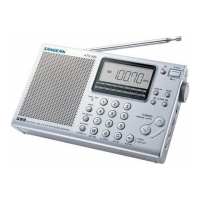
This document is a Service Manual for the Sangean MS-103 and MS-103L 12-band receivers. It provides comprehensive information for servicing and maintaining these radio receivers.
The Sangean MS-103 and MS-103L are portable 12-band receivers designed for receiving various radio frequencies. The MS-103 model supports FM, MW, SW1, and SW2-10 bands, while the MS-103L model supports FM, MW, LW, and SW1-9 bands. This broad range of supported bands allows users to tune into a wide variety of broadcasts, from local FM stations to international shortwave transmissions. The "12-band" designation indicates its capability to receive signals across multiple frequency segments, offering versatility for different listening environments and preferences.
Important Technical Specifications (based on the "SPECIFICATIONS" section):
- Tuning Range:
- Min: 87.35 MHz (Nominal), 87.15 MHz (Limit)
- Max: 108.25 MHz (Nominal), 108.45 MHz (Limit)
- Intermediate Frequency: 10.7 MHz (Nominal), ±0.25 MHz (Limit)
- Max. Sensitivity:
- 98MHz: 20 dB (Nominal), 26 dB (Limit)
- 106MHz: 20 dB (Nominal), 26 dB (Limit)
- Useable Sensitivity (S/N 30dB):
- 90MHz: 20 dB (Nominal), 26 dB (Limit)
- 98MHz: 20 dB (Nominal), 26 dB (Limit)
- 106MHz: 20 dB (Nominal), 26 dB (Limit)
- Calibration:
- 90MHz: ±500 kHz (Nominal), ±1000 kHz (Limit)
- 98MHz: ±500 kHz (Nominal), ±1000 kHz (Limit)
- 106MHz: ±500 kHz (Nominal), ±1000 kHz (Limit)
- Audio Fidelity (-6dB):
- 90MHz: 250 Hz (Nominal), 200 Hz (Limit)
- 98MHz: 4000 Hz (Nominal), 3600 Hz (Limit)
- 3dB Limiting (1mV): 98MHz: 20 dB (Nominal), 26 dB (Limit)
- Image Rejection: 98MHz: 26 dB (Nominal), 20 dB (Limit)
- I.F. Rejection: 98MHz: 80 dB (Nominal), 60 dB (Limit)
- A.F.C. Hold Range (1mV): 98MHz: 600 kHz (Nominal), 400-800 kHz (Limit)
- T.H.D. (75kHz Dev.): 98MHz: 1 % (Nominal), 2 % (Limit)
- Lowest Battery Voltage: 1.85 V (Nominal), 2.1 V (Limit)
- Max. Output Power: 98MHz: 180 mW (Nominal), 150 mW (Limit)
- Output Power (10% T.H.D.): 98MHz: 150 mW (Nominal), 120 mW (Limit)
- Power Consumption at R.O.: 98MHz: 110 mA (Nominal), 130 mA (Limit)
- Stereo Indicator Sensitivity: 98MHz: 20 dB (Nominal), 26 dB (Limit)
- Tuning Indicator Sensitivity: 98MHz: 26 dB (Nominal), 32 dB (Limit)
- Over Load Capacity: 98MHz: 100 dB (Limit)
- AM Suppression: 98MHz: 36 dB (Nominal), 30 dB (Limit)
- Min. Output: 98MHz: 1.5 mV (Nominal), 1.0 mV (Limit)
- S/N Ratio (1mV): 98MHz: 46 dB (Nominal), 36 dB (Limit)
- Supply Voltage: DC 3V, R.O.: 50mW, Load: 8 ohm, Modulation: 1kHz 22.5kHz Dev.
- Tuning Range:
- Min: 2.2 MHz (Nominal), 2.3 MHz (Limit)
- Max: 5.3 MHz (Nominal), 5.5 MHz (Limit)
- Intermediate Frequency: 460 kHz (Nominal), ±3.5 kHz (Limit)
- Max. Sensitivity:
- 2.75MHz: 16 dB (Nominal), 22 dB (Limit)
- 4.0MHz: 16 dB (Nominal), 22 dB (Limit)
- 5.0MHz: 16 dB (Nominal), 22 dB (Limit)
- Useable Sensitivity (S/N 20dB):
- 2.75MHz: 26 dB (Nominal), 32 dB (Limit)
- 4.0MHz: 26 dB (Nominal), 32 dB (Limit)
- 5.0MHz: 26 dB (Nominal), 32 dB (Limit)
- Calibration:
- 2.5MHz: ±50 kHz (Nominal), ±100 kHz (Limit)
- 4.0MHz: ±50 kHz (Nominal), ±100 kHz (Limit)
- 5.0MHz: ±50 kHz (Nominal), ±100 kHz (Limit)
- Image Rejection: 5.0MHz: 14 dB (Nominal), 8 dB (Limit)
- Lowest Battery Voltage: 4.0MHz: 1.85 V (Nominal), 2.1 V (Limit)
- Tuning Indicator Sensitivity: 4.0MHz: 26 dB (Nominal), 32 dB (Limit)
- S/N Ratio (1mV): 4.0MHz: 32 dB (Nominal), 26 dB (Limit)
- Supply Voltage: DC 3V, R.O.: 50mW, Load: 8 ohm, Modulation: 1kHz 30% Mod.
- Tuning Range:
- Min: 515 kHz (Nominal), 522 kHz (Limit)
- Max: 1620 kHz (Nominal), 1620 kHz (Limit)
- Intermediate Frequency: 460 kHz (Nominal), ±3.5 kHz (Limit)
- Max. Sensitivity:
- 540kHz: 60 dBμ (Nominal), 64 dBμ (Limit)
- 600kHz: 58 dBμ (Nominal), 62 dBμ (Limit)
- 1000kHz: 58 dBμ (Nominal), 62 dBμ (Limit)
- 1400kHz: 58 dBμ (Nominal), 62 dBμ (Limit)
- Useable Sensitivity (S/N 20dB):
- 540kHz: 60 dBμ (Nominal), 64 dBμ (Limit)
- 600kHz: 58 dBμ (Nominal), 62 dBμ (Limit)
- 1000kHz: 58 dBμ (Nominal), 62 dBμ (Limit)
- 1400kHz: 58 dBμ (Nominal), 62 dBμ (Limit)
- Calibration:
- 600kHz: ±25 kHz (Nominal), ±50 kHz (Limit)
- 1000kHz: ±25 kHz (Nominal), ±50 kHz (Limit)
- 1400kHz: ±40 kHz (Nominal), ±70 kHz (Limit)
- Freq. Response (-6dB):
- 1000kHz: 250 Hz (Nominal), 200 Hz (Limit)
- 1000kHz: 2400 Hz (Nominal), 2000 Hz (Limit)
- Bandwidth: 1000kHz: 4 kHz (Nominal), 3.5 kHz (Limit)
- T.H.D. (5mV): 1000kHz: 2 % (Nominal), 4 % (Limit)
- A.G.C. (5-100mV): 1000kHz: 36 dB (Nominal), 30 dB (Limit)
- Image Rejection: 1400kHz: 36 dB (Nominal), 30 dB (Limit)
- I.F. Rejection: 600kHz: 30 dB (Nominal), 24 dB (Limit)
- Modulation (5mV): 200kHz: 20 % (Nominal), 15 % (Limit)
- Lowest Battery Voltage: 1000kHz: 1.85 V (Nominal), 2.1 V (Limit)
- Tuning Indicator Sensitivity: 1000kHz: 58 dB (Nominal), 62 dB (Limit)
- S/N Ratio (1mV): 1000kHz: 32 dB (Nominal), 26 dB (Limit)
- Supply Voltage: DC 3V, R.O.: 50mW, Load: 8 ohm, Modulation: 1kHz 30% Mod.
- Tuning Range:
- Min: 145 kHz (Nominal), 152 kHz (Limit)
- Max: 285 kHz (Nominal), 281 kHz (Limit)
- Intermediate Frequency: 460 kHz (Nominal), ±3.5 kHz (Limit)
- Max. Sensitivity:
- 170kHz: 60 dBμ (Nominal), 64 dBμ (Limit)
- 220kHz: 58 dBμ (Nominal), 62 dBμ (Limit)
- 270kHz: 60 dBμ (Nominal), 64 dBμ (Limit)
- Useable Sensitivity (S/N 20dB):
- 170kHz: 64 dBμ (Nominal), 68 dBμ (Limit)
- 220kHz: 62 dBμ (Nominal), 68 dBμ (Limit)
- 270kHz: 62 dBμ (Nominal), 68 dBμ (Limit)
- Calibration:
- 170kHz: ±3 kHz (Nominal), ±8 kHz (Limit)
- 220kHz: ±3 kHz (Nominal), ±8 kHz (Limit)
- 270kHz: ±4 kHz (Nominal), ±8 kHz (Limit)
- I.F. Rejection: 270kHz: 28 dB (Nominal), 22 dB (Limit)
- Lowest Battery Voltage: 220kHz: 1.85 V (Nominal), 2.1 V (Limit)
- Tuning Indicator Sensitivity: 220kHz: 62 dB (Nominal), 68 dB (Limit)
- S/N Ratio (1mV): 220kHz: 32 dB (Nominal), 26 dB (Limit)
- Supply Voltage: DC 3V, R.O.: 50mW, Load: 8 ohm, Modulation: 1kHz 30% Mod.
The manual details specifications for multiple SW bands (SW1-SW10 for MS-103, SW1-SW9 for MS-103L), including tuning range, intermediate frequency, max. sensitivity, useable sensitivity, calibration, and image rejection. For example, for SW10 (25M Band) on the MS-103:
- Tuning Range: 25.60 - 26.19 MHz (Nominal), 25.67 - 26.1 MHz (Limit)
- Intermediate Frequency: 460 kHz (Nominal), ±3.5 kHz (Limit)
- Max. Sensitivity: 30 dBμ (Nominal)
- Useable Sensitivity: 30 dB (Nominal)
- Calibration: ±50 kHz (Nominal), ±100 kHz (Limit)
- Image Rejection: 8 dB (Nominal), 4 dB (Limit)
- S/N Ratio (1mV): 30 dB (Nominal), 26 dB (Limit)
- Over Load Capacity: 80 dBμ (Nominal), 60 dBμ (Limit)
Usage Features:
The manual primarily focuses on service and maintenance, so direct "usage features" for the end-user are not explicitly detailed. However, based on the technical specifications and the nature of a 12-band receiver, the following can be inferred:
- Wide Frequency Coverage: The ability to tune into FM, MW, LW (MS-103L), and multiple shortwave bands (SW1-SW10 or SW1-SW9) provides extensive listening options, from local news and music to international broadcasts and amateur radio.
- Portable Design: As a receiver, it is likely designed for portability, allowing users to listen on the go or in various locations.
- Battery Operated: The "Lowest Battery Voltage" specification indicates that the device is battery-powered, enhancing its portability.
- Tuning Indicator: The presence of "Tuning Indicator Sensitivity" suggests a visual aid to help users accurately tune into stations.
- Audio Output: The "Max. Output Power" and "Output Power (10% T.H.D.)" indicate that the device has an internal speaker or an output for headphones/external speakers.
Maintenance Features:
The service manual is a critical resource for maintaining the Sangean MS-103 and MS-103L receivers. It provides detailed instructions and diagrams essential for technicians and experienced users.
- Tuner Alignment Instruction: This section provides step-by-step procedures for aligning the tuner for FM, MW, LW, and all SW bands. This is crucial for ensuring optimal reception quality and frequency accuracy over time. It specifies the equipment needed (e.g., AM Signal Generator, VTVM, 12pf dummy Ant.) and the adjustments to be made (e.g., adjusting coils L1-L24, VT1-VT6).
- Test Equipment Connection: Diagrams illustrate how to connect various test equipment (AM SG, FM SG, Freq. Counter, SP, VTVM, Scope) for different band alignments (MW.IF, Band/Tracking; LW Band/Tracking; SW Band/Tracking; FM Band/Tracking). This ensures proper setup for accurate measurements and adjustments.
- Tuner Adjustment Points: A detailed diagram (PCB A and PCB B) shows the exact locations of all adjustable components (L1-L24, VT1-VT6, T1, VR1) on the Printed Circuit Board (PCB), making it easy to identify and access them during alignment.
- Disassembly Diagram and Instructions: The manual includes an exploded view diagram of the receiver, showing all components and their assembly order. This is accompanied by step-by-step disassembly instructions, which are vital for accessing internal components for repair or replacement. For instance, it details how to remove the back cover, battery cover, front cabinet, and speaker.
- Parts List: A comprehensive list of all components, including part numbers, descriptions, quantities, and application/drawing numbers, is provided. This is essential for ordering replacement parts and identifying specific components within the device.
- Block Diagrams (103 and 103L): These diagrams provide a high-level overview of the receiver's electronic architecture, illustrating the main functional blocks and their interconnections. This helps in understanding the signal flow and troubleshooting at a system level.
- Schematic Diagrams (103 and 103L): Detailed circuit diagrams show all individual components (resistors, capacitors, transistors, ICs, coils, etc.) and their connections. These are indispensable for in-depth troubleshooting, component-level repair, and understanding the electrical operation of the receiver.
- PCB Top and Bottom View Diagrams: These diagrams show the layout of components on both sides of the Printed Circuit Board. They are crucial for identifying components during repair, especially when working with surface-mount devices or when tracing circuit paths. The diagrams also highlight differences in parts between the MS-103 and MS-103L models.
- Dial Cord Stringing Diagram: This specialized diagram illustrates the correct routing and tensioning of the dial cord, which is responsible for moving the tuning pointer in conjunction with the tuning shaft. This is a common maintenance task for older radios and requires precise reassembly for accurate tuning.
In summary, the Sangean MS-103 and MS-103L are versatile 12-band receivers offering broad frequency coverage. This service manual provides an exhaustive guide for their maintenance, covering everything from detailed electrical specifications and alignment procedures to comprehensive parts lists and assembly diagrams, making it an invaluable resource for ensuring the longevity and optimal performance of these devices.

 Need help?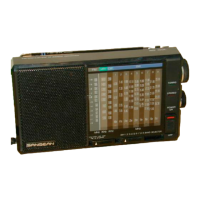

 To Next Page
 General