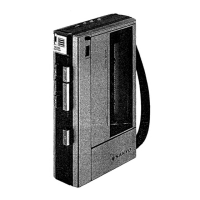
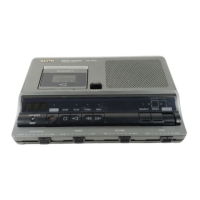
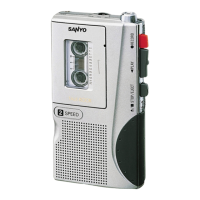
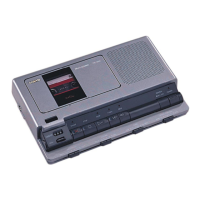
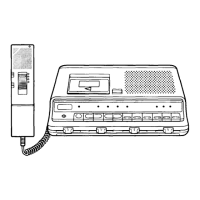
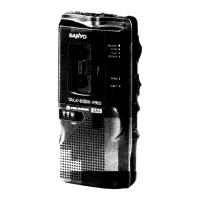
The Sanyo M1011 is a Mini Cassette Recorder, designed for portability and ease of use. This service manual provides detailed information for its maintenance and repair, alongside its key specifications and operational features.
Function Description:
The Sanyo M1011 primarily functions as a mini cassette recorder, capable of both recording and playback. It is designed for personal use, likely for voice recording, memos, or simple audio playback. The device incorporates a one-push button recording feature, quick review, and quick recording, suggesting a focus on user-friendly operation for capturing audio swiftly. An auto-stop mechanism is also included, which helps prevent tape damage and conserves battery life.
Important Technical Specifications:
- Power Source: The unit operates on 6V DC, supplied by four UM-3 (HP 7, AA Cell, Mignonzelle, R6) batteries. This makes it highly portable, relying on commonly available batteries.
- Output Power: It delivers a maximum output power of 500mW, suitable for personal listening through its built-in speaker or connected headphones.
- Current Consumption (at Vol. Min.):
- Record mode: 140mA
- Playback mode: 120mA
- Fast Forward mode: 220mA
- Rewind mode: 220mA
These figures indicate the power draw during different operations, useful for estimating battery life.
- Recording System: The recorder uses a DC Bias system for recording, a common method for achieving good audio quality in compact cassette recorders.
- Erasing System: It employs Magnet Erasing, a standard technique for clearing previously recorded audio from the tape.
- Tape Speed: The tape speed is 1-7/8ips (inches per second) with a ±3% tolerance, which is the standard speed for compact cassettes.
- Pitch Control: The device features a pitch control function, allowing for a ±20% to -10% adjustment. This can be useful for correcting playback speed or for specific audio effects.
- Fast Forward Time: For a C-60 cassette (60 minutes total playing time), the fast forward time is approximately 150 seconds.
- Rewind Time: Similarly, for a C-60 cassette, the rewind time is approximately 150 seconds.
- Wow & Flutter: The wow and flutter specification is 0.4% WRMS (Weighted Root Mean Square). This indicates the level of speed variation during playback, with lower values being better for audio fidelity.
- Frequency Response (Overall): The overall frequency response ranges from 200Hz to 6,000Hz. This range is typical for a mini cassette recorder, suitable for voice and general audio, though not high-fidelity music.
- Erase Ratio (Overall): An erase ratio of 40dB indicates the effectiveness of the magnet erasing system in removing previous recordings.
- Signal to Noise Ratio: The signal to noise ratio is 30dB, which is a measure of how much background noise is present relative to the audio signal.
- Crosstalk (Track to Track): The crosstalk between tracks is 50dB, indicating good separation between audio channels.
- Harmonic Distortion (K3): The third-order harmonic distortion (K3) is 10%, which is a measure of non-linear distortion in the audio signal.
- Hum & Noise (at Vol. Min.):
- At Vol. Min.: -50dBs
- At Vol. Max.: -30dBs
These figures represent the level of audible hum and noise when no signal is present.
- Terminal Impedance:
- MIC: 3kΩ
- Ext. Speaker: 8Ω
These specifications are important for connecting external microphones and speakers.
Usage Features:
The Sanyo M1011 is designed for straightforward operation. The "One Push Button Recording" and "Quick Recording" features highlight its immediate readiness to capture audio. The "Quick Review" function allows for easy checking of recorded content. The presence of a built-in microphone (BM1) and an external microphone jack (MIC) offers flexibility in audio input. An earphone jack allows for private listening, while an external speaker terminal provides an option for louder playback. The "Remote Jack" suggests compatibility with a remote control for hands-free operation. Pitch control adds a layer of functionality for specific playback needs.
Maintenance Features:
The service manual emphasizes several key aspects for maintenance and adjustment:
- General Remarks for Adjustment:
- Before adjustment, it is crucial to wipe all tape-contacting surfaces and driving parts clean with an alcohol-soaked soft cloth. This prevents issues caused by oil and grease stains.
- Belts should be handled carefully to avoid grease contamination. Used rubber parts, if deteriorated or scratched, must be replaced.
- Equipment Required for Adjustment:
- VTVM (Vacuum Tube Voltmeter)
- Frequency Counter
- Dummy Load (8Ω)
- Test Tapes: 3kHz for Tape Speed Adjustment (e.g., TEAC MTT-111) and 8kHz for Head Azimuth Adjustment (e.g., TEAC MTT-113C).
- DC Constant-voltage Regulator (for 6V DC supply during adjustment).
- Alignment Tool.
- Head Azimuth Adjustment: This critical adjustment ensures optimal playback and recording quality. It involves connecting a VTVM to the earphone jack, playing an 8kHz test tape, and slowly turning the azimuth adjusting screw until the VTVM reads the maximum. The screw should then be secured with paint or glue.
- Tape Speed Adjustment: This procedure requires removing the battery compartment lid, connecting a frequency counter to the earphone jack, and playing a 3kHz test tape. The tape speed is then adjusted by turning the potentiometer (P101) on the P.C.Board until the frequency counter reads 3kHz (±3%).
- Disassembly Instructions: The manual provides detailed steps for disassembling the cabinet bottom, amplifier P.C.Board, and mechanism chassis. These instructions are crucial for accessing internal components for repair and maintenance. Specific attention is given to noting lead wires and unsoldering connections where necessary.
- Parts List: Comprehensive lists for package, accessories, cabinet, and mechanism parts are provided with part numbers and quantities, facilitating easy identification and ordering of replacement components.
- Exploded Views: Detailed exploded views of the cabinet and mechanism are included, offering a visual guide for assembly and disassembly, and helping to locate specific parts.
- P.C.Board Parts List: A list of components on the Printed Circuit Boards (P.C.B.) is provided, including ICs, transistors, capacitors, resistors, and switches, along with their specifications.
- IC & Transistor Lead Identification: Diagrams for transistor lead identification (2SC536, 2SC693) and block diagrams for the LA4140 (Power Amplifier) and LA5512 (Motor Governor Circuit) are included, aiding in circuit analysis and troubleshooting.
- Wiring Diagram and Schematic Diagram: These diagrams are essential for understanding the electrical connections and circuit design, enabling technicians to diagnose and repair electrical faults.
The Sanyo M1011 is a well-documented device, with its manual providing all necessary information for both understanding its capabilities and performing detailed service and repair.

 Need help?
 General

 To Next Page