EasyManua.ls Logo

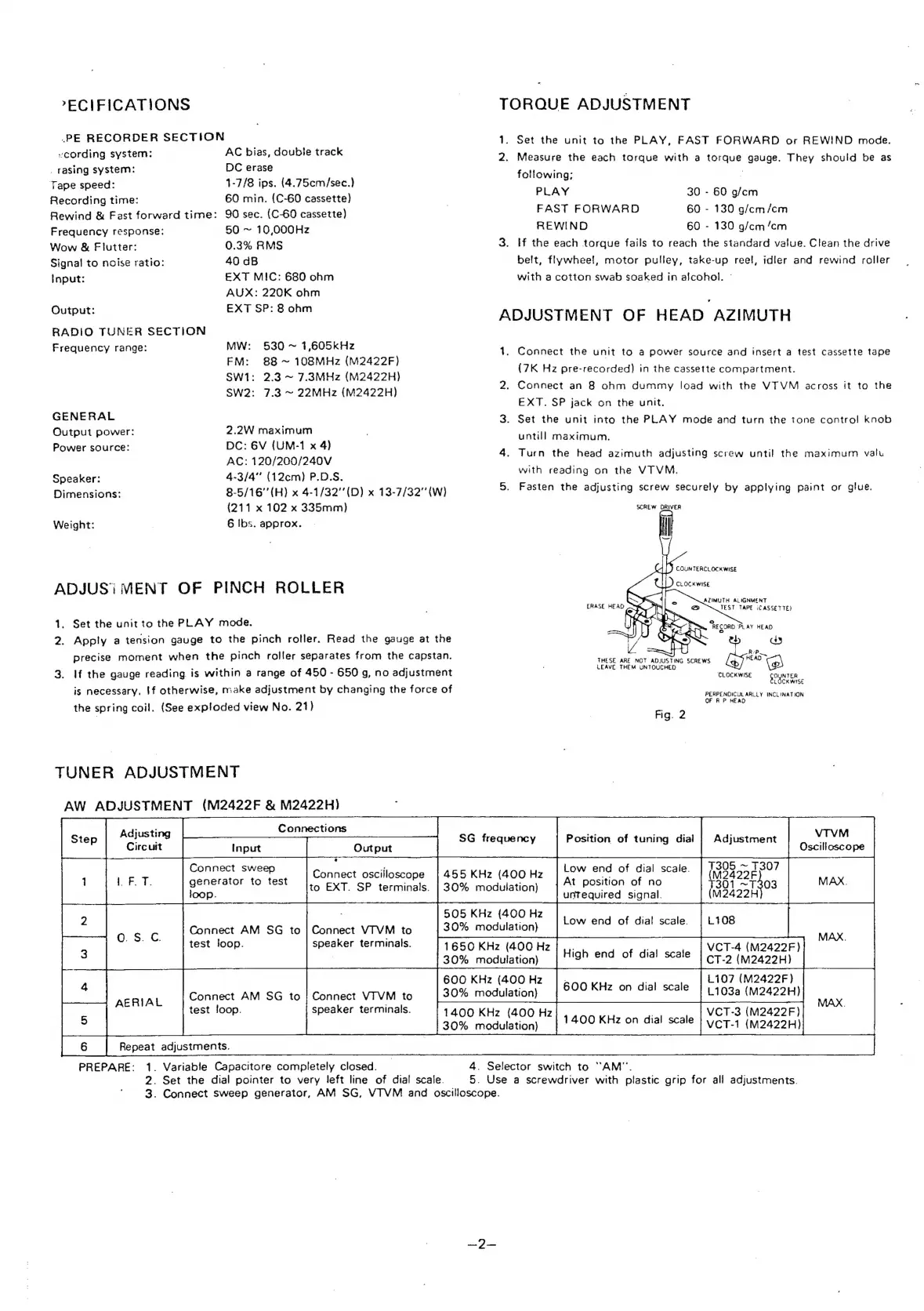
Sanyo M2422F - Torque Adjustment

Sanyo M2422F
13 pages
Print Icon
To Next Page IconTo Next Page
To Previous Page IconTo Previous Page
Loading...
-ECIFICATIONS
.PE
RECORDER
SECTION
cording
system:
AC
bias,
double
track
.
rasing
system:
Tape
speed:
Recording
time:
DC
erase
1-7/8
ips.
(4.75cm/sec.)
60
min.
(C-60
cassette)
Rewind
&
Fast
forward
time:
90
sec.
(C-60
cassette)
Frequency
response:
50
~
10,000Hz
Wow
&
Flutter:
0.3%
RMS
Signal
to
noise
ratio:
40
dB
Input:
EXT
MIC:
680
ohm
AUX:
220K
ohm
Output:
EXT
SP:
8
ohm
RADIO
TUNER
SECTION
Frequency
range:
MW:
530
~
1,605kHz
GENERAL
Output
power:
Power
source:
Speaker:
Dimensions:
Weight:
FM:
88
~
108MHz
(M2422F)
SW1:
2.3
~
7.3MHz
(M2422H)
SW2:
7.3
~
22MHz
{M2422H)
2.2W
maximum
DC:
6V
(UM-1
x
4)
AC:
120/200/240V
4-3/4"
(12cm)
P.D.S.
8-5/16''(H)
x
4-1/32'(D)
x
13-7/32"'(W)
(211
x
102
x
335mm)
6
Ibs.
approx.
ADJUSi
MENT
OF
PINCH
ROLLER
oh
Set
the
unit
to
the
PLAY
mode.
2.
Apply
a
tension
gauge
to
the
pinch
roller.
Read
the
gauge
at
the
precise
moment
when
the
pinch
roller
separates
from
the
capstan.
3.
If
the
gauge
reading
is
within
a
range
of
450
-
650
g,
no
adjustment
is
necessary,
if
otherwise,
make
adjustment
by
changing
the
force
of
the
spring
coil.
(See
exploded
view
No.
21)
TUNER
ADJUSTMENT
AW
ADJUSTMENT
(M2422F
&
M2422H)
;
PREPARE:
Adjusting
ccs
0.8.
C.
3
4
6
|
FT
AERIAL
Repeat
adjustments.
Connect
sweep
generator
to
test
loop.
Connect
oscilloscope
to
EXT.
SP
terminals.
Connect
AM
SG
to
|
Connect
VTVM
to
test
loop.
speaker
terminals.
Connect
AM
SG
to
|
Connect
VIVM
to
test
loop.
speaker
terminals.
1.
Variable
Capacitore
completely
closed.
2.
Set
the
dial
pointer
to
very
left
line
of
dial
scale.
3.
Connect
sweep
generator,
AM
SG,
VTVM
and
oscilloscope.
SG
frequency
|
Position
of
tuning
dial
|
Adjustment
ve
Oscilloscope
455
KHz
(400
Hz
Low
end
of
dial
scale.
30%
modulation)
S03
nedlton
108
a
eee
eee
ee
30%
modulation)
30%
modulation)
TORQUE
ADJUSTMENT
1.
Set
the
unit
to
the
PLAY,
FAST
FORWARD
or
REWIND
mode.
2.
Measure
the
each
torque
with
a
torque
gauge.
They
should
be
as
following;
PLAY
30
-
60
g/cm
FAST
FORWARD
60
-
130
g/cm/cm
REWIND
60
-
130
g/cm/cm
3.
If
the
each
torque
fails
to
reach
the
standard
value.
Clean
the
drive
belt,
flywheel,
motor
pulley,
take-up
reel,
idler
and
rewind
roller
with
a
cotton
swab
soaked
in
alcohol.
~
ADJUSTMENT
OF
HEAD
“AZIMUTH
1.
Connect
the
unit
to
a
power
source
and
insert
a
test
cassette
tape
(7K
Hz
pre-recorded)
in
the
cassette
compartment.
2.
Connect
an
8
ohm
dummy
load
with
the
VTVM
across
it
to
the
EXT.
SP
jack
on
the
unit.
3.
Set
the
unit
into
the
PLAY
mode
and
turn
the
tone
contro!
knob
untill
maximum.
4.
Turn
the
head
azimuth
adjusting
screw
until
the
maximum
valu
with
reading
on
the
VIVM.
5.
Fasten
the
adjusting
screw
securely
by
applying
paint
or
glue.
SCREW
ORIVER
COUNTERCLOCKWISE
CLOCK
WISE
AZIMUTH
ALIGNMENT
ERASE
HEAD
TEST
TAPE
iC
ASSET
TE)
Hepes
RECORD
‘PLAY
HEAD
mh
dy
RPL
THESE
ARE
NOT
ADJUSTING
SCREWS
HEAD
@
LEAVE
THEM
UNTOUCHED
Clockwise
GouNTER
COCKWISE
PERPENDICULARLLY
INCLINATION
OF
R
P
HEAD
Fig.
2
At
position
of
no
MAX.
untequired
signal.
(
4.
Selector
switch
to
“AM".
5.
Use
a
screwdriver
with
plastic
grip
for
all
adjustments.

Related product manuals