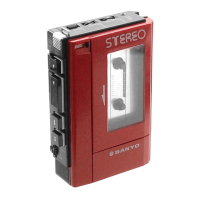
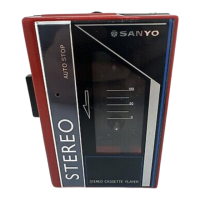
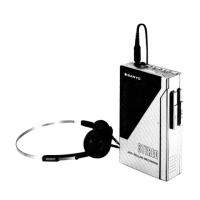
The Sanyo MGP17 is a portable stereo cassette player, designed for personal audio playback. This device emphasizes portability and ease of use, offering a compact solution for enjoying cassette tapes on the go.
Function Description
The primary function of the Sanyo MGP17 is to play back audio from standard cassette tapes. It features a stereo output, typically delivered through headphones, allowing for a personal listening experience. The device includes basic controls for tape transport, such as play, fast forward, and rewind. It also incorporates a graphic equalizer control, enabling users to adjust the audio frequency response to their preference, enhancing the sound quality for different types of music or listening environments. The integrated amplifier P.C. board and graphic equalizer P.C. board work in conjunction to process and amplify the audio signal before it reaches the headphones.
Important Technical Specifications
Power Source: The unit operates on 3V, typically supplied by two UM-3, HP 7, AA Cell, or Mignon size R6 batteries.
Output Power: It delivers 25mW x 2 (Max.) of output power, suitable for headphone listening.
Current Consumption (at Vol. Min.):
- Playback mode: 170mA
- Fast Forward: 240mA
- Rewind mode: 240mA
Tape Speed: 4.75cm/s ±3%
Time Required:
- Fast Forward: 160sec. (with C-60 cassette)
- Rewind Time: 160sec. (with C-60 cassette)
Torque:
- Playback: 32 – 60g-cm
- Fast Forward/Rewind: more than 50g-cm
Wow & Flutter: 0.5% WRMS (Weighted Root Mean Square), indicating a relatively stable tape speed.
Frequency Response: 63Hz – 10,000Hz, covering a decent range for portable audio.
Graphic EQ. Control (100Hz/1kHz/10kHz):
- +10dB
- -10dB
Signal to Noise Ratio: more than 43dB, suggesting a reasonably clean audio output.
Crosstalk: more than 50dB
Channel Separation (with FezO3): more than 30dB
Hum & Noise (at Vol. Min.): -56dBs
Terminal Impedance:
- Headphones: 32Ω
Dimensions: 86(W) x 120(H) x 36(D) mm
Weight (w/o battery): 225g (Approx.)
The device utilizes specific integrated circuits (ICs) and transistors for its audio processing. For instance, the BA3506A is likely used for the amplifier section, and the LA5523 for the motor control. The 2SC2812 transistor is also identified, indicating its role in the circuit.
Usage Features
The Sanyo MGP17 is designed for straightforward operation.
Portable Design: Its compact dimensions and light weight (225g without batteries) make it highly portable, fitting easily into bags or pockets for on-the-go listening.
Battery Operation: Powered by two AA batteries, it offers convenience for use in various locations without needing an external power source.
Graphic Equalizer: The inclusion of a graphic equalizer with controls for 100Hz, 1kHz, and 10kHz frequencies allows users to customize the sound profile. This feature enables boosting or cutting specific frequency ranges to suit personal preferences or to compensate for different headphone characteristics or recording qualities.
Standard Controls: It features standard tape transport controls (play, fast forward, rewind) for easy navigation through cassette tapes.
Headphone Output: The dedicated headphone jack ensures a private listening experience.
Maintenance Features
The manual provides detailed instructions for disassembly, repair, and adjustment, making it serviceable for technicians.
General Remarks for Disassembly:
- Before disassembling, spread a soft rubber mat or cloth to prevent scratches and grease stains.
- Use appropriate materials to avoid damage to static-sensitive components (transistors and ICs).
- Reassemble the unit carefully, noting the positions of screws, soldering, and wire arrangement.
Cabinet Bottom Removal:
- Open the cassette compartment lid by pressing the stop button.
- Remove the tape from the compartment.
- Turn the unit over, remove the battery compartment lid, and remove the batteries.
- Remove four screws (1-4) fastening the cabinet bottom and lift the cabinet bottom away.
Cassette Mechanism Removal:
- Remove the P.C.Board following instructions for "Cabinet Bottom Removal" and "P.C.Board Removal".
- Remove three screws (6-8) holding the cassette mechanism.
P.C.Board Removal:
- Remove the cabinet bottom.
- Unsolder the FPC of the Graphic Equalizer from the P.C.Board.
- Remove the screw (5) fastening the P.C.Board.
- Turn over the P.C.Board to avoid damage to the playback head and motor leads.
Adjustment Procedures:
- Tape Speed Adjustment: Requires a frequency counter, dualtrace oscilloscope, VTVMs (2 sets), and dummy loads. A 3kHz test tape (e.g., TEAC MTT-111) is used. The procedure involves connecting the equipment, playing the test tape, and adjusting the potentiometer (P401) on the P.C.Board until the frequency counter reads 3kHz.
- Head Azimuth Adjustment: Requires a dualtrace oscilloscope and a 10kHz test tape (e.g., TEAC MTT-114). The procedure involves connecting the equipment, playing the test tape, and slowly turning the azimuth adjusting screw until the amplitudes of both channel output waveforms become maximum and the waveforms overlap as well as possible (phase-illuminated). The VTVMs must be read at the maximum as much as possible. After adjustment, secure the adjusting screw with paint or glue.
Parts List: Comprehensive lists are provided for cabinet, headphones, mechanism, and P.C. board components, including part numbers, descriptions, and quantities, facilitating replacement and repair. Exploded views are also included to aid in identifying component locations.

 Need help?
 General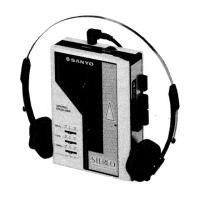

 To Next Page