EasyManua.ls Logo

Sanyo RD2016 - Page 7

Sanyo RD2016
16 pages
Print Icon
To Next Page IconTo Next Page
To Previous Page IconTo Previous Page
Loading...
ABOUT
METAL
TAPE
Where
as
normal,
chrome,
ferrochrome
and
other
sound
recording
tapes
are
surface-coated
with
magnetic
powder
of
iron
oxide,
metal
tape
has
the
surfaces
covered
with
an
unoxidized
alloy
whose
main
ingredient
is
pure
iron.
Since
base
film
is
almost
the
same
in
all
kinds
of
tape,
the
metal
tape
does
not
differ
significantly
from
the
others
in
Cra
———
TE
[roe
Molecular
construction
Density
of
residual
magnetic
flux
Br
(gauss)
lene
ies
18000
regard
to
the
physical
and
mechanical
properties.
It,
however,
excels
in
terms
of
electrical
characteristics
because
of
its
special
surface
coating.
.
For
this
reason,
it
can
provide
the
tape-deck
enthusiasts
with
greater
satisfaction,
enabling
them
to
achieve
superior
high
fidelity
in
the
recording
and
playback
of
music.
3,200
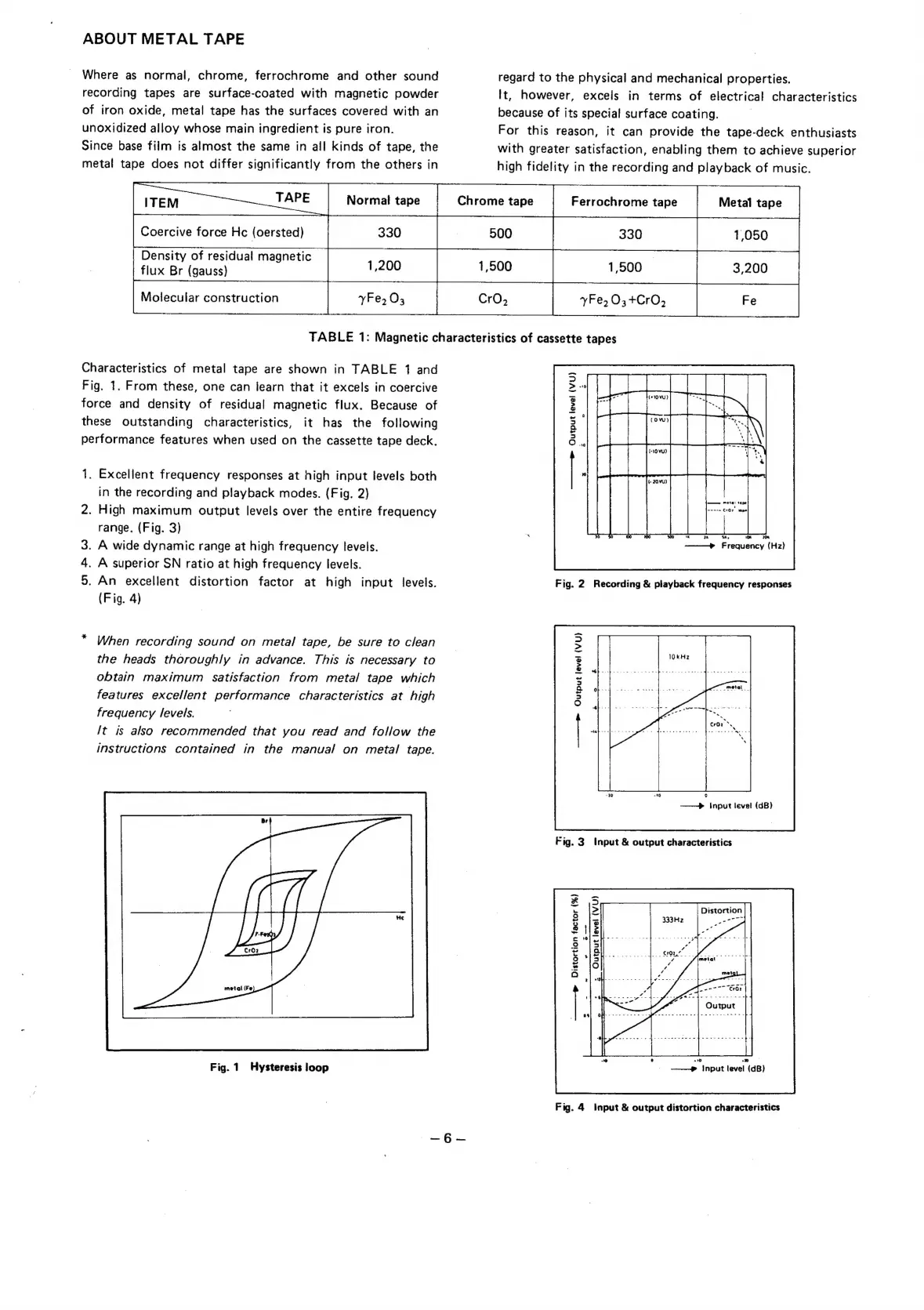
TABLE
1:
Magnetic
characteristics
of
cassette
tapes
Characteristics
of
metal
tape
are
shown
in
TABLE
1
and
Fig.
1.
From
these,
one
can
jearn
that
it
excels
in
coercive
force
and
density
of
residual
magnetic
flux.
Because
of
these
outstanding
characteristics,
it
has
the
following
performance
features
when
used
on
the
cassette
tape
deck.
=—h
.
Excellent
frequency
responses
at
high
input
levels
both
in
the
recording
and
playback
modes.
(Fig.
2)
2.
High
maximum
output
levels
over
the
entire
frequency
range.
(Fig.
3)
3.
A
wide
dynamic
range
at
high
frequency
levels.
.
A
superior
SN
ratio
at
high
frequency
levels.
5.
An
excellent
distortion
factor
at
high
input
levels.
(Fig.
4)
>
When
recording
sound
on
metal
tape,
be
sure
to
clean
the
heads
thoroughly
in
advance.
This
is
necessary
to
obtain
maximum
Satisfaction
from
metal
tape
which
features
excellent
performance
characteristics
at
high
frequency
levels.
It
is
also
recommended
that
you
read
and
follow
the
instructions
contained
in
the
manual
on
metal
tape.
Fig.
1
Hysteresis
loop
(ow)
4
4
+
20¥U)
etgl
ia
wonmee
Cr
pT)
Le)
706
bo]
a
10"
wn
LS
——»
Frequency
(Hz)
——
Output
fevel
(VU)
Fig.
2
Recording
&
playback
frequency
responses
———
Output
Jevel
(VU)
——>
Input
level
(dB)
Fig.
3
input
&
output
characteristics
Distortion
7
-
Output
level
(VU)
-———_»
Distortion
factor
(%)
Fig.
4
Input
&
output
distortion
characteristics

Related product manuals