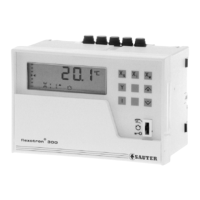
AVM 234S
51.377/3
Sauter Components
Connected as a 2-point valve actuator (24 V)
This type of activation (OPEN/CLOSED) can be achieved by two wires. Power is applied to terminals 1
and 2a. By applying power (24 V) at terminal 2b, the shaft extends. When the power is switched off, the
actuator moves to the opposite end position. The motor's electronic cut-out responds in the end positions
(valve limit, or when maximum stroke is reached) or in the event of an overload (no limit switches).
The coding switch can be used to set the run times. The characteristic cannot be selected in this case
(resulting in the characteristic for the valve). Terminals 3i, 3u and 44 must not be connected.
Connected as a 3-point valve actuator (24 V)
Applying power at terminal 2a (or 2b) makes it possible to move the valve to any desired position. If pow-
er is applied at terminals 1 and 2b, the shaft extends. It retracts if power is applied at terminals 1 and 2a.
In the end positions (at the valve stop, or when the maximum stroke is reached), or in the event of an
overload, the motor's electronic cut-out is activated (no limit switches). The direction of the stroke can be
changed by transposing the connections.
The coding switch is used to set the running times. In this case, the characteristic cannot be selected
(resulting in the characteristic for the valve). Terminals 3i, 3u and 44 must not be connected.
Connected (with 230 V) as a 2-/3-point or with continuous control (accessory 0372332)
The accessory module is slotted into place in the terminal compartment and then connected accordingly.
The coding switch on the board is used to select the running times. The characteristic can be selected
only in the case of continuous activation; the characteristic for the valve is applicable. On this actuator
(which has no spring return action), the switching lever is in the lower position.
Connected to a control voltage (0...10 V and/or 4...20 mA)
The in-built positioner controls the actuator in accordance with the controller output signal y.
The control signal used is a voltage signal (0...10 V–) at terminal 3u, or a current signal at terminal 3i. If a
control signal is present at both terminals (3u (0...10 V) and 3i (4...20 mA)) simultaneously, the input with
the higher value takes priority.
Mode of action 1 (mains voltage to internal connection 2a): as the output signal increases, the shaft ex-
tends.
Mode of action 2 (mains voltage to internal connection 2b): as the output signal increases, the shaft re-
tracts.
The starting point and the control span are fixed. To set partial ranges, a split-range unit (for voltage input
3 u only) is available as an accessory (see the description below); this unit can be fitted in the actuator.
When the power supply is applied and initialisation has been carried out, the actuator moves to every
valve stroke between 0% and 100%, depending on the control signal. The electronics and the travel
measurement system ensure that no stroke is lost, and the actuator does not require re-initialisation at
intervals. When the end positions are reached, the position is checked, adjusted as necessary and
stored again. This ensures parallel running of several drives of the same SUT type. Feedback signal y
0
=
0...10 V corresponds to the effective valve stroke of 0 to 100%.
If the 0...10 V control signal is interrupted in direction of action 1, the spindle retracts completely. So that
the shaft can extend (direction of action 1), a voltage of 10 V must be applied at terminals 1 and 3u, or it
is necessary to switch over to direction of action 2.
The coding switch can be used to set the characteristic for the valve. Equal-percentage and square char-
acteristics can be produced only if the actuator is used as a continuous actuator. Further switches can be
used to select the running times (can be used for 2-point, 3-point or continuous functions).
Continuous activation can also be used with 230 V or 110 V. Note that the controller's neutral conductor
should be connected to the control voltage. The neutral conductor of the power supply should be used
only for the module.
LED indicators (dual-colour, red and green)
Both LEDs flashing red: initialisation procedure
Upper LED lit red: upper limit or "CLOSED" position reached
Lower LED lit red: lower limit or "OPEN" position reached
Upper LED flashing green: actuator running, moving towards "CLOSED" position
Upper LED lit green: actuator stationary, last direction of running "CLOSED"
Lower LED flashing green: actuator running, moving towards "OPEN" position
Lower LED lit green: actuator stationary, last direction of running "OPEN"
No LED lit: no power supply (terminal 2a or 2b)
Both LEDs flashing red and green: actuator is in manual mode
7151377003 10

 To Next Page
 Loading...