Need help?
Do you have a question about the Scala SC 6400 and is the answer not in the manual?
Highlights key functionalities like fuzzy logic, memory, and WHO indicator.
Instructions for inserting batteries and using alkali types for the monitor.
Guide on how to correctly set the date and time on the blood pressure monitor.
Tips for accurate readings, including resting conditions and body position.
Guide on proper cuff placement for accurate blood pressure readings.
Procedure to stop the measurement process at any time.
How to access stored blood pressure measurements.
Procedures for removing single or all stored measurements.
Classification of blood pressure readings according to WHO standards.
Identifies common error messages and provides solutions for the monitor.
Guidelines for proper care and upkeep of the blood pressure monitor.
Recommendation for checking pressure indication accuracy every two years.
Details of the manufacturer's warranty and exclusions.
Instructions for environmentally sound disposal of the device and batteries.
Lists key technical data including measuring range, accuracy, and power supply.
Defines important symbols found on the device and packaging.
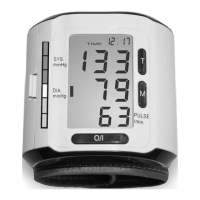
The Scala Digital Wrist Blood Pressure Monitor SC 6400 is designed for regular monitoring of blood pressure, offering a user-friendly experience with several integrated features. It is important to note that individuals with cardiac arrhythmia should consult a doctor before using this monitor.
The SC 6400 utilizes fuzzy logic to determine the appropriate pumping pressure during measurement. If the initial factory-set pressure is insufficient, the device intelligently adjusts and continues pumping to ensure accurate readings. This monitor is capable of storing up to 85 measurements in its memory, each entry including the systolic and diastolic blood pressure, heart rate, and the corresponding date and time. The device also incorporates a WHO-Interpretation system, which uses a colored band to visually indicate blood pressure readings, aiding in quick assessment.
To begin using the monitor, two LR03 alkali batteries must be inserted into the battery compartment located on the side of the device. If the batteries are low, a battery icon will appear on the LC display, indicating that replacement is needed before further use.
Setting the clock is the initial step after battery insertion. This is done by holding the TIME button for approximately 5 seconds, which will make the year blink. The year, month, day, hour, and minutes can then be set sequentially using the 0/I-START button and confirmed with the TIME button.
For accurate measurements, it is crucial to follow specific guidelines. Measurements should always be taken under consistent conditions, at rest, and not under the influence of alcohol, after meals, or during periods of physical or mental stress. Ideally, the user should be seated at a table, and the monitor must be positioned at heart level.
To take a measurement, the cuff should be placed around the left wrist, ensuring the device rests on the artery and is about 1 cm away from the wrist joint. The cuff should be applied with moderate tightness. Pressing the 0/I-START button initiates the automatic measurement. The cuff inflates to approximately 190 mmHg, and the automatic deflation begins shortly after. A blinking heart icon on the LC display indicates that a Korotkoff sound has been detected, signifying systolic pressure. If the initial inflation is insufficient (e.g., less than 150 mmHg), the monitor will re-inflate to about 220 mmHg. At the end of the measurement, the results are displayed, and the cuff deflates. A measurement can be aborted at any time by pressing the 0/I-START button, which will instantly deflate the cuff.
The memory function allows users to recall stored measurements using the MEMORY button. The oldest measurement is assigned number 1, and subsequent measurements increment until 85. When the memory is full, the newest measurement replaces the oldest, shifting all other entries. Individual blood pressure values can be deleted from memory by pressing the MEMORY button to view the desired value, then holding the 0/I-START button for at least 4 seconds until "dEL" and the memory location number are displayed, followed by another instant press of the 0/I-START button. To delete all blood pressure values, press the MEMORY button, then hold the POWER key (or 0/I-START button) for at least 4 seconds until "dEL" and "ALL" are displayed, followed by an instant press of the 0/I-START button. The time and date settings are not affected by memory deletion.
The device provides troubleshooting messages on the display, such as "LL Err" for pressure below 20mmHg, "UU Err" for pressure above 300mmHg, "P Err" for pumping errors, "crErr" for signal noise, and "HI" for pumping pressure above 300mmHg. A battery icon or no display indicates low batteries. In case of an error, it is recommended to wait at least 5 minutes before repeating the measurement.
To ensure the longevity and accuracy of the SC 6400, proper cleaning and maintenance are essential. The monitor should not be exposed to extreme temperatures, moisture, dust, or direct sunlight. The cuff, which contains a sensitive airtight bulb, should be handled with care to avoid torsion or kinking. The device itself should be cleaned with a soft, dry cloth, avoiding fuels, thinners, or other solvents. Stains on the cuff can be carefully removed with a wet cloth and soap water, but the cuff should never be washed. The monitor should not be dropped or treated with force. Attempting to open the monitor will invalidate the factory calibration. Periodic re-calibration of the pressure indication every 2 years is recommended.
 General
| Type | Automatic |
|---|---|
| Product color | Red, White |
| Placement supported | Wrist |
| Battery type | LR03 |
| Number of batteries supported | 2 |

 To Next Page