INSTRUCTIONS FOR HEATING
12
Handling fuels
Selecting Wood/Fuel
You can use any type of wood as firewood, however, harder types,
such as beech, ash, are generally better for heating as they burn
more evenly and create less ash. Other wood types like maple, birch
and spruce are excellent alternatives.
Handling
Firewood is best if you fell the tree, and saw and split the wood,
before May 1st. Remember to cut the logs to match the size of your
wood-burning stove‘s combustion chamber. We recommend a dia-
meter of 6-10 cm. The length should be about 6 cm shorter than
that of the combustion chamber to leave enough space for air to
circulate. Firewood with a greater diameter needs splitting. Split
wood dries faster.
Storing
You need to store the sawn and split firewood in a dry place for 1-2
years before burning. Wood dries faster if you stack it in an airy place.
Before use, store the firewood for a few days at room temperature.
Note that wood absorbs moisture during the autumn and winter
seasons.
Moisture
To avoid environmental issues, and for optimum burning, wood
has to be perfectly dry to be suitable for use as firewood. The max.
residual moisture in the wood should not exceed 21%. A moisture
content of 15-18% yields best results. As an easy way of checking if
wood is dry, just knock two pieces of wood together. If the wood is
moist, the sound will be dull.
If you use damp wood, most of the heat it produces will be used
to evaporate the water. The temperature in the wood stove does
not rise, and the room is not sufficiently heated. Of course, this is
not economical, and it will cause soot build up on the glass pane,
in the stove, and in the chimney. Burning moist wood also causes
pollution.
Understanding units for measuring wood
Various units of measurement are used for wood. Before you buy
wood, it makes sense to familiarise yourself with the terms. There
are various brochures, in public libraries for example, that cover this
topic.
Use of the following as fuel is illegal
Painted, pressure impregnated, or glued wood, driftwood from the
sea. Never burn chipboard, plastics, or chemically treated paper.
These materials are dangerous to humans, to the environment, your
wood stove, and your chimney. To keep a long story short – make
sure you burn only quality firewood.
Firewood fuel value
The fuel value is different for different types of wood. In other words,
you need to use more wood of certain types to achieve the same
heating performance. This Instruction Manual assumes that you
will be using beech, which has a very high fuel value, and is also a
wood that is easy to procure. If you use oak or beech wood fuel, note
that these wood types have a greater fuel value than, say, birch.
Make sure you use less fuel to avoid damage to the wood-burning
stove.
Wood types Kg Dry wood/m
3
Compared to
beech
Hornbeam 640 110%
Beech/Oak 580 100%
Ash 570 98%
Maple 540 93%
Birch 510 88%
Pine 480 83%
Fir 390 67%
Poplar 380 65%
General Notes
Your wood stove is not designed for continual heating for periods
of over 24 hours.
Please note! Parts of the wood-burning stove, especially the outer
surfaces, become hot during use. Please exercise due care.
Never empty ashes into a flammable container. Ashes can contain
glowing embers long after you finish using your wood stove.
While the stove is not in use you can close the baffle to avoid drafts
through the stove.
After longer breaks you should check the smoke outlet paths for
blockages before lighting.
Chimney fires
In case of a chimney fire, keep the stove door, the ash drawer, and
all the valves on the stove closed. In case of emergency, call the fire
service.
For security reasons it is not allowed to store flammable materials
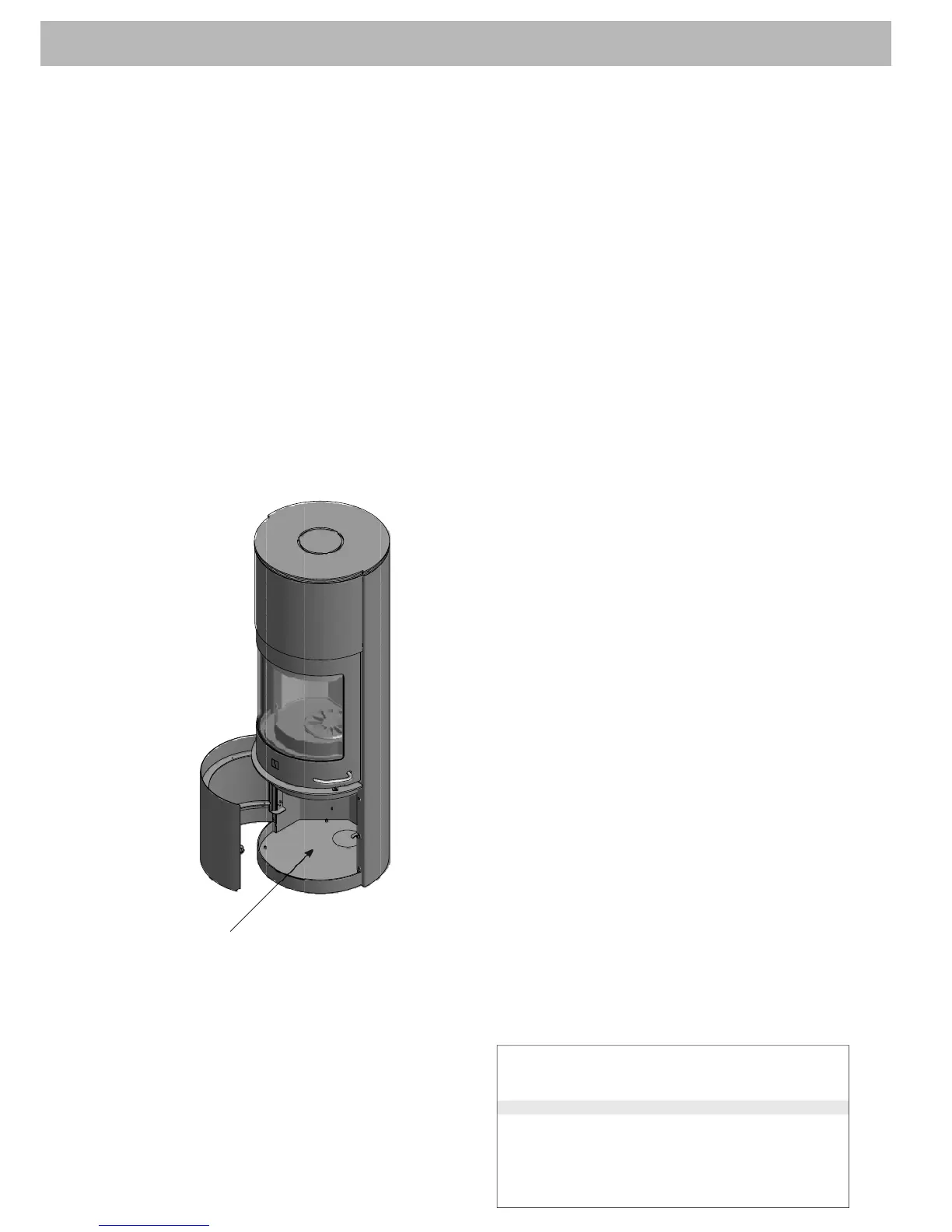
under the combustion chamber of the Scan 53.


 To Next Page