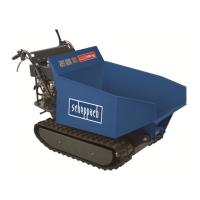
The Scheppach DP3000 is a robust and versatile dumper designed for transporting heavy loads, particularly in outdoor and challenging environments. This manual provides comprehensive instructions for its assembly, operation, and maintenance, ensuring safe and efficient use.
Function Description:
The DP3000 is primarily used for material transport, featuring a dump box capable of carrying significant weight. It is powered by a 4-stroke gasoline engine, which drives the wheels and enables both forward and reverse movements. The dumper is equipped with an ignition system controlled by an engine switch, and its speed is regulated by a throttle control lever. Steering is managed through left and right steering levers, offering maneuverability in various terrains. The gear selection lever allows the operator to choose between different forward and reverse gears, adapting to the load and ground conditions. The dump box itself can be fixed in position and then unlocked and tilted for easy emptying, a process that may require a second person for heavy loads. The machine's all-wheel drive capability enhances traction and stability, especially on uneven or slippery surfaces.
Usage Features:
Before operating the DP3000, it is crucial to ensure proper assembly and perform essential checks. The steering rod, wheels, transport tray, and gear selector lever must be securely attached according to the provided instructions. The on/off switch cable also needs to be fastened. Prior to starting the engine, operators must verify the fuel level, ensuring the tank is at least half-filled with clean, fresh fuel (min. 90 octane, max. 5% bio-ethanol). The ignition cable must be secured to the spark plug, and the air filter and fuel lines should be in good condition.
Starting the engine involves a specific sequence: for cold starts, the choke lever is set to the choke position, the throttle lever to halfway, the engine switch to "ON," and the fuel cock to the open position. The starting rope is then pulled slowly several times to prime the carburetor, followed by smooth, brisk pulls until the engine starts. After a few seconds of warming up, the choke lever is gradually moved to the run position. For warm starts, the choke is not typically needed.
Once the engine is running and warmed up, the throttle lever is used to accelerate the engine speed. To move the dumper, the desired gear is engaged using the gear selection lever, and the clutch control lever is slowly squeezed. The clutch control lever has a latch that must be pressed to engage the clutch. Releasing the clutch control lever disengages the clutch, causing the machine to stop and brake automatically. Steering is intuitive, with the left and right steering levers controlling turns. The sensitivity of the steering increases with speed and decreases with load, requiring more pressure on the levers when the dumper is heavily loaded.
Operators are advised to drive at a safe speed, adjusting to the slope of the land, surface conditions, and load weight. On soft ground, using the first forward/reverse gear is recommended, avoiding rapid acceleration, sharp turns, or sudden stops. When stopping on a steep slope, a wedge should be positioned to secure the machine. The idle speed function, achieved by setting the throttle control lever to "L," helps reduce engine stress, conserve fuel, and lower noise levels when the machine is not actively working. In emergencies, the engine can be stopped by simply turning the engine switch to "OFF." Under normal conditions, the throttle is moved to "L," the engine is allowed to idle for a minute or two, and then the engine switch is turned to "OFF," followed by turning the fuel valve lever to the closed position.
Maintenance Features:
Regular maintenance is crucial for the DP3000's longevity and safe operation. Before any cleaning or maintenance, the engine must be switched off, and the spark plug boot pulled from the spark plug to prevent accidental starting. The machine should be kept free of dirt and dust, and cleaned with a damp cloth or compressed air after each use. Strong detergents or petroleum-based cleaners should be avoided on plastic parts.
Key maintenance tasks include:
- Adjusting the clutch: As the clutch wears, the lever's opening may widen. This requires adjusting the cable using the adjustment device and counter-nut to restore the original position.
- Adjusting the steering: If steering becomes difficult, the steering levers can be adjusted by slackening the locknut and unscrewing the adjusters to eliminate play in the cable. Care must be taken not to unscrew the adjusters too much, as this can lead to a loss of traction.
- Lubrication: The gearbox is pre-lubricated and sealed.
- Oil changes: The transmission oil should be replaced every 1000 hours when the engine is warm. This involves draining the old oil from the drain plug and refilling with 1.62 liters of clean transmission oil through the filler neck. The engine oil level should be checked before each use using the dipstick and topped up if necessary. The engine oil itself should be replaced every 50 hours, following a similar drain and refill procedure.
- Air filter cleaning: The air filter (14) should be cleaned every 30 hours. This involves removing the air filter cover, loosening the thumbscrews, removing the filter, tapping it clean, and replacing it if necessary. Reassembly is done in reverse order. Gasoline or low flash point cleaning solvents should never be used to clean the air filter element due to fire and explosion risks.
- Spark plug check and replacement: The spark plug (13) should be checked after 10 hours for dirt and grime, and cleaned with a copper wire brush if needed. It should be maintained after 50 hours of operation. This involves removing the ignition cable, cleaning any dirt from the base, removing the plug with a wrench, visually inspecting it for discoloration and debris, checking the gap (0.6 to 0.7 mm), and then reinserting and tightening it.
- Drive chain lubrication: The drive chain (24) should be regreased every 500 operating hours after removing its cover.
- Wheel disassembly: Instructions are provided for disassembling the wheels for maintenance.
For long-term storage, the fuel tank should be drained outdoors, and the engine allowed to cool. The machine should be stored in a dark, dry, frost-proof place, inaccessible to children, with good ventilation. Before recommissioning, the spark plug should be removed, the starter rope pulled several times to clean the firing chamber, the spark plug contacts cleaned or replaced, and the tank refilled.
The manual also emphasizes general safety practices, such as keeping the work area tidy, being aware of environmental influences, keeping bystanders away, storing unused tools securely, avoiding overloading the machine, wearing suitable clothing and personal protective equipment, and maintaining secure footing. It also highlights the dangers of flammable fuels, toxic emissions, hot components, and noise, providing warnings and precautions for each.


 To Next Page


 General
 Weight and Dimensions