Seite 26 von 60Seite 26 von 60
Residual risks and accident prevention
standards
Neglect of ergonomic principles
Negligent handling of personal protective equip-
ment (PPE)
Negligent handling or ommission of the personal pro-
tective equipment may cause serious injuries.
– Wear prescribed personal protection equipment.
Human behaviour, misbehaviour
– For any work be fully concentrated.
m Residual risks - Cannot be entirely excluded.
Danger from noise
hearing damage
Prelonged unprotected work with the device may
cause hearing damage.
– Always wear ear-muffs.
In case of emergency
In case of a possibly occuring accident take the nec-
essary rst aid steps as appropriate and obtain quali-
ed medical aid as quickly as possible.
During longer work, because of vibrations, there is
a risk of circulation problems in the user‘s hands
(white-nger-syndrome). White-nger-syndrome is
a vascular disease where the small blood vessels in
ngers and toes contract seizure-like. The affected
areas are no longer supplied with blood and there-
fore look very pale. Frequent use of vibrating ma-
chines can cause nerve damage in people whose
circulation is compromised (e.g. smokers, people
with diabetes).
If you notice unusual impairment, immediately stop
the work and consult a doctor. Observe the following
notices in order to reduce risks:
• Keep your body, and particularly your hands, warm
in cold weather.
• Take regular breaks during which you should move
your hands to promote circulation.
• Ensure the lowest possible vibration of the ma-
chine by regularly maintaining it and keeping com-
ponents tight.
6. Technical data
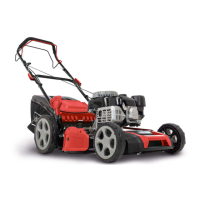
MS139-42
Technical data
Type engine
four stroke engine/air cooled
Cubic capacity
139 cm³
Rotation speed
3000 U/min
Max. engine output kW
2,6 kW / 3,5 HP
Fuel
Normalbenzin/Bleifrei max.
5% Bioethanol
Capacity tank/gasoline
1000 cm³
Motor oil
SAE 30 / 10W30
Capacity tank/oil
0,6 l
Cutting height
adjustment
25 - 70 mm / 5-steps
Collection bag capacity
40 l
Cutting width
42 cm
Weight
26,0 kg
Subject to technical changes!
Information concerning noise emission measured
according to relevant standards:
Sound pressure L
pA
= 81 dB(A)
Uncertainty K
PA
= 3 dB(A)
Sound power L
WA
= 92,1 dB(A)
Uncertainty K
PA
= 2,46 dB(A)
Wear ear-muffs.
The impact of noise can cause damage to hearing.
Vibration A
hv
(left/right) = 2,2 m/s
2
Uncertainty K
PA
= 1,5 m/s
2
7. Before rst use
Before starting the equipment
Assembling the components
Some parts of the mower come disassembled. For
quick and easy assembly, read and follow the inst-
ructions below.
Important! You will need the following additional tools
(not supplied) for assembly, and also for mainte-
nance work:
• A 1 liter measuring jug (oil/petrol resistant)
• A petrol can (5 liters is sufcient for approx. 6
operating hours)
• A funnel (suitable for the tankʼs petrol ller neck)
• Household wipes (to wipe up oil/petrol residue;
dispose of these at a lling station)
• A petrol suction pump (plastic, available from DIY
stores)
• An oil can with hand pump (available from DIY
stores)
• Spark plug wrench
• 0,6 liter of engine oil (SAE 30 / 10W30)
Assembly
1. Take the mower and attachment parts out of the
packaging and check that all parts are present.
2. Attach the lower push bar to both sides of the
mower with two screws (a, e), 2 washer (b), one
plastic grip nut (c) and one star grip nut (d) each.
Make sure that the cables, which will be attached
later, are not in the way (Fig. 2-3).
3. Attach the upper push bar on the lower push bar
with one quick-release lever (5), one xation slice
(g), one washer (b) and one plastic nut (f) each on
both sides (Fig. 4-5). Note the correct alignment of
the quick-release lever xation slice ensuring the
quick-release function remains intact.
4. Insert the pull start handle (17) in the designated
hook as shown in Fig. 6.
5. Fix the cables to the push bar with the cable clips
(18) provided (Fig. 7).
6. Grass box (16) - open it up and click the plastic
clips into position on the frame (Fig. 8).
7. Mowing with grass box:
Lift the discharge ap (15) with one hand and hang
the grass box (16) as shown in Fig. 9.
8. Mulching:
If the grass box (16) is attached, remove it and
replace it with the mulch insert (19) as shown in
Fig. 10-12.
Setting the cutting height


 To Next Page
 Loading...