This document is a user and maintenance manual for Scotsman Dice ice makers, specifically the NU and NW series. It provides comprehensive information on the appliance's use, ordinary maintenance, safety warnings, technical specifications, and troubleshooting.
Function Description
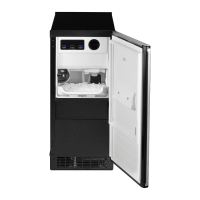
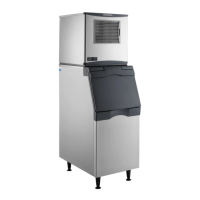
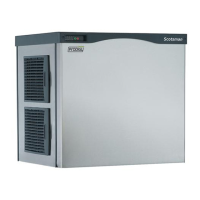
The Scotsman Dice ice maker is designed solely for producing ice. It is not intended for use as a container for bottles, cans, or other items. The NU series models feature a built-in ice container, while the NW series models are designed to be installed on top of a separate ice bin, with an optional outlet kit for unloading onto a conveyor belt or a low container on wheels.
The appliance incorporates an XSafe natural sanitization system (for XSafe models only) based on a UV lamp. This system treats the air with ozone technology in the food area of the ice maker, keeping the ice maker and container clean, and reducing mold, viruses, and other microorganisms. This system is fully automated and chemical-free.
Important Technical Specifications
Operating Limits:
- Working temperature: Minimum 10°C, Maximum 43°C
- Water temperature: Minimum 5°C, Maximum 38°C
- Water pressure: Minimum 0.1 MPa (1 Bar), Maximum 0.5 MPa (5 Bar)
- Voltage tolerance: -10% to +10% with respect to data on the plate
- Sound level: < 70 dB(A)
Refrigerant Gas Safety Warnings:
- The appliance may contain propane (R290), which is a highly flammable gas.
- It may also contain fluorinated greenhouse gases governed by the Kyoto protocol, with quantities indicated on the serial plate.
- GWP (Global Warming Potential) values:
- HFC R404A: 3750
- HFC R452A: 2140
- HFC RE134A: 1430
- R290: 3
- The propane used in refrigeration systems is odorless and heavier than air; in case of leaks, it migrates to the ground.
- The system is hermetically sealed.
Electrical Specifications:
- The appliance must be connected to a wall switch installed on the power line.
- The main switch and/or electrical outlet must be close to the appliance and within reach of the operator.
- The socket of the power supply line must be earthed.
- Disconnection devices must be incorporated into the power supply in compliance with installation rules.
Physical Dimensions and Installation:
- A minimum distance of 150 mm from walls is required for sufficient ventilation.
- The appliance must be perfectly level.
Usage Features
Starting the Appliance:
- Insert the plug into a socket with adequate capacity and turn on the switch that powers the socket, or if connected to an electrical panel, set the main switch of the panel to ON.
- Open the water supply tap.
- Press the green ON/OFF key (if present). For models without this button, no operation is required; the "appliance powered" green light will turn on.
- The appliance automatically loads water and, after a delay of 3 or 90 minutes (depending on the model), begins ice production.
- The first ice will be released after a few minutes and can be removed using the provided scoop.
- A sensor inside the container stops production if the maximum capacity level is exceeded, indicated by the "container full" light. Production resumes automatically once ice is removed and the level drops.
Stopping Ice Production:
- Press the green ON/OFF key (if present). For models without the ON/OFF green button, unplug the appliance or turn off the switch that powers the socket or electrical panel.
Turning the Appliance Off:
- To completely turn off the appliance (e.g., for cleaning or at the end of the working day), unplug it or turn off the main system switch. Note that even if the ON/OFF key is off, the appliance is still powered up unless completely disconnected.
Indicator Lights ("B"):
- OMP/OFF (Green): Electrically powered appliance.
- Snowflake (Green): Appliance is making ice.
- Arrow (Green): Appliance is unloading ice.
- FULL (Yellow): Full ice container.
- Exclamation Mark (Red): Alarm (refer to troubleshooting section).
- LED CLEAN (Yellow): Indicates cleaning is in progress.
RESET Button ("R"):
- Reset after alarm: Used to clear any alarm.
- Phase transition: When the machine is running, it allows transitioning between operating phases (Start, automatic cleaning, pressure adjustment, freezing, collection, full container).
Maintenance Features
Ordinary Cleaning (User-Performed):
- Before cleaning: Disconnect from power supply, close water tap, and wear personal protective equipment (e.g., gloves).
- Daily:
- Clean the ice scoop with the manufacturer's disinfectant mixed with warm water (1 ml in 1 liter). Rinse and dry thoroughly.
- Monthly:
- Clean the ice collection compartment with a soft cloth soaked in the manufacturer's disinfectant mixed with warm water (1 ml in 1 liter). Rinse thoroughly.
- Clean external surfaces with a soft cloth moistened with a specific product for stainless steel, free of acid, aggressive, or abrasive agents.
- Clean front or side air vents ("D") with a soft bristle brush or vacuum cleaner.
- Remove and wash the air filter ("C", if present) with warm water and soap, rinse thoroughly, and reposition it only after it has completely dried.
- Clean the control panel and door with a soft cloth slightly moistened with a neutral detergent.
- Do NOT use: Abrasive or powder detergents, aggressive or corrosive detergents (e.g., hydrochloric or sulfuric acid, caustic soda), abrasive or sharp tools (e.g., abrasive sponges, scrapers, steel brushes), or steamed/pressurized water jets.
Extraordinary Maintenance (Authorized Technicians Only):
- Every 6 months / 1 year: Contact the official local Dealer/Distributor for washing, descaling, and sanitizing the water circuit.
- Every year: Contact the official local Dealer/Distributor for the annual maintenance plan and XSafe lamp replacement.
- Replacement of faulty components must be performed by qualified personnel authorized by the Manufacturer. Using non-original spare parts or unauthorized interventions voids the warranty.
- The XSafe UV lamp replacement cannot be carried out by the user; contact a specialized technician.
Downtime and End of Life Disposal:
- Downtime: During any downtime, switch off power and water. Before resuming, clean the appliance and accessories, submit it for water circuit check and cleaning, and reconnect to power and water supply.
- End of Life Disposal: The appliance must be collected separately from other waste. The manufacturer organizes and manages the separate collection. Users must contact the manufacturer to follow the appropriate disposal system. This complies with Directives 2011/65/EU and 2012/19/EU on waste electrical and electronic equipment.

 Need help?

 To Next Page
 General