scrub your zincs with plastic scrubber or
stainless steel brush to remove the film which
develops. This film will reduce the
effectiveness of your zincs drastically.
! Do not use a brush or scrubber made of
any other metal as it will contaminate your zincs.
! Your downrigger weights should be pure lead, as impurities can produce a
negative charge.
! Use a nylon snap to connect the downrigger cable to the downrigger weight
or use a short piece of monofilament to insulate the weight from the wire.
This breaks a harmful elelctrolysis field which might occur.
! Replace your downrigger cable at least every 2 years if it has been used
often in saltwater, as the galvanic action will etch it over time.
! Do not use zincs on your downrigger wire. This may cause a negative
voltage zone to occur.
Controlling Electrolysis
It is important to guard against the effects of electrolysis on your boat. Careful
testing of your boats electrolysis condition will prevent corrosion damage and
perhaps enhance your fishing results. Ideally, your boat should be set up so that
the corrosion is controlled and dissipated in the sacrificial anodes. It is
recommended to measure the levels of electrolysis around your boat to ensure
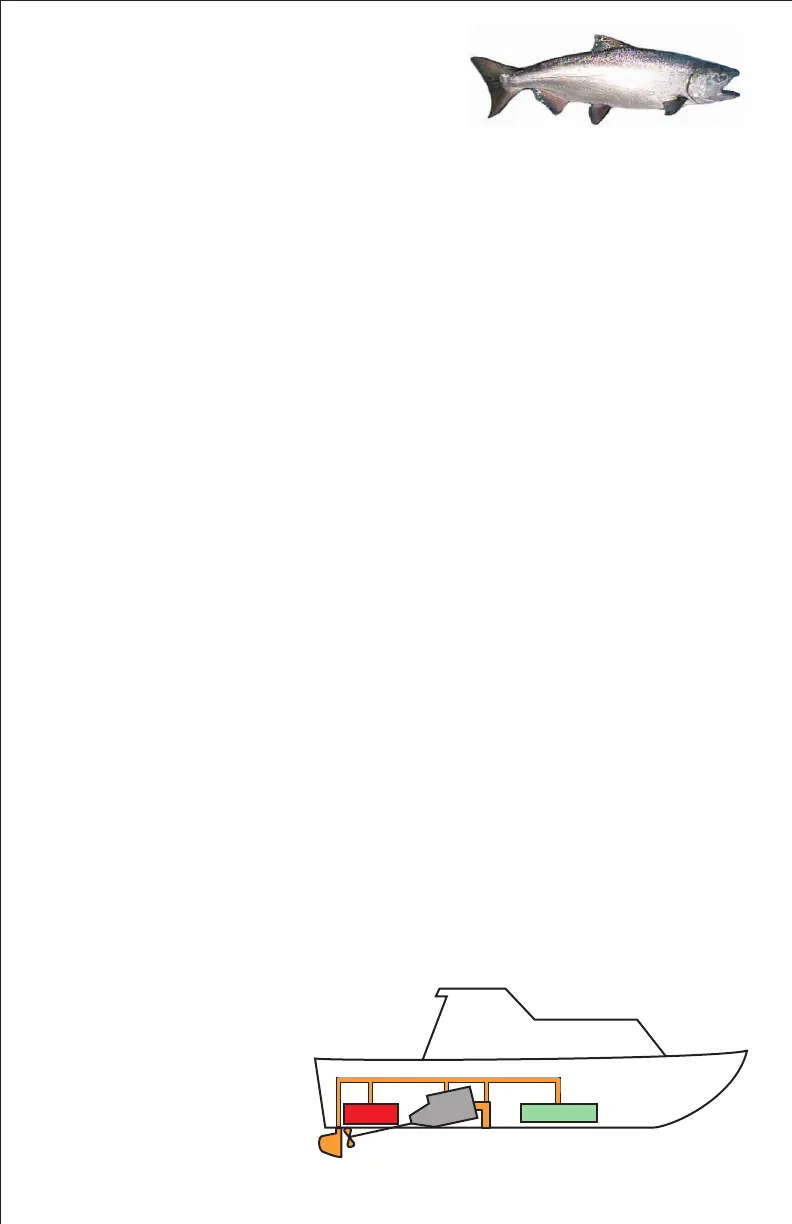
proper protection. Here's how: Inspect the inside your hull. Look for a copper
bonding wire running along the bottom of the hull, connecting all the underwater
metal fittings-engine, fuel tanks, thru hulls, etc. Check that this wire is unbroken
and has clean, tight connections. Check the connections with a voltmeter, by
touching the positive lead to the fitting and the negative lead to the bonding wire.
The meter should show a reading of .010 volts.
Aluminum boats with an outboard should be properly electrically grounded to the
metal hull or bonding strap. An electric start outboard should also be grounded
(connect the negative terminal of the battery to the boat hull). Also test for
continuity to the boat hull or bonding strap as well as the outboard motor. A #10
bonding wire should be installed from the negative terminal to the hull and to the
outboard if there is no continuity. With the boat in the water, lower a downrigger
wire into the water a few feet. Do this away from marinas or docks to avoid stray
electrical currents. Now test the voltage on your downrigger wire. With your
downrigger weight and wire in the water, turn off everything electrical on your
boat. Turn the master connect battery switches off. Connect the negative lead
from your volt meter to the negative battery terminal, the engine or to one of the
bonded metal fittings on the hull. Connect the positive lead to your downrigger
wire near the spool or along the arm. You should get a natural electrolysis
reading of between .7 and .9 volts. If your reading is much outside this range,
you have a problem. Turn
each of the boat's electrical
systems on one at a time,
starting with the battery
switches, then the bilge
pump, engine and than each
of the other electrical devices.
If your natural electrolysis
voltage reading changes by
Bonding Wire
Water Intake
Rudder & Prop
Fuel Tank
Engine
Battery
Page 3


 To Next Page
 Loading...