
 Need help?
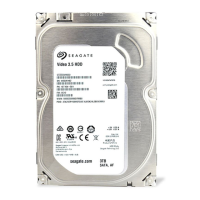
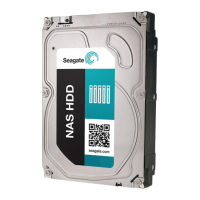
Do you have a question about the Seagate NAS HDD and is the answer not in the manual?
Describes the two types of zones in NAS HDD models: Conventional and Sequential Write zones.
Provides a quick reference table for drive specifications like capacity, heads, and density.
Lists the recording method, density, and interface technology used by the drive.
Covers the power consumption and requirements for the drive.
Details power requirements in watts and amps for spinup, idle, operating, standby, and sleep modes.
Covers temperature, humidity, shock, and vibration specifications for NAS HDDs.
Specifies operating and non-operating ambient temperature ranges for the drive.
Details the operating and non-operating shock levels the drive can withstand.
States the Mean Time Between Failure Rate (MTBF) and operating assumptions.
Provides essential handling and electrostatic discharge (ESD) safety guidelines before installation.
Instructs on drive mounting orientations, screw specifications, and clearance for cooling.
Lists the SATA standard commands that the drive supports, with their command codes.
Explains how to control drive features (e.g., write cache, transfer mode) via this command.
Describes S.M.A.R.T. commands for near-term failure prediction and drive monitoring.
 General
| Interface | SATA 6Gb/s |
|---|---|
| Form Factor | 3.5-inch |
| Operating Temperature | 0°C to 70°C |
| Capacity | 1TB |
| Cache | 64MB |
| Workload Rate Limit | 180TB/year |
| Drive Bays Supported | 1 to 8 |
| MTBF | 1 million hours |
| Power Consumption | 6.8W |
| Non-Recoverable Read Errors | 1 per 10E15 |


 To Next Page