EasyManua.ls Logo

Sealey DBG508 - User Manual

Sealey DBG508
4 pages
Print Icon
To Next Page IconTo Next Page
Loading...
 WARNING! Ensure Health and Safety, local authority and general workshop practice regualations are adhered to when using
tools and equipment.
DONOT use the dial bore gauge if damaged.
DO NOT drop.
This is a precision instrument, always return gauge components to the internally lined storage case.
Maintain the gauge in good and clean condition for best and safest performance.
Keep the work area clean, uncluttered and ensure there is adequate lighting.
Ensure the work area floor is not slippery; wear non slip shoes.
Components to be measured and the dial bore gauge to be stored at room temperature (21°C).
INSTRUCTIONS FOR:
DIAL BORE GAUGE
MODEL NO: DBG508
1. SAFETY
DBG508 Issue: 1 - 19/06/15
Original Language Version
© Jack Sealey Limited
IMPORTANT: PLEASE READ THESE INSTRUCTIONS CAREFULLY. NOTE THE SAFE OPERATIONAL REQUIREMENTS, WARNINGS & CAUTIONS. USE THE
PRODUCT CORRECTLY AND WITH CARE FOR THE PURPOSE FOR WHICH IT IS INTENDED. FAILURE TO DO SO MAY CAUSE DAMAGE AND/OR
PERSONAL INJURY AND WILL INVALIDATE THE WARRANTY. KEEP THESE INSTRUCTIONS SAFE FOR FUTURE USE.
Thank you for purchasing a Sealey product. Manufactured to a high standard, this product will, if used according to these
instructions, and properly maintained, give you years of trouble free performance.
2. INTRODUCTION
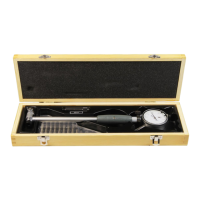
Precision mechanism with Ø55mm dial and locking rotating bezel, offering an accurate method of measuring a bore or detecting a taper or
ovality. Will indicate the deviation from set size by up to 0.8mm with an accuracy of 0.01mm. Included with the bore gauge are; probe body,
dial indicator, anvils, spanner andspacer rings. Supplied in wooden storage case. .
3. SPECIFICATION
Model No: ..............................................................................DBG508
Measuring Range: .................................................................18-35mm
Maximum Deviation Measurement (dial bore gauge): ..............0.8mm
Maximum Deviation Measurement (dial gauge separate): ..........5mm
Dial Bezel Diameter:................................................................Ø55mm
Resolution:...............................................................0.01mm (0.0004")
4. CONTENTS
4.1. There are 3 main components-:
Item Description Qty
1 Dial gauge indicator 1
2 Probe body 1
3 Anvils and spacer rings 1-set
Question and Answer IconNeed help?

Do you have a question about the Sealey DBG508 and is the answer not in the manual?

Summary

Safety

General Safety Precautions

Adherence to safety regulations and proper handling of the precision instrument.

Introduction

Specifications

Contents

Operation

Setting Up the Dial Bore Gauge

Step-by-step guide for assembling and preparing the gauge for use.

Calibration Procedure

Instructions for calibrating the gauge using a micrometer or slip gauges.

Taking Accurate Measurements

Detailed steps for performing accurate bore measurements using the calibrated gauge.

Maintenance

Care and Storage

Guidelines for keeping the dial bore gauge clean, dry, and stored properly.

Summary

Safety

General Safety Precautions

Adherence to safety regulations and proper handling of the precision instrument.

Introduction

Specifications

Contents

Operation

Setting Up the Dial Bore Gauge

Step-by-step guide for assembling and preparing the gauge for use.

Calibration Procedure

Instructions for calibrating the gauge using a micrometer or slip gauges.

Taking Accurate Measurements

Detailed steps for performing accurate bore measurements using the calibrated gauge.

Maintenance

Care and Storage

Guidelines for keeping the dial bore gauge clean, dry, and stored properly.

Overview

The Sealey DBG508 Dial Bore Gauge is a precision instrument designed for accurately measuring bores and detecting taper or ovality. It functions as a comparator, indicating the deviation from a set size rather than providing an absolute measurement.

Function Description:

The core function of the DBG508 is to provide a precise method for internal diameter measurement. It utilizes a precision mechanism with a Ø55mm dial and a locking rotating bezel. The gauge works by comparing the bore's internal diameter to a pre-set size, indicating any deviation. This allows for the identification of inconsistencies such as taper (a gradual change in diameter along the bore's length) or ovality (a non-circular shape of the bore). The instrument is particularly useful for engineers and inspectors who require high accuracy in their measurements.

Important Technical Specifications:

  • Model No: DBG508
  • Measuring Range: 18-35mm (up to 36mm with spacers)
  • Maximum Deviation Measurement (dial bore gauge): 0.8mm
  • Maximum Deviation Measurement (dial gauge separate): 5mm
  • Dial Bezel Diameter: Ø55mm
  • Resolution: 0.01mm (0.0004")
  • Accuracy: Indicates deviation from set size by up to 0.8mm with an accuracy of 0.01mm.
  • Components: The kit includes a probe body, dial indicator, anvils, spanner, and spacer rings, all supplied in a wooden storage case.

Usage Features:

The DBG508 is designed for user-friendly operation, though it requires careful setup and calibration for accurate results.

  • Setting Up:
    • Before use, the bore diameter or gap must be measured to the nearest millimeter using a rule or vernier calipers. The bore or gap should fall within the 18mm to 34mm range (up to 36mm with spacers).
    • Appropriate anvils and spacers must be selected from a provided table based on the target measurement range.
    • The dial bore gauge is assembled with the selected parts, ensuring all components are clean and fitted correctly with the supplied spanner, avoiding overtightening.
    • The dial stylus is inserted into the probe body, causing the dial pointer to rotate clockwise for one complete cycle, indicated by the secondary dial indicator showing "1". The dial stem is then clamped with the thumb screw, again, without overtightening.
    • The nib projection is 1.5mm, with a recommended measurement zone of 0.35mm to 1.15mm.
  • Calibration:
    • Calibration can be achieved using slip gauges, a micrometer, or vernier calipers. The manual suggests using a micrometer for its similar accuracy to the dial gauge.
    • The micrometer is set to the target size (e.g., Ø23.75mm).
    • The gauge anvil and nib are maneuvered inside the micrometer's measuring gap, ensuring the axis is centralized.
    • The large dial pointer's total sweep is observed using the small dial, confirming one full rotation.
    • Once alignment is satisfactory, the dial bezel is rotated until the "0" (zero) aligns with the pointer, and the bezel is locked. This calibrates the gauge for the specific target bore range.
    • Tolerance bands can be set using the two markers on the bezel, by setting one marker at "0" and the other at the desired tolerance (e.g., +5.2 divisions for a +0.052mm tolerance).
  • Accurate Measurement:
    • The bore or gap's machined finish must be clean with a surface texture of 3.2µm to 6.4µm or better.
    • The anvil end is offered into the bore at an angle, with the anvil tip entering just ahead of the sprung loaded self-centering guide.
    • The dial gauge tube is rocked to the horizontal position and beyond, observing the pointer sweep. The three-point location (spring-loaded self-centering guide and anvil tip) ensures proper alignment.
    • The bezel is rotated so that the "0" aligns with the largest sweep position of the pointer.
    • The measurement is then taken by comparing the dial pointer's position to the initial datum "0" reading, counting the 0.01mm divisions. A larger deflection indicates a smaller bore.
    • For taper and ovality measurements, the bore can be measured at different points and orientations, referencing back to the initial datum "0" reading.
  • Safety Precautions:
    • Adhere to Health and Safety, local authority, and general workshop practice regulations.
    • Do not use if damaged.
    • Avoid dropping the instrument.
    • Always return components to the storage case after use.
    • Maintain a clean and well-lit work area with non-slip floors.
    • Store components and the gauge at room temperature (21°C).

Maintenance Features:

Proper maintenance is crucial for the longevity and accuracy of this precision instrument.

  • Cleaning: All components should be kept dry and cleaned with a soft microfibre cloth.
  • Storage: After use, all items must be returned to their presentation case. The gauge should be stored indoors in a temperature-controlled, dry environment, ideally around 21°C.
  • Handling: As a precision instrument, it is intended for use by engineers and engineering inspectors and should be kept out of reach of children.

Sealey DBG508 Specifications

General IconGeneral
BrandSealey
ModelDBG508
CategoryMeasuring Instruments
LanguageEnglish

Related product manuals