Need help?
Do you have a question about the Sealey HVF20PO and is the answer not in the manual?
Check electrical equipment, leads, plugs for safety. Use RCD. PAT test if used commercially.
Ensure cable insulation is safe before connecting to power supply.
Regularly inspect cables/plugs for wear/damage and check connections.
Ensure voltage matches and plug is fitted with the correct fuse.
Disconnect when not in use. Use in dry areas only. Do not touch if in water.
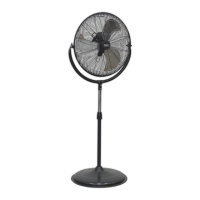
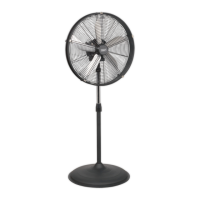
The Sealey Industrial High Velocity Oscillating Fan 20" (Model No: HVF20PO) is designed for moving significant volumes of air, making it suitable for a variety of environments including industrial, commercial, agricultural, workshop, and showroom applications. This fan is engineered for performance and durability, ensuring years of trouble-free operation when used and maintained according to the provided instructions.
The primary function of the HVF20PO fan is to generate a powerful airflow for ventilation and cooling purposes. It features three-speed settings, allowing users to select the desired airflow intensity to suit different needs and environments. The fan is equipped with fully guarded blades for safety and includes an oscillation feature to distribute air across a wider area. Its height-adjustable stand and tilting blade cradle provide flexibility in directing the airflow precisely where it's needed. The large diameter base ensures stability during operation, even at higher speeds.
Before using the fan, it is crucial to ensure all electrical safety guidelines are followed. The fan operates on a standard mains supply and is fitted with a BS1363/A 13 Amp 3-pin plug. Users must verify that the insulation on all cables and the appliance itself are safe, and regularly inspect power supply cables, plugs, and connections for any wear or damage. An RCD (Residual Current Device) is recommended for enhanced electrical safety. It is important to ensure the voltage rating of the appliance matches the power supply and that the correct fuse is fitted. The fan should never be pulled or carried by its power cable, nor should the plug be pulled from the socket by the cable. Any worn or damaged cables, plugs, or connectors must be repaired or replaced immediately by a qualified electrician.
Assembly of the fan involves bolting the bottom tube to the base, placing the fan head assembly onto the upper tube, and securing it with two bolts. The height of the fan can be adjusted by loosening the collar on the tube, sliding it to the desired height, and then retightening. Similarly, the angle of the fan head can be adjusted by loosening the head clamp, moving the head to the desired position, and retightening the clamp.
To operate the fan, it should be placed on a level, dry surface. After plugging the power cord into the mains supply, the fan's three speeds can be selected using the switch located at the back of the fan. The fan speed increases as the switch is turned in a clockwise direction. To initiate the oscillation feature, the control button should be pressed down. To stop the oscillation, the button should be lifted.
The fan is designed for indoor use only and should not be used in wet areas or areas with high condensation, such as showers or pools. If the fan accidentally falls into water or any other liquid, it must be immediately switched off and disconnected from the mains power supply before touching it. When moving the fan from one location to another, it should always be disconnected from the power supply, and it must be ensured that the fan stands on a level surface. Due to its powerful airflow, users should ensure that no materials or items that could be blown about are in the path of the air stream. The fan should not be operated in environments with harmful, explosive, or flammable gases, fumes, or hazardous substances. Objects should never be inserted through the fan guard, and the fan should not be covered during use. Immersion of the fan in water or any other liquid is strictly prohibited. Children should not be allowed to operate the fan, and it should not be placed where it could be easily knocked over or where the lead could cause a person to trip. The fan is not intended for outdoor use. Modifying the speed control or attempting to fit any additional external speed control device is not permitted. When not in use, the fan should be covered to protect it from dust and stored in a safe, dry, childproof location.
Regular maintenance is essential to ensure the fan's continued performance and longevity. Before any cleaning or maintenance, the control switch must be turned to OFF, and the fan must be disconnected from the power supply. The fan should be cleaned using only a soft, damp cloth. Solvents or other chemicals should not be used for cleaning. It is critical never to immerse the fan in water or allow water to drip into the motor housing.
To clean the fan blades, the seven clips around the guards should be loosened, and the front guard should be lifted off from the top hook. The blades and guards can then be wiped clean. For reassembly, the front guard should be hooked into place at the top of the rear guard, and then the seven clips should be pushed back into place to engage both the front and rear guards securely.
For electrical components or motor service, an authorized service agent should be contacted. Only recommended parts should be used for repairs, as unapproved parts can be dangerous and will invalidate the warranty. The fan should be kept clean and maintained in good condition.
At the end of its working life, the product must be disposed of in compliance with the EU Directive on Waste Electrical and Electronic Equipment (WEEE). It should be disposed of in an environmentally protective way, and local solid waste authorities should be contacted for recycling information. Unwanted materials should be recycled instead of being disposed of as waste. All tools, accessories, and packaging should be sorted and taken to a recycling center. If the product becomes completely unserviceable and requires disposal, any fluids (if applicable) should be drained into approved containers and disposed of according to local regulations.
 General
| Model | HVF20PO |
|---|---|
| Type | Pedestal Fan |
| Voltage | 230V |
| Frequency | 50Hz |
| Blade Size | 20 inch |
| Speed Settings | 3 |
| Oscillation | Yes |
| Height Adjustable | Yes |
| Fan Diameter | 20 inch |

 To Next Page