Need help?
Do you have a question about the Sealey SCF8W and is the answer not in the manual?
Essential electrical safety precautions, including RCD usage, cable integrity, and plug wiring.
General safety advice for fan operation, maintenance, and storage.
Guidelines for appliance use by individuals with reduced capabilities and child supervision.
Instructions on how to mount the fan using the clamp or wall mount and adjust its position.
Steps for plugging in the fan and operating the speed control switch.
Procedures for cleaning the fan using a damp cloth and avoiding solvents.
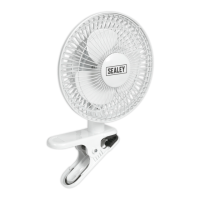
This document describes the Sealey Products Clip-On Fan 2 Speed 8" 230V, Model No: SCF8W.
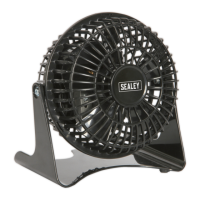
The Sealey SCF8W is a clip-on fan designed to provide optimum air circulation. It features a tilt and swivel head, allowing for flexible positioning to direct airflow. The fan is equipped with fully guarded blades for enhanced safety during operation. A smooth-running motor powers the fan blades, and a switch control offers two speed settings for ease of use. The fan can be used as a clip-on device, attaching to suitable surfaces, or it can be wall-mounted using keyhole slots on its clamp.
The manual emphasizes the importance of electrical safety. Users are responsible for ensuring all electrical products are safe before use, checking power cables, plugs, sockets, and connectors for wear or damage. The risk of electric shock should be minimized by installing appropriate safety devices. A Residual Current Circuit Breaker (RCCB) should be incorporated into the main distribution board, and a Residual Current Device (RCD) is also recommended, especially with portable products not protected by an RCCB. If in doubt, a qualified electrician should be consulted.
The Electricity at Work Act 1989 requires all portable electrical appliances used in business premises to be tested by a qualified electrician using a Portable Appliance Tester (PAT) at least once a year. The Health & Safety at Work Act 1974 makes owners responsible for the safe condition of appliances and the safety of operators.
Insulation on all cables and the appliance must be safe before connecting to the power supply. Cables must be protected against short circuit and overload. Power supply cables and plugs should be regularly inspected for wear or damage, and all connections checked for looseness. The voltage marked on the appliance must match the power supply, and the plug must be fitted with the correct fuse.
Users must NOT pull or carry the appliance by the power cable, nor pull the plug from the socket by the cable. Worn or damaged cables, plugs, or connectors must not be used and should be immediately repaired or replaced by a qualified electrician. If a BS 1363/A UK 3-pin plug is damaged, the cable should be cut just above the plug and disposed of safely. A new plug must be fitted according to specific instructions:
Products requiring more than 13 amps are supplied without a plug, necessitating contact with a qualified electrician to ensure a suitably rated supply is available. The installation of an industrial round pin plug and socket is recommended.
If an extension reel is used, it must be fully unwound before connection. An RCD-fitted reel is preferred. The cable core section should be at least 1.5mm², but 2.5mm² section cable is recommended to ensure suitability for this product and other appliances that may be used with it.
This appliance is not intended for use by persons (including children) with reduced physical, sensory or mental capabilities or lack of experience and knowledge, unless they have been given supervision or instruction concerning the use of the appliance by a person responsible for their safety. Children should be supervised to ensure they do not play with the appliance.

 To Next Page
 General