225Checking and refilling levels
– Wait two minutes.
– Pull out the dipstick. Wipe the dipstick with a clean cloth and
insert it again, pushing it in as far as it will go.
– Then pull it out once more and check the oil level ⇒ fig. 144.
Top up with engine oil if necessary.
Oil level in area
A
No oil should be added ⇒ .
Oil level in area
B
It is not necessary to add oil, but some can be added if care is taken to
ensure that the level does not exceed area
A
.
Oil level in area
C
Oil must be added. Afterwards, the oil level should be in the lined area
B
.
Depending on how you drive and the conditions in which the vehicle is
used, oil consumption can be up to 0.5 l/1000 km. Oil consumption is likely
to be higher for the first 5000 km. For this reason the engine oil level must
be checked at regular intervals, preferably when filling the tank and before
a journey.
WARNING
Any work carried out in the engine compartment or on the engine must
be carried out cautiously.
● When working in the engine compartment, always observe the safety
warnings ⇒ page 220.
–
–
–
CAUTION
If the oil level is above the area
A
do not start the engine. This could result
in damage to the engine and catalytic converter. Contact an Authorised
Service Centre.
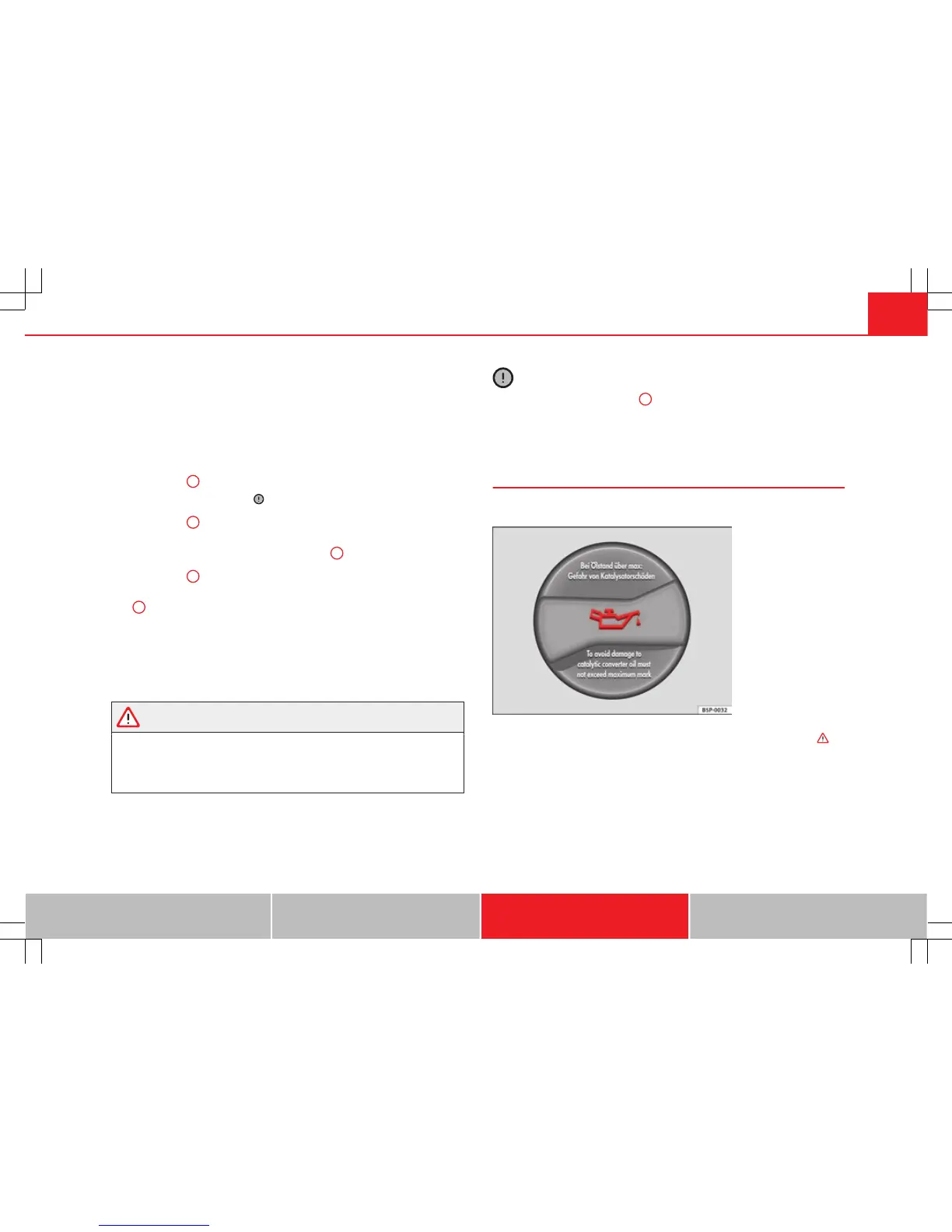
Topping up engine oil
Top up gradually with small quantities of oil.
Fig. 145 In the engine
compartment: Engine oil
filler cap
Before opening the bonnet, read and observe the warnings ⇒
in
Safety instructions on working in the engine compartment on
page 220.
– Unscrew cap from oil filler opening ⇒ fig. 145.
– Top-up oil in small amounts, using the correct oil.
Safety First Operating Instructions Practical Tips Technical Specifications


 To Next Page