- 8 - Copyright © 2019, Fast ČR, a.s. 09/2019
More information can be found in chapter "Cleaning and maintenance".
Always use good quality clean cold water.
Store coffee beans or ground coffee in acool, dry place. After opening
apacket, take care to reseal it well and consume the coffee within
two weeks. It is better to purchase smaller packets of ground coffee
or coffee beans.
To achieve an even more delicious flavour, prepare coffee from freshly
ground coffee beans.
Do not prepare coffee from already used ground coffee.
CLEANING AND MAINTENANCE
Disconnect the power plug from the power socket and allow the
appliance to cool down before cleaning it.
For cleaning, do not use cleaning products with an abrasive effect,
solvents, etc. that could damage the appliance. No part of this appliance
is intended for washing in adishwasher.
Warning:
To prevent the risk of injury by electrical shock, do not
submerge the appliance, power cord or power plug in
water or any another liquid.
Cleaning the filter and holder
Before taking out the holder A3, permanent filter A2 and permanent
filter lid A1, make sure that all the parts have cooled down completely.
These parts may be very hot during the coffee brewing process as well
as afterwards. Remove the used coffee out of the permanent filter A2.
This can be thrown out with household waste or composted.
Carefully wash the permanent filter lid A1, permanent filter A2 and
filter holder A3 in warm water with asmall amount of neutral kitchen
detergent. Rinse under clean running water and dry thoroughly.
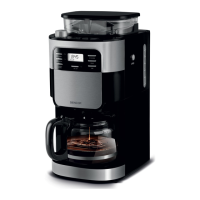
Cleaning the glass kettle and lid
Pour any unused coffee out of the kettle A6 and allow it to cool down
completely. It is important to clean the kettle A6 after every use. This
will prevent the formation of deposits, which may negatively affect the
flavour of the brewed coffee and shorten the lifespan of the kettle A6.
Rinse out the glass kettle A6 with warm water and wash it in warm water
with asmall amount of kitchen detergent. Rinse under clean running
water and dry thoroughly.
Cleaning the outer surface of the coffeemaker
Before cleaning the outer surface, make sure that the coffeemaker has
cooled down completely, especially the hotplate A14. Wipe the outer
surface of the coffeemaker, including the hotplate using asponge lightly
dipped in warm water. Wipe dry using aclean wiping cloth.
Removing limescale deposits
Over time, limescale deposits may form in the coffeemaker, which
may negatively affect the flavour of the brewed coffee and shorten
the lifespan of the coffeemaker. It is important to regularly remove
limescale deposits.
1.
Pour asolution of water and descaling agent into the water tank A12
up to the maximum mark. Follow the instructions on the packaging
of the agent.
Note:
The descaling agent can be purchased in ordinary retail
chains. Always use adescaling agent intended for home
coffeemakers. Alternatively, citric acid or an 8% white
vinegar solution in the recommended 2:1 ratio.
2. Place the kettle A6 on the hotplate A14.
3. Press the GRIND OFF B11 button to skip the coffee grinding phase.
Indicator light B10 will turn on.
4.
Press the ON / OFF B8 button. The Power On indicator light B7
will be lit.
5. After ashort moment the solution will start dripping into the kettle
A6.
6.
Wait until all the water in the water tank flows through the filter
into the glass kettle.
7.
Abeep is made when the water tank is empty. Pour the solution out
of the kettle and rinse it out.
8. Pour clean cold water into the water tank A12 up to the maximum
mark and again allow all the contents of the water tank to flow
through the coffeemaker.
Storage
When not using the appliance for an extended period of time, disconnect
the power plug from the power socket, allow the appliance to cool
down and clean it according to the instructions in chapter "Cleaning
and maintenance".
Before storing it, check that the appliance and all its accessories are
thoroughly clean and dry.
Store the appliance in adry, clean and well-ventilated location not
exposed to extreme temperatures and out of children'sreach.
TECHNICAL SPECIFICATIONS
Rated voltage range .........................................................................220 – 240V~
Rated frequency ..............................................................................................50Hz
Rated power input .........................................................................................900W
Noise level .................................................................................................... 83 dB(A)
The declared noise emission level of the appliance is 83dB(A), which
represents alevel Aof acoustic power with respect to areference acoustic
power of 1pW.
Changes to text and technical parameters are reserved.
INSTRUCTIONS AND INFORMATION REGARDING THE
DISPOSAL OF USED PACKAGING MATERIALS
Dispose of used packaging material at asite designated for waste in
your municipality.
DISPOSAL OF USED ELECTRICAL AND ELECTRONIC
EQUIPMENT
This symbol on products or original documents means that
used electric or electronic products must not be added to
ordinary municipal waste. For proper disposal, renewal and
recycling hand over these appliances to determined
collection points. Alternatively, in some European Union
states or other European countries you may return your
appliances to the local retailer when buying an equivalent
new appliance.
Correct disposal of this product helps save valuable natural resources
and prevents potential negative effects on the environment and human
health, which could result from improper waste disposal. Ask your local
authorities or collection facility for more details.
In accordance with national regulations penalties may be imposed for
the incorrect disposal of this type of waste.
For business entities in European Union states
If you want to dispose of electric or electronic appliances, ask your retailer
or supplier for the necessary information.
Disposal in other countries outside the European Union.
This symbol is valid in the European Union. If you wish to dispose of this
product, request the necessary information about the correct disposal
method from the local council or from your retailer.
This product meets all the basic requirements of EU directives
related to it.


 To Previous Page
 Loading...