EasyManua.ls Logo

Sencore TF151 - FET Modes of Operation; Measuring FET Transconductance (Gm); Gm Measurement Setup and Procedure

Default Icon
24 pages
Print Icon
To Next Page IconTo Next Page
To Previous Page IconTo Previous Page
Loading...
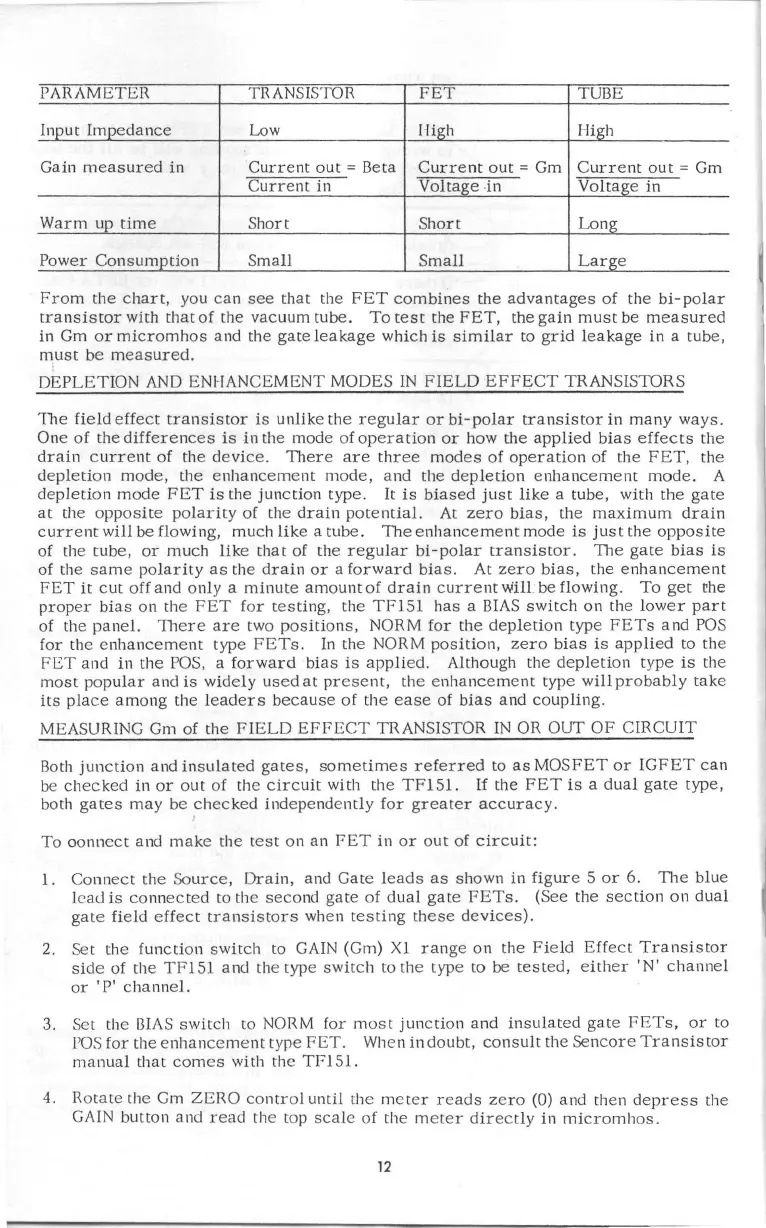
PARAMETEH TRANSISTOR
FET
TUBE
Input
Impedance
Low High
High
Gain
measured
in
Current
out
= Beta
Current
out
= Gm
Current
out
= Gm
Current
in
Voltage
in
Voltage
in
Warm
up
time
Short
Short
Long
Power
Consumption
Small
Small
Large
From
the
chart,
you
can
see
that
the
FET
combines
the
advantages
of
the
bi-polar
transistor
with
that
of
the
vacuum
tube.
To
test
the
FET,
the
gain
must
be
measured
in Gm
or
micromhos
and
the
gate
leakage
which
is
similar
to
grid
leakage
in
a tube,
must
be
m
eas
ured.
DEPLETION
AND ENHANCEMENT MODES
IN
FIELD
EFFECT
TRANSISTORS
111e
field
effect
transistor
is
unlike
the
regular
or
bi-polar
transistor
in
many
ways.
One
of
the
differences
is
in
the mode of
operation
or
how the
applied
bias
effects
the
drain
current
of
the
device.
111ere
are
three
modes
of
operation
of
the
FET,
the
depletion
mode,
the enhanc
ement
mode,
and the
depletion
e
nhancement
mode.
A
depletion
mode
F
ET
is
the
junction
type.
It
is
biased
just
like
a tube, with
the
gate
at
the
opposite
polarity
of the
drain
potential.
At
zero
bias,
the
maximum
drain
current
will
be flowing,
much
lik
e a
tube.
The
enhancement
mode
is
just
the
opposite
of the
tube,
or
much
like
that
of the
regular
bi-polar
transistor.
The
gate
bias
is
of the
same
polarity
as
the
drain
or
a
forward
bias.
At
zero
bias,
the
enhancement
FET
it
cut
off
and
only
a
minute
amount
of
drain
current
will. be flowing.
To
get
rhe
proper
bias
on
the
FET
for
testing,
the
TF151
has
a
BIAS
switch
on
the
lower
part
of the
panel.
There
are
two
positions,
NORM
for
the
depletion
type
FETs
and
POS
for
the e
nhancem
e
nt
type
FETs.
In the NORM
position,
zero
bias
is
applied
to
the
FET
and
in
the
POS, a
forward
bias
is
applied.
Although the
depletion
type
is
the
most
popular
and
is
widely
used
at
present,
the en
hancem
ent
type
will
probably
take
its
pla
ce
among
the l
eaders
because
of
the
ease
of
bias
and
coupling
.
MEASUHING Gm of the
FIELD
EFFECT
TRANSISTOR
IN
OR OUT
OF
CIRCUIT
Both
junction
and
insulated
gates,
sometimes
referred
to
as
MOSFET
or
IGFET
can
be
checked
in
or
out
of
the
circuit
with
the
TFlSl.
If the
FET
is
a
dual
gate
type,
both
gates
may
be
checked
independently
for
greater
accuracy
.
,
To
oonnect
and
make
t
he
test
on
an
PET
in
or
out
of
circuit:
1.
Connect
the
Source,
Drain,
and
Gate
leads
as
shown in
figure
5
or
6.
111e
blue
!cad
is
co
nn
ected
to the
seco
nd
gate
of
dual
gate
FETs.
(See
the
section
on
dual
gate
field
effect
transistors
when
testing
these
devices).
2.
Set the
function
switch
to
GAIN
(Gm)
Xl
range
on
the
Field
Effect
Transistor
side
of the
TF
lSl
and
the type
switch
to the
type
to be
tested,
e
ith
er
'N'
channel
or
'P'
channel.
3. Set the
BIAS
sw
it
ch to
NOHM
for
m
ost
junction
and
insulated
gate
FETs,
or
to
POS
for
the
enhance
m
ent
type
FET.
When
in
doubt,
consult
the
Sencore
Transistor
manual
that
comes
with
the
TP151.
4.
Hotate
the Gm
ZEHO
co
ntr
ol until the
meter
reads
zero
(0) and then
depress
the
GAIN
button
a
nd
read
the top
scale
of
the
meter
directly
in
micromhos
.
12

Related product manuals