VP400 Series Video Pro Form7343A Operation Manual
24
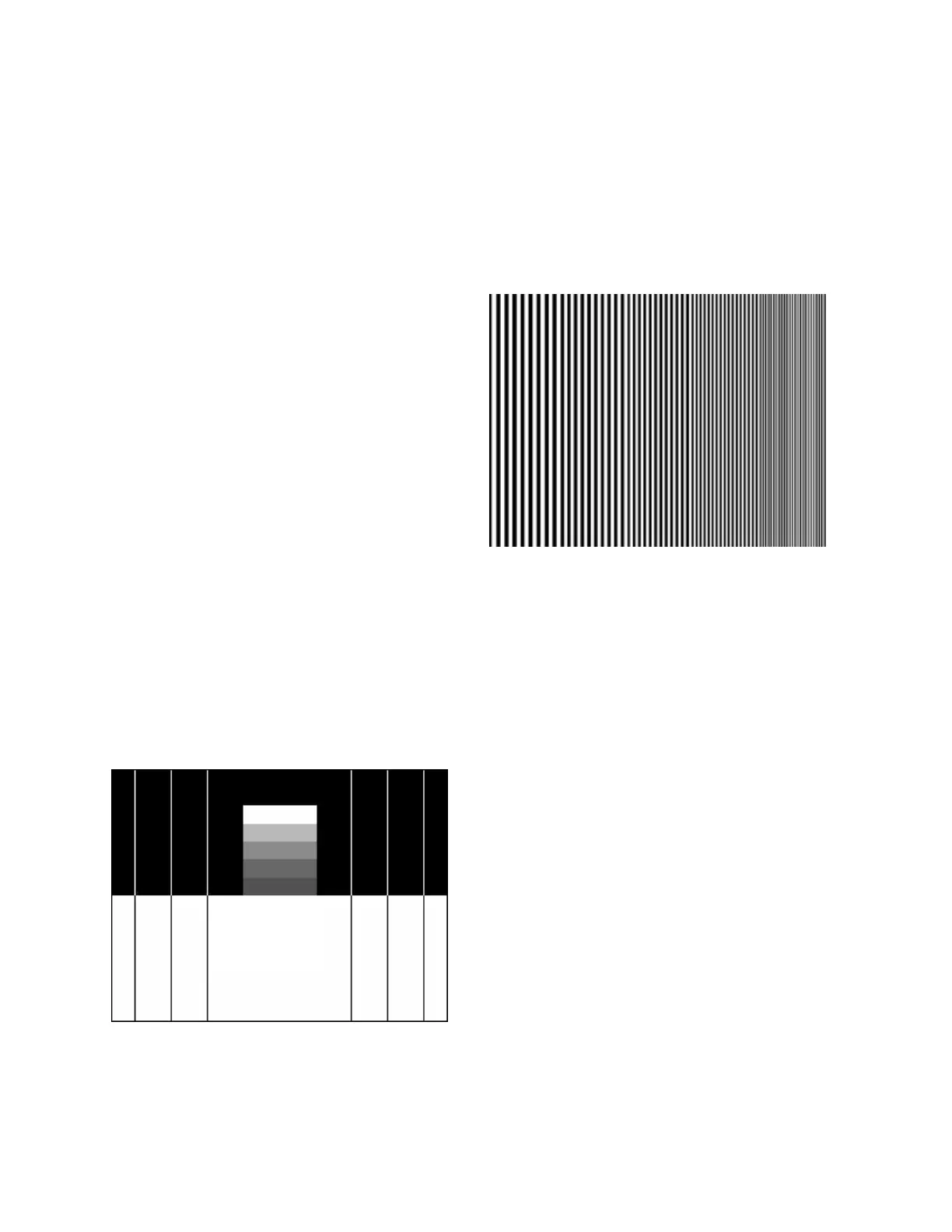
Multiburst
Pattern Description:
The Multiburst pattern consists of five equal-width vertical segments. Vertical segments are
filled with alternating black and white stripes of one, two, three, four, and five pixel spacing
(right to left). This pixel spacing directly corresponds to the horizontal resolution of the format
being displayed. If, for example, the horizontal resolution of the current format is 640, the one
pixel spacing is such that, if it were continued across the entire screen, there would be 320 white
and 320 black stripes.
Pattern Usage:
Use to check a display device’s capability to
produce sharply defined stripes, at equal
brightness, up to the format’s full resolution.
This pattern is also useful in adjusting the
sharpness control. Starting with the sharpness
control at its minimum setting, increase the
control until all five bursts are at equal
brightness levels. Do not adjust the control high
enough to cause ghosting lines adjacent to the
widest stripes.
Needle
Pattern Description:
This pattern is black on top and white on bottom with lines (needle pulses) drawn from top to
bottom on each side of the pattern, through the black/white transition. Electrically, the needle
pulse lines are the same width on the top and the bottom of the pattern. A five-step grayscale is
positioned on the center of the upper black pattern area. The top grayscale block is 100% white.
Pattern Usage:
This pattern makes it easy to detect whether scan
velocity modulation (SVM) is enabled on a
display device. If SVM is enabled, the black lines
on the bottom of the pattern will be thicker than
the white lines on the top of the pattern.
This is also a good pattern for properly adjusting
the contrast/picture/white level control for
maximum white luminance level on a CRT-type
display (use the HiLoTrk pattern for non-CRT
displays). If the contrast/picture control is adjusted
for a higher white level than the CRT display
device is capable of producing properly, one of a number of distortion effects will be observed;
blooming, raster distortion, or yellowed whites.
Blooming in CRT displays results in light from very bright pixels (phosphors) spilling over to
adjacent pixels. This causes bright picture areas to become defocused and slightly larger than



 To Next Page