5. Wireless audio is always the lowest priority use of any given frequency. If another
type of device is on the same frequency we are, it has more right to the frequency than
we do and we need to find another frequency. This is as true for major motion pictures
as it is for student productions.
6. Fewer frequencies are available for wireless audio than there used to be, and the
spectrum is getting more crowded than ever. This trend is continuing, so a frequency
1
available today in a given place might not be available tomorrow.
7. Monitor wireless audio closely at all times for interference and loss of signal.
Someone could turn on a device near you that wasn't on when you started the set-up.
8. How long a mic cable do you have in case you can’t find any open frequencies?
Unlikely but entirely possible.
9. Watch battery levels closely and bring fresh spare batteries.
What frequencies does our gear operate on?
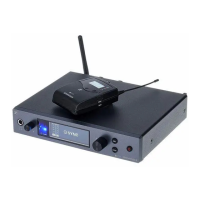
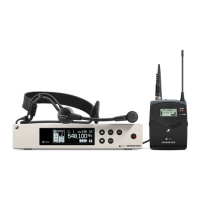
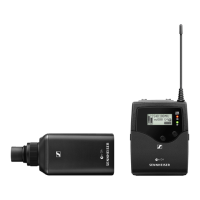
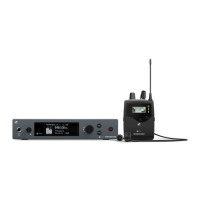
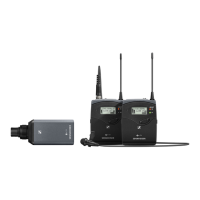
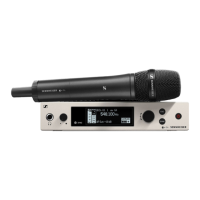
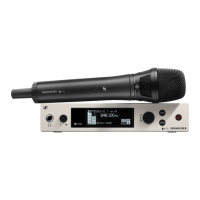
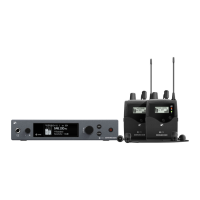
Our wireless audio equipment (field and studio) operates on one of three bands, which
Sennheiser calls AW+, A, and GW1:
Field Production
Wireless Audio
Studio A
Wireless
Audio Cart
Studio B
Wireless
Audio Cart
As of this writing, it’s legal to use our gear at full power (50 mW) anywhere in the United States
on any unused frequency in these ranges.
Finding an unused frequency
The good news is that our equipment can scan what frequencies are free or in use wherever
you are at the moment and pick the best one. Here’s how to do that with our field equipment:
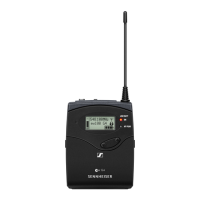
1. Make sure you have the receiver in hand, not the transmitter, and all other wireless
equipment is turned off.
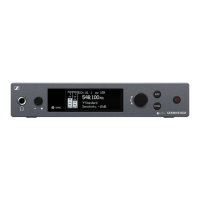
2. Open the door on the front of the receiver you want to tune and press the ON/OFF
button. The blue screen will light up and show you a control panel.
1
The electromagnetic spectrum is a broad range of frequencies: VHF, UHF, microwaves, infrared, visible,
and ultraviolet light, x-rays, and deadly gamma rays. Parts of the VHF band (30–300 MHz) and UHF band
(300 MHz–3 GHz) are used for public safety, air traffic control, marine band radios, broadcast television
and radio, Wi-Fi, Bluetooth, cordless phones, two-way radios, and wireless audio. In the United States,
the Federal Communications Commission regulates what devices can use which parts of the
electromagnetic spectrum.
9/18/2018 rev. 10/11/2024 p. 3



 To Next Page