
 Need help?
Do you have a question about the Sennheiser SL MCR DW and is the answer not in the manual?
Displays status information for the device or individual channels.
Provides analog audio output and is suitable for Phoenix Contact connectors.
Restores factory settings by holding for 5 seconds.
Outputs digital audio signals via the Dante interface.
Outputs digital audio, provides PoE, and handles network configuration.
Utilizes Dante interface with two RJ-45 sockets for digital audio and redundant output.
Uses the Analog Out socket for analog audio signal output.
Crucial safety guidelines for physical mounting and electrical installations by specialists.
Instructions for wall mounting using the supplied frame and appropriate hardware.
Steps for mounting the receiver on the ceiling using the supplied frame and suitable anchors.
Attaching the receiver to a standard microphone stand using the mounting frame's thread.
Mounting the receiver onto a VESA 100 mount using the mounting frame's holes.
Details on powering the receiver via PoE and its automatic startup.
Using Sennheiser Control Cockpit software for device operation and configuration.
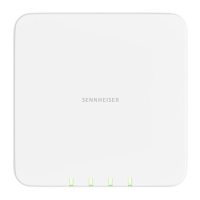
Explains what all LEDs indicate for the entire device status.
Describes LED status for each individual channel's radio connection.
The Sennheiser SL MCR DW is a versatile receiver designed to handle both analog and digital audio signals, offering flexible connectivity and control options for professional audio environments.
The primary function of the SL MCR DW is to receive audio signals and output them in either analog or digital formats. It supports Power over Ethernet (PoE) for power supply, simplifying installation by eliminating the need for a separate power cable. The device can be controlled and monitored via a network using Sennheiser Control Cockpit software, providing comprehensive management capabilities.
The receiver provides a 3-pin Analog Out socket for analog audio output, compatible with Phoenix Contact MCVW 1.5-3-ST-3.81 connectors. For digital audio, it features a Dante™ interface with two RJ-45 sockets (Dante I and Dante II), supporting redundant output for enhanced reliability. These Dante ports also facilitate network control and configuration.
The Dante II / PoE / Ctrl RJ-45 socket serves multiple purposes: it provides PoE supply for powering the receiver, acts as a digital audio output, and enables configuration and control via the network. This integrated approach streamlines cabling and setup. The receiver automatically powers on when PoE is supplied, and there is no separate on/off switch.
The SL MCR DW is primarily operated and configured using the free Sennheiser Control Cockpit software, which can be downloaded from the Sennheiser website. This software allows for comprehensive control and monitoring of the receiver via a network, eliminating the need for direct interaction with the device itself. The online help within the software provides detailed information on its functions and how to configure the SL MCR DW and the network. A one-time registration with an email address is required to receive the software activation code.
The receiver features status LEDs that provide visual feedback on the device's operational status and the status of individual microphone channels.
The SL MCR DW offers flexible mounting options to suit various installation needs:
Firmware updates for the receiver are performed using the Sennheiser Control Cockpit software. Detailed instructions for this procedure can be found in the software's instruction manual, available in the Sennheiser Documentation app or the download area of the Sennheiser website.
A "Reset" button is provided on the device to restore factory settings. This button should be held for 5 seconds to initiate the reset process.
The SL MCR DW is designed for professional use, offering robust audio capabilities, simplified power and network integration, and comprehensive remote management through dedicated software. Its flexible mounting and clear status indicators contribute to its ease of use and reliability in various audio setups.
 General
| Signal-to-Noise Ratio | > 90 dB(A) |
|---|---|
| Power Supply | 12 V DC |
| Dimensions | Approx. 212 x 168 x 43 mm (8.35" x 6.61" x 1.69") |
| Weight | Approx. 1020 g (35.97 oz) |
| THD | < 0.1% |
| Total Harmonic Distortion | < 0.1% |
| Operating Range | Up to 100 meters |
| Operating Temperature | -10 °C to +55 °C |
| Audio Frequency Response | 20 Hz - 20 kHz |




 To Next Page