10
Installation and Maintenance
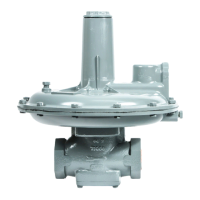
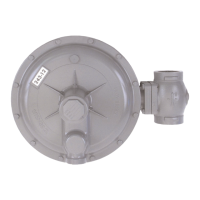
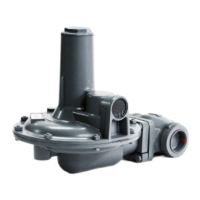
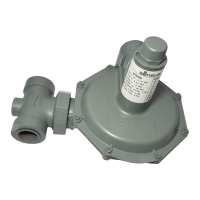
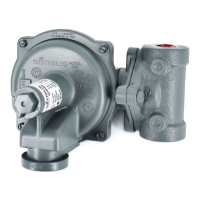
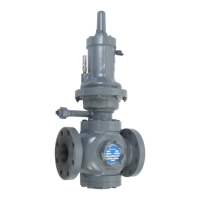
Model 121 Regulators
Servicing – 3/4", 1", 1-1/4"
Back Pressure Models General Instructions
1. Make sure the regulator is entirely depressured before servicing.
2. Carefully note location and position of all disassembled parts
to be certain reassembly is correct. Inspect each one carefully
and replace those that are worn or damaged or otherwise
unsatisfactory.
3. A moderate application of lubricant to O-Ring 13 will help
assure free stem movement and a tight seal. Similar application
of lubricant to the other O-Rings or Tetraseals will help assure
their tightness. Do not use petroleum base lubricants.
4. Bolted connections should be tightened evenly and firmly.
Carefully tighten diaphragms into place. Bolts must be tight
enough to prevent leakage, but not so tight that the diaphragm
material is crushed or damaged.
5. Upon completion of servicing, make certain that regulator
installation is entirely free of leaks.
To Service Valve – 15
1. Remove bolts 29 and remove upper case assembly.
2. Remove Retaining Ring 16a.
3. Remove both halves of valve holder 16b.
4. Remove valve 15 (washer 14A and holder 14B will likely
remove with the valve. Retain for reassembly).
– To reassemble, replace parts in reverse sequence
.
To Service Main Diaphragm – 11d
1. Remove top cap 1, and release and remove adjustment 3.
On high pressure model remove cap 1a, release adjustment 3a,
and remove cover 5 and button 7a. Mark or measure position
of adjustment 3 or 3a. Use this to return adjustment to
this setting during reassembly.
2. Remove spring 9.
3. Remove bolts 22, nuts 23, and upper case 21.
4. Rotate diaphragm assembly 11 counterclockwise
(this unscrews 11h from 12) and remove.
5. To disassemble diaphragm assembly, remove nut 11a.
Carefully note location and position of all parts to be certain
of correct reassembly. Abrasive side of emery cloth washers
face against diaphragm.
– To reassemble, replace parts in reverse sequence.
Make sure the screwed connection between 11h and 12d is
loose by approximately 1/2 turn. To do this, carefully rotate
diaphragm assembly 11 clockwise until this screwed connection
bottoms (do not jam it together). Then, back-off diaphragm
assembly 11 counterclockwise approximately 1/2 turn.
The 11h to 12d screwed connection must not be tight.
To Service Orifice – 20
1. Remove top cap 1, and release and remove adjustment 3.
On high pressure model remove cap 1a, release adjustment
3a, and remove cover 5 and button 7a. Mark or measure
position of adjustment 3 or 3a. Use this to return adjustment
to this setting during reassembly.
2. Remove spring 9.
3. Remove bolts 38 and bottom cap 37 along with Tetraseal 32.
4. Unscrew orifice 20 using 1-5/8" hex socket wrench.
When replacing orifice use a moderate amount of pipe
dope on orifice threads.
– To reassemble, replace parts in reverse sequence.
To Service Seal Diaphragm – 12b
1.
Remove bolts 29, upper case assembly
, and then remove
seal diaphragm, and stem assembly 12.
2. To disassemble 12, screw piston 12a from stem 12d.
Use a spanner wrench in notch in skirt of piston
(this can also be done by inserting a standard 7/32"
Allen wrench in the notch).
– To reassemble, replace parts in reverse sequence.
Make certain that fabric side of seal diaphragm 12b faces
upward and “rubber” side faces downward toward body.
Do not pinch loop in seal diaphragm 12b between 35
and centerpiece 27.
Periodic Inspection:
Regulators are pressure control devices with numerous moving
parts subject to wear that is dependent upon particular operation
conditions. To assure continuous satisfactory operation,
a periodic inspection schedule must be adhered to with the
frequency of inspections, determined by the severity of service
and applicable laws and regulations.


 To Next Page
 Loading...