Need help?
Do you have a question about the SGM Giotto spot 400 and is the answer not in the manual?
Read carefully for safe installation, use, and maintenance; follow all warnings.
Lists available accessories and explains the meaning of important safety symbols used in the manual.
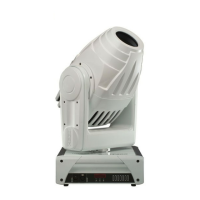
Introduction to the Giotto Spot as an innovative professional moving head spot for high-profile shows.
Details the lamp, effects, movement, ballast, optics, display, signal, and mounting systems of the fixture.
Detailed electrical and mechanical parameters covering power, lamp specs, optics, and physical dimensions.
Information regarding manual updates, verifying supplied items, and handling of packing material.
Step-by-step instructions for safely accessing the internal components of the fixture.
Critical safety warnings and practical steps for installing the lamp into the fixture.
Instructions for installing and replacing gobos and performing lamp alignment.
Guides on fitting/removing gobo adapters and installing or replacing color filters.
Instructions for power cable wiring, power supply connection safety, and fixture mounting safety guidelines.
Guidelines for positioning the fixture and securing it using mounting clamps and safety chains.
Specifications for DMX signal cable construction and DMX termination procedures.
Diagram illustrating the wiring for an RS232 connection using 5-pin XLR connectors.
Introduction to the fixture's microcomputer for customization, information retrieval, and menu navigation.
Configuring the fixture's DMX address, Pan movement direction, and Pan movement range limits.
Configuring Tilt movement direction, Tilt limits, and inverting Pan/Tilt controls.
Monitoring lamp elapsed time, lamp strike count, and fixture operating hours for maintenance.
Selecting the input signal type (DMX/RS232) and defining movement resolution (8/16-bit).
Configuring remote reset, movement speed, display brightness, orientation, and DMX delay.
Managing shutter lock, setting/restoring default parameters, and calibrating wheel starting positions.
Executing test programs for fixture diagnostics and understanding reserved functions.
Control of Pan and Tilt axes using MSB and LSB DMX channels for precise positioning.
Detailed control of the iris aperture for beam diameter adjustment, featuring speed and low noise.
Explanation of the five different operating modes for the color wheel, including Full, Half, Soft, Rainbow, and Music Change.
Controls for selecting rotary gobos, gobo scrolling speed, and music synchronization.
Control of the shutter for blackout effects and strobe functionality, including sync with music.
Linear regulation of luminous power using the dimmer channel for smooth light output.
Control of gobo rotation speed and positioning, including direction and indexing modes.
Selection of the two available rotary prisms (Comet, 4-Facet) for projecting multiple images.
Control of the rotation speed and direction for the selected prisms.
Precise linear focusing for sharp projections or blurred effects, with coated side outwards for dichroic gobos.
Adjusting the beam angle from 9° to 24°, maintaining gobo focus.
Selection of fixed gobos and open position on the effects wheel, combinable with rotary gobos.
Linear adjustment of the frost effect, from disabled to fully inserted.
Control of movement timing for Pan and Tilt, ensuring synchronized arrival at destination.
Remote control for lamp ignition/dousing and fixture reset, including automatic restrike attempts.
Activating the Goboshake effect to vibrate gobos at selectable speeds.
Selecting the operating mode for the color wheel, influencing how colors are regulated or changed.
Selecting the operating mode for the gobo wheel, either position indexing or rotation.
Selection of predefined Macros, combining various fixture functions for dynamic effects.
 General
| Brand | SGM |
|---|---|
| Model | Giotto spot 400 |
| Category | Lighting Equipment |
| Language | English |

 To Next Page