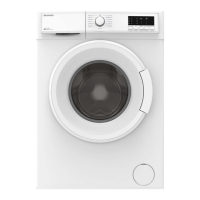
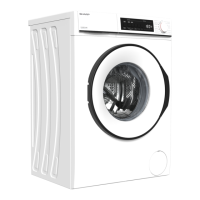
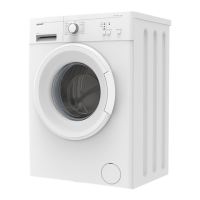
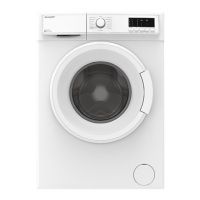
This document provides a comprehensive guide for the ES-FW810W, ES-FWX812W, ES-FW1010W, and ES-FWX1014W series of Front Load Washing Machines. It covers essential information from safety precautions and installation to operational instructions and maintenance.
Function Description
These washing machines are designed for automated laundry washing, offering various programs to suit different fabric types and soil levels. Key functions include:
- Multiple Wash Programs: Options like Cotton, Synthetics, Wool, Delicate, Down, Power, Sanitize, Mix Wash, Quick 15/30/45, Silent Wash, Soak, Spin, Rinse+Spin, and Drum Clean cater to diverse washing needs.
- Spin Speed Selection: Users can choose different spin speeds to optimize drying based on demand, with limitations depending on the program.
- Temperature Control: Adjustable water temperature settings are available for various clothes and situations, though some programs have fixed temperatures.
- Delay Timer: This feature allows users to set a delayed start time for the washing cycle, enabling convenience and energy management.
- Quick Wash: A dedicated button for quick wash cycles, though not available for all programs.
- Additional Rinse: The option to add extra rinse cycles for thorough cleaning, not available for all programs.
- Child Lock Function: Prevents children from tampering with the machine during operation by locking the door and controls.
- End Buzzer Deletion: Allows users to disable the end-of-cycle buzzer.
- Adding Clothes Midway: Provides the flexibility to add forgotten items during a wash cycle, with restrictions for RINSE course or high water temperature.
- Automatic Door Lock/Unlock: The door locks automatically when the machine starts and unlocks when the cycle finishes or is paused, with safety mechanisms for high temperature or water levels.
Important Technical Specifications
The washing machines come in several models with varying capacities and dimensions:
| Model |
Dimensions (W×D×H) mm |
Max. Wash Cloth Mass |
Power Source |
Rated Washing Water |
Power Consumption (WASH) |
Power Consumption (SPIN) |
Power Consumption (WARM) |
Maximal Input Power |
Required Water Pressure |
| ES-FW810W |
596×565×850 |
8 kg |
220 ~50Hz |
68L |
150W |
300W |
1800W |
2000W |
0.03-0.8MPa |
| ES-FWX812W |
596×565×850 |
8 kg |
220 ~50Hz |
56L |
140W |
200W |
1800W |
2000W |
0.03-0.8MPa |
| ES-FW1010W |
596×635×850 |
10 kg |
220 ~50Hz |
77L |
100W |
320W |
1800W |
2000W |
0.03-0.8MPa |
| ES-FWX1014W |
596×635×850 |
10 kg |
220 ~50Hz |
60L |
150W |
300W |
1800W |
2000W |
0.03-0.8MPa |
Spin speeds vary by model and program, typically ranging from 500 rpm to 800 rpm. Total wash times also differ based on the selected program, temperature, and spin speed, ranging from approximately 10 minutes for a spin cycle to 133 minutes for Drum Clean.
Usage Features
- Control Panel: Features a power ON/OFF button, a program knob for selecting wash cycles, START/PAUSE button, and a display window showing time, speed, and error codes. Additional buttons include DELAY TIMER, +QUICK, +RINSE, TEMP, and SPIN SPEED.
- Detergent Case: Designed for liquid detergent, bleach, powder detergent, and softener. Users are advised to use low-bubble liquid synthetic detergents and dilute concentrated detergents. For powder detergents, pre-dissolving is recommended, especially for those that don't dissolve easily. Overuse of detergent should be avoided to prevent excessive bubbles and function faults.
- Wool Program: Specifically designed for delicate and woolen clothes, requiring special detergent and a maximum water temperature of 40°C to prevent distortion. Clothes should be removed promptly after the cycle.
- Start Delay Course: Allows setting a finishing time for the wash. This function is not available for WOOL and Feather courses. The preset time can be changed or canceled by restarting the machine.
- Washing Tips: Emphasizes checking pockets, zipping zippers, fixing buttons/hooks, binding loose bands, separating colored clothes, following care labels, pre-treating heavily soiled areas, and adding 2-3 pieces of clothes to balance the load during spin cycles to prevent heavy shocks.
- Troubleshooting Guide: Provides solutions for common issues such as the door not opening, peculiar smells, no water inflow, water not draining, abnormal sounds during spin, and program stops. Error codes (E11, E12, H, U3, U4) are explained with corresponding remedies.
Maintenance Features
- General Maintenance: Regular maintenance is crucial for extending the machine's service life. Always unplug the machine during maintenance to avoid electrical hazards.
- Washer Body: Clean with a soft, clean cloth dipped in detergent or liquid soap. Avoid direct water contact, scouring powder, diluents, gasoline, or alcohol.
- Rubber Seal on Door: Wipe dirt and debris with a towel after each use and remove any objects from the gap.
- Water Inlet Valve: Suggested cleaning every 6 months. This involves detaching the water supply hose, removing and cleaning the metal filter with a toothbrush, and then reassembling.
- Detergent Case: Clean regularly to prevent mildew. It can be pulled out, cleaned with water, and restored.
- Pump Clean and Wash: Recommended monthly. After draining water and turning off power, open the pump cover (after the water has cooled), rotate and take out the pump anticlockwise, clean the filter, and then reinsert it by rotating clockwise. Ensure the filter is tightened to prevent water leakage.
- Frozen Machine: In case of freezing, wrap the faucet and water supply hose joint with a hot towel, dismount and soak the water supply hose in 50°C hot water, and pour 2-3 liters of 50°C hot water into the tub. Then, link the water supply hose, open the faucet, and start the machine to check for clogs.
- Transportation: Requires two people, holding the machine feet.
- Installation: Involves removing transportation bolts, attaching the universal connector to the faucet, installing the water supply hose, and connecting the drain pipe. The machine must be installed on a hard, flat, and skidproof surface, avoiding soft blankets or wooden floors. It must be leveled using the adjustable legs to prevent strong shock, noise, and disfunction during operation. The base protection device should not be stuck at the bottom.
- Hose Sets: New hose-sets supplied with the appliance must be used, and old hose-sets should not be reused.
- Ventilation: Do not block ventilation openings on the bottom of the washer, especially when installed on a carpeted floor.
- Water Tap: Turn off the water tap when the unit is not in use to prevent water leakage.

 Need help?
 General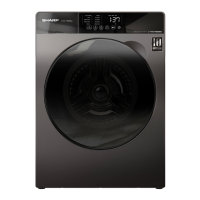


 To Next Page