GX-CD30/30C/130/130C
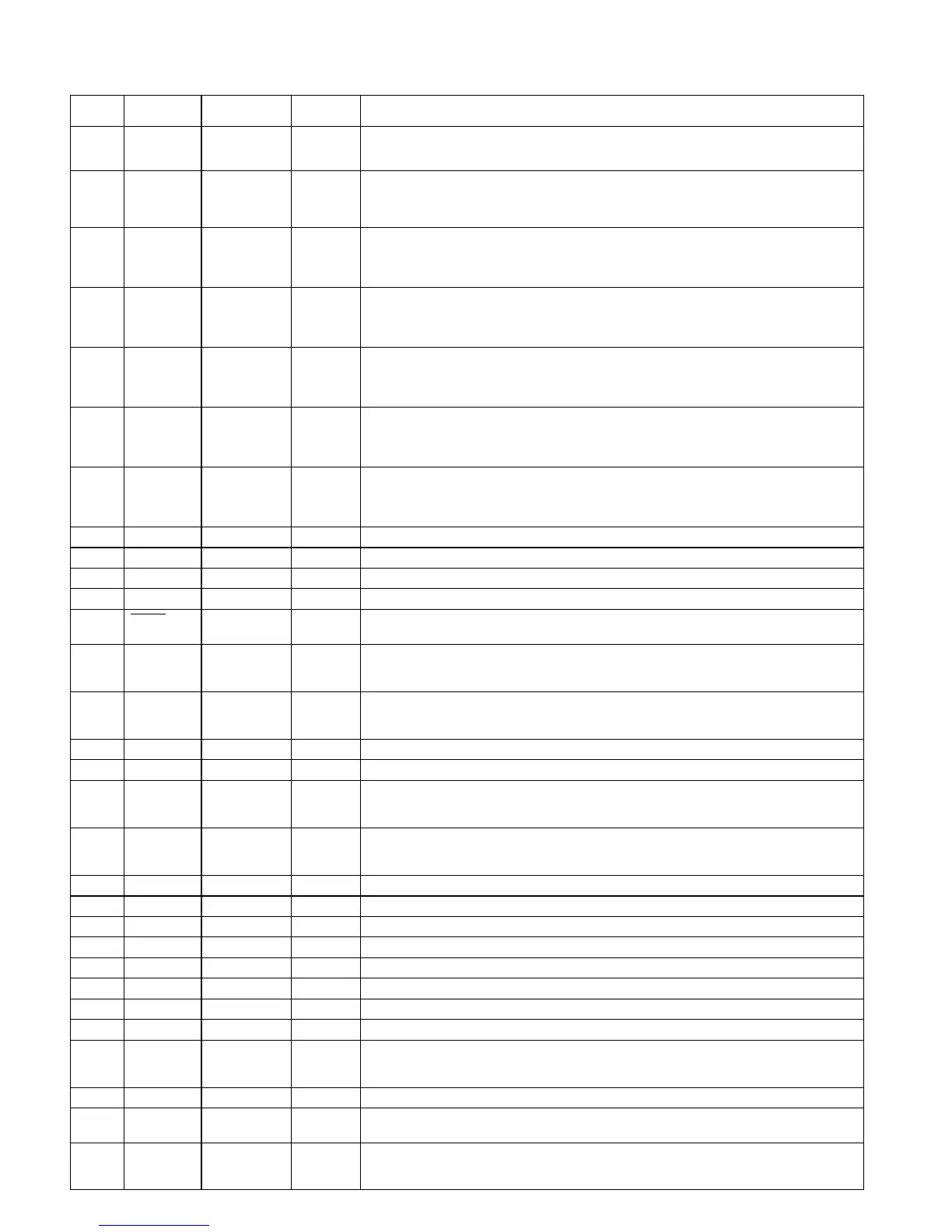
1* P03 MTCONT2 Input/Output
Used to input or output 4 bits at a time. When the output latch is set to "1", the unit will be in the input
mode. The key-on wakeup function, which can be switched on or off by the software, and a pull-up
transistor, which can be turned on or off by the software, are built in.
2*-5* P10-P13 POWER-IN, Input/Output
Used to input or output 4 bits at a time. When the output latch is set to "1", the unit will be in the input
CK (VOL), mode.The key-on wakeup function, which can be switched on or off by the software, and a pull-up
DATA (VOL), transistor,which can be turned on or off by the software, are built in.
STB (VOL)
6* D0 POWER-ON Input/Output
Each terminal can be used to input or output 1 bit at a time. The output section has a latch which holds
1 bit. One of the D ports is assigned by register Y as a data point, to execute input or output.
To use the port for input, set the output latch for that bit to "1". All of the output latches on port D can
be set to "1" using the CLD command.
7 D1 MUTE Input/Output
Each terminal can be used to input or output 1 bit at a time. The output section has a latch which holds
1 bit. One of the D ports is assigned by register Y as a data point, to execute input or output.
To use the port for input, set the output latch for that bit to "1". All of the output latches on port D can
be set to "1" using the CLD command.
8*-12 D2-D6 SYNC-OUT, Input/Output
Each terminal can be used to input or output 1 bit at a time. The output section has a latch which holds
RES,CQCK, 1 bit. One of the D ports is assigned by register Y as a data point, to execute input or output.
COIN,REC To use the port for input, set the output latch for that bit to "1". All of the output latches on port D can
be set to "1" using the CLD command.
13,14 D7,D8 SL+,SL- Input/Output
Each terminal can be used to input or output 1 bit at a time. The output section has a latch which holds
1 bit. One of the D ports is assigned by register Y as a data point, to execute input or output.
To use the port for input, set the output latch for that bit to "1". All of the output latches on port D can
be set to "1" using the CLD command.
15*,16* D9,D10 SRS2,SRS1 Input/Output
Each terminal can be used to input or output 1 bit at a time. The output section has a latch which holds
1 bit. One of the D ports is assigned by register Y as a data point, to execute input or output.
To use the port for input, set the output latch for that bit to "1". All of the output latches on port D can
be set to "1" using the CLD command.
17 P20 DRF Input/Output Used to receive 4 bits at a time.
18 P21 SQOUT Input/Output Used to receive 4 bits at a time.
19 P22 WRQ Input/Output Used to receive 4 bits at a time.
20 P23 PU-IN Input/Output Used to receive 4 bits at a time.
21 RESET Input/Output
Reset pulse input/output terminal. When a reset is caused by the watch dog timer, an "L" level will be
output. The output is an N channel open drain.
22 XIN Input Input/output terminals for the main clock generation circuit. Used by connecting a ceramic resonator
between the XIN and XOUT terminals. There is a built-in feedback resistor between the XIN and XOUT
terminals.
23 XOUT Output Input/output terminals for the main clock generation circuit. Used by connecting a ceramic resonator
between the XIN and XOUT terminals. There is a built-in feedback resistor between the XIN and XOUT
terminals.
24 VSS — GND input terminal.
25 VDD — Positive power supply terminal.
26* XCOUT Output Input/output terminals for the sub clock generation circuit. Used by connecting a crystal oscillator
between the XCIN and XCOUT terminals. There is a built-in feedback resistor between the XCIN and
XCOUT terminals.
27 XCIN Input Input/output terminals for the sub clock generation circuit. Used by connecting a crystal oscillator
between the XCIN and XCOUT terminals. There is a built-in feedback resistor between the XCIN and
XCOUT terminals.
28 AVSS Input GND input terminal for the A-D converter.
29 VREF Input Reference voltage input terminal for the A-D converter.
30 P30 REMOCONINT2 Input Used to receive 4 bits at a time.
31 P31 TORAY1 Input Used to receive 4 bits at a time.
32 P32 TORAY2 Input Used to receive 4 bits at a time.
33 P33 Input Used to receive 4 bits at a time.
34 P40 Input Used to receive 4 bits at a time.
35-37 AIN5-AIN7 Input Used to receive 4 bits at a time.
38-40 VLC3-VLC1 Input
LCD power input terminals. To use the internal resistor, connect VLC3 to VDD (if a brightness control
is needed, connect VLC3 to VDD through a resistor). When an external power supply is used, apply
voltages as follows: 0<VLC1<VLC3<VLCD<VDD.
41-44 COM3-COM0 Output LCD common output terminals.
45-61* SEG16-SEG0 Output LCD segment output terminals.
(45*-56*)
62*-64* P00-P02 Input/Output
Used to input or output 4 bits at a time. When the output latch is set to "1", the unit will be in the input
mode. The key-on wakeup function, which can be switched on or off by the software, and a pull-up
transistor, which can be turned on or off by the software, are built in.
FUNCTION TABLE OF IC
IC701 RH-iX0105AWZZ (IX0105AW): System Control Microcomputer
Port Name Function
Terminal
Name
Pin No.
Input/
Output
In this unit, the terminal with asterisk mark (*) is (open) terminal which is not connected to the outside.
– 28 –



 To Next Page