EasyManua.ls Logo

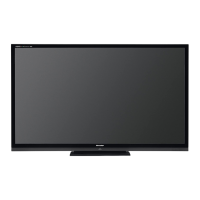
Sharp LC-70UQ17U - User Manual

Sharp LC-70UQ17U
152 pages
Print Icon
To Next Page IconTo Next Page
Loading...

Table of Contents

Questions and Answers

  • M
    Mark MendozaAug 16, 2025
    What to do if 3D images appear 2D with Sharp LCD TV glasses?
    • I
      Ian LittleAug 16, 2025
      If 3D images appear 2D while wearing the 3D glasses with your Sharp LCD TV, the glasses may be set to 2D mode. To switch to 3D mode, press the power button while viewing 2D images. The LED light will blink green, and the 2D images should switch to 3D.
  • B
    Brandon WilsonOct 31, 2025
    What to do if 3D images are not displayed on my Sharp LC-70UQ17U LCD TV?
    • C
      courtney22Oct 31, 2025
      If 3D images are not displaying on your Sharp LCD TV, here are some things to check: * Verify that “3D auto change” is not set to “Off”. Press the 2D/3D button to switch to 3D mode. * If “3D auto change” is set to “Mode1” or “Mode2”, ensure the content being viewed has a compatible display format. * Press the 2D/3D button to select the correct display format for the 3D image. * Make sure the 3D glasses are powered on by pressing the power button for at least 2 seconds. * Ensure the 3D glasses are in 3D mode and not 2D mode by pressing the power button for less than 2 seconds. * Confirm there are no obstructions between the 3D glasses and the TV, and that nothing is covering the receiver on the 3D glasses. Avoid placing anything between the 3D emitter on the TV and the receiver...

Summary

Part Names

TV

Overview of TV components, connections, and ports.

Remote Control Unit

Detailed description of remote control buttons and their functions.

Watching TV

Displaying an External Equipment Image

How to select and display input sources from external devices.

Initial Installation

Steps for the first-time setup, language, and channel tuning.

Direct Button Operation

Changing Channels

Methods for changing TV channels using the remote or TV controls.

Changing Volume

Adjusting the TV's audio volume level.

MUTE

Function to temporarily silence the TV's audio output.

FREEZE

Captures and holds a static image from the current video.

FLASHBACK

Switches to the previously viewed channel or input.

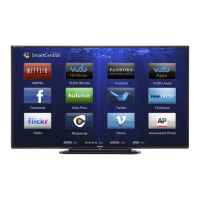
SmartCentral

Accessing and launching various applications.

NETFLIX

Direct access to the Netflix streaming service.

AUDIO

Adjusting audio modes like Stereo, SAP, and digital broadcasts.

Sleep Timer

Setting the TV to automatically switch to standby.

AV MODE

Selecting viewing options for optimal picture quality.

Closed Captions and Digital Closed Captions

Displaying subtitle text for TV programs.

VIEW MODE

Adjusting screen size and aspect ratio for different content.

On-Screen Display Menu

Introduction

Explains on-screen display elements and navigation.

On-Screen Display Menu Operation

How to navigate and use the TV's menu system.

Picture Settings

Adjusting image quality parameters like brightness and contrast.

Audio Settings

Customizing sound quality and surround effects.

Setup

Configuration options for language, channels, and system.

Information

Viewing TV software version and license details.

Enjoying 3 D Image Viewing

Information

General information and precautions for 3D viewing.

Preparing for the 3 D glasses

Instructions for using and setting up 3D glasses.

Using the 3 D glasses

How to pair, switch modes, and use 3D glasses.

Specifications - 3 D glasses (sold separately)

Technical details of the 3D glasses.

Troubleshooting - 3 D Images

Solutions for common 3D viewing problems.

Display Methods for 3 D and 2 D Images

Explains conversion between 3D and 2D image formats.

Viewing 3 D Images

Steps to view 3D content and switch modes.

Configuring the TV Setting to Enhance 3 D Image Viewing

Adjusting TV settings for optimal 3D experience.

Enjoying Photo;Music;Video Playback

Preparation

Connecting USB devices or Home Network servers.

Selecting the Folders to Play Back

Navigating and selecting media files for playback.

Playing Back Files on a USB Memory Device;Home Network Server

How to play photos, music, and videos from storage.

Presetting Remote Control Function

Programming the remote to control other AV devices.

Operating the Connected Equipment

Using the remote for connected devices like VCR, BD, DVD.

Using AQUOS LINK

Controlling HDMI Equipment Using AQUOS LINK

Interactively operating HDMI-connected devices.

Link Operation Menu

Adjusting settings for AQUOS LINK-compatible equipment.

Using a Smartphone with the TV

Connecting and using a smartphone with the TV.

Using a PC

Adjusting the PC Image

Optimizing PC display settings like resolution and position.

Setting Audio Input

Configuring audio output from PC to TV terminals.

Control of the TV

Controlling the TV via PC using RS-232C or IP.

PC Compatibility Chart

Supported PC resolutions and frequencies.

Using the Internet

Connecting to the Internet

Requirements and methods for internet connection.

Internet Setup

Configuring network settings for internet access.

Entering Text (Software Keyboard)

Using the on-screen keyboard for text input.

Using the Browser

Navigating websites and using browser features.

Using Applications via the Internet

Accessing and managing internet applications.

Using the Bluetooth;Miracast devices

Using the Bluetooth;Miracast devices

Connecting and using Bluetooth or Miracast devices.

Appendix

Removing the Stand

Instructions for detaching the TV stand.

Setting the TV on the Wall

Procedures for wall mounting the TV.

Troubleshooting

Common problems and their solutions.

Specifications

TV (For the UQ17 U models)

Technical specifications for specific TV models.

Wireless LAN

Specifications for the TV's wireless network capabilities.

Bluetooth (For the UQ17 U, TQ15 U, SQ17 U, SQ15 U, SQ10 U and LE657 U models)

Technical specifications for Bluetooth functionality.

Trademarks

Dimensional Drawings

LC-70 UQ17 U

Physical dimensions and mounting points for a specific model.

LC-60 UQ17 U

Physical dimensions and mounting points for a specific model.

LC-70 TQ15 U

Physical dimensions and mounting points for a specific model.

LC-60 TQ15 U

Physical dimensions and mounting points for a specific model.

LC-70 SQ17 U;LC-70 SQ15 U;LC-70 SQ10 U;LC-70 EQ10 U

Physical dimensions and mounting points for specific models.

LC-60 SQ17 U;LC-60 SQ15 U;LC-60 SQ10 U;LC-60 EQ10 U

Physical dimensions and mounting points for specific models.

LC-70 LE650 U;LC-70 C6500 U

Physical dimensions and mounting points for specific models.

LC-60 LE650 U;LC-60 C6500 U

Physical dimensions and mounting points for specific models.

LC-90 LE657 U

Physical dimensions and mounting points for a specific model.

Sharp LC-70UQ17U Specifications

General IconGeneral
Screen shapeFlat
Response time- ms
Display diagonal70 \
Display brightness- cd/m²
Native aspect ratio16:9
LED backlighting typeEdge-Lit LED
Supported video modes1080p
Contrast ratio (dynamic)12000000:1
Supported graphics resolutions3840 x 2160, 1920 x 1080 (HD 1080)
3DYes
Audio input4
3D glasses quantity2
Analog signal format systemNTSC
Digital signal format systemATSC
RMS rated power20 W
DVI portNo
DVI-D ports quantity0
Common interface (CI)-
USB 2.0 ports quantityUSB 2.0 ports have a data transmission speed of 480 Mbps, and are backwards compatible with USB 1.1 ports. You can connect all kinds of peripheral devices to them.
Wi-Fi standards802.11a, 802.11b, 802.11g
Product colorBlack
Panel mounting interface400 x 400 mm
AC input voltage110 - 240 V
AC input frequency60 Hz
Power consumption (standby)- W
Package depth279 mm
Package width1729 mm
Package height1070 mm
Package weight57500 g
Sustainability certificatesENERGY STAR
Weight and Dimensions IconWeight and Dimensions
Depth (with stand)- mm
Height (with stand)979 mm
Weight (with stand)48500 g
Depth (without stand)59 mm
Width (without stand)1578 mm
Height (without stand)934 mm
Weight (without stand)42500 g

Related product manuals