EasyManua.ls Logo

Sharp R-961 (W) - Page 18

Sharp R-961 (W)
52 pages
Print Icon
To Next Page IconTo Next Page
To Previous Page IconTo Previous Page
Loading...
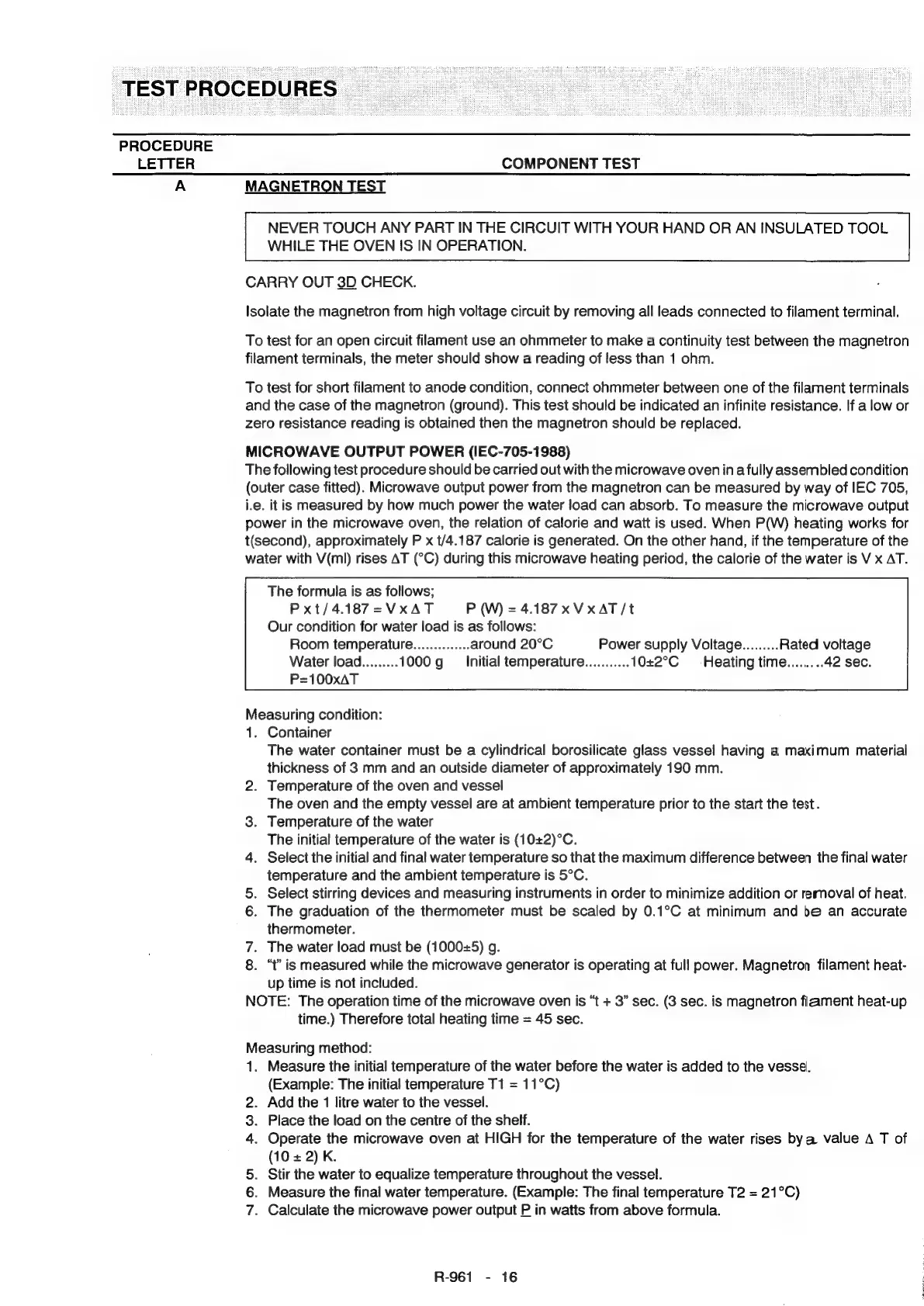
TEST
PROCEDURES
PROCEDURE
LETTER
COMPONENT
TEST
A
MAGNETRON
TEST
NEVER
TOUCH
ANY
PART
IN
THE
CIRCUIT
WITH
YOUR
HAND
OR
AN
INSULATED
TOOL
WHILE
THE
OVEN
IS
IN
OPERATION.
CARRY
OUT
3D
CHECK.
Isolate
the
magnetron
from
high
voltage
circuit
by
removing
all
leads
connected
to
filament
terminal.
To
test
for
an
open
circuit
filament
use
an
ohmmeter
to
make
a
continuity
test
between
the
magnetron
filament
terminals,
the
meter
should
show
a
reading
of
less
than
1
ohm.
To
test
for
short
filament
to
anode
condition,
connect
ohmmeter
between
one
of
the
filament
terminals
and
the
case
of
the
magnetron
(ground).
This
test
should
be
indicated
an
infinite
resistance.
If
a
low
or
zero
resistance
reading
is
obtained
then
the
magnetron
should
be
replaced.
MICROWAVE
OUTPUT
POWER
(IEC-705-1988)
The
following
test
procedure
should
be
carried
out
with
the
microwave
oven
in
a
fully
assembled
condition
(outer
case
fitted).
Microwave
output
power
from
the
magnetron
can
be
measured
by
way
of
IEC
705,
i.e.
it
is
measured
by
how
much
power
the
water
load
can
absorb.
To
measure
the
microwave
output
power
in
the
microwave
oven,
the
relation
of
calorie
and
watt
is
used.
When
P(W)
heating
works
for
t(second),
approximately
P
x
t/4.187
calorie
is
generated.
On
the
other
hand,
if
the
temperature
of
the
water
with
V(ml)
rises
AT
(°C)
during
this
microwave
heating
period,
the
calorie
of
the
water
is
V
x
AT.
The
formula
is
as
follows;
Pxt/4.187=VxAT
P
(W)
=
4.187
x
Vx
AT/t
Our
condition
for
water
load
is
as
follows:
Room
temperature
around
20°C
Power
supply
Voltage
Rated
voltage
Water
load
1000
g
__siInitial
temperature
10+2°C
Heating
time.........42
sec.
P=100xAT
Measuring
condition:
1.
Container
The
water
container
must
be
a
cylindrical
borosilicate
glass
vessel
having
a
maximum
material
thickness
of
3
mm
and
an
outside
diameter
of
approximately
190
mm.
2.
Temperature
of
the
oven
and
vessel
The
oven
and
the
empty
vessel
are
at
ambient
temperature
prior
to
the
start
the
test.
3.
Temperature
of
the
water
The
initial
temperature
of
the
water
is
(10+2)°C.
4.
Select
the
initial
and
final
water
temperature
so
that
the
maximum
difference
between
the
final
water
temperature
and
the
ambient
temperature
is
5°C.
5.
Select
stirring
devices
and
measuring
instruments
in
order
to
minimize
addition
or
removal
of
heat.
6.
The
graduation
of
the
thermometer
must
be
scaled
by
0.1°C
at
minimum
and
be
an
accurate
thermometer.
7.
The
water
load
must
be
(1000+5)
g.
8.
“t’
is
measured
while
the
microwave
generator
is
operating
at
full
power.
Magnetron
filament
heat-
up
time
is
not
included.
NOTE:
The
operation
time
of
the
microwave
oven
is
“t
+
3”
sec.
(3
sec.
is
magnetron
flament
heat-up
time.)
Therefore
total
heating
time
=
45
sec.
Measuring
method:
1.
Measure
the
initial
temperature
of
the
water
before
the
water
is
added
to
the
vesse.
(Example:
The
initial
temperature
T1
=
11°C)
.
Add
the
1
litre
water
to
the
vessel.
.
Place
the
load
on
the
centre
of
the
shelf.
.
Operate
the
microwave
oven
at
HIGH
for
the
temperature
of
the
water
rises
bya
value
A
T
of
(10
+
2)
K.
.
Stir
the
water
to
equalize
temperature
throughout
the
vessel.
.
Measure
the
final
water
temperature.
(Example:
The
final
temperature
T2
=
21°C)
.
Calculate
the
microwave
power
output
P
in
watts
from
above
formula.
&OWN
NOOO
R-961
-
16

Related product manuals