EasyManua.ls Logo

Sharp R-961 (W) - Page 29

Sharp R-961 (W)
52 pages
Print Icon
To Next Page IconTo Next Page
To Previous Page IconTo Previous Page
Loading...
TOUCH
CONTROL
PANEL
ASSEMBLY
_
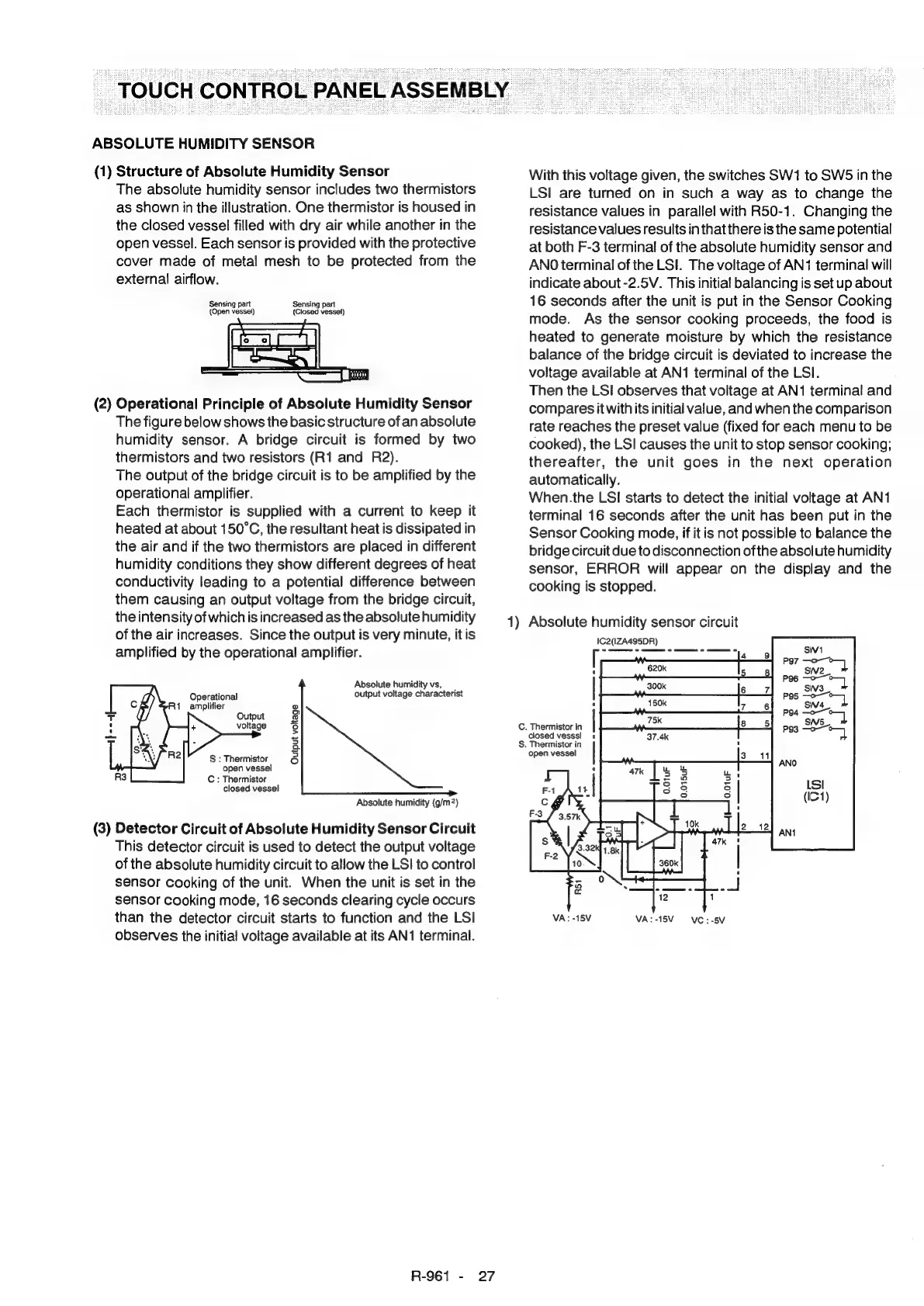
ABSOLUTE
HUMIDITY
SENSOR
(1)
Structure
of
Absolute
Humidity
Sensor
With
this
voltage
given,
the
switches
SW1
to
SW5
in
the
The
absolute
humidity
sensor
includes
two
thermistors
as
shown
in
the
illustration.
One
thermistor
is
housed
in
the
closed
vessel
filled
with
dry
air
while
another
in
the
open
vessel.
Each
sensor
is
provided
with
the
protective
cover
made
of
metal
mesh
to
be
protected
from
the
external
airflow.
Sensing
part
{Open
vessel)
Sensing
part
(Closed
vessel)
(2)
Operational
Principle
of
Absolute
Humidity
Sensor
The
figure
below
shows
the
basic
structure
of
an
absolute
humidity
sensor.
A
bridge
circuit
is
formed
by
two
thermistors
and
two
resistors
(R1
and
R2).
The
output
of
the
bridge
circuit
is
to
be
amplified
by
the
operational
amplifier.
Each
thermistor
is
supplied
with
a
current
to
keep
it
heated
at
about
150°C,
the
resultant
heat
is
dissipated
in
the
air
and
if
the
two
thermistors
are
placed
in
different
humidity
conditions
they
show
different
degrees
of
heat
conductivity
leading
to
a
potential
difference
between
them
causing
an
output
voltage
from
the
bridge
circuit,
the
intensity
of
which
is
increased
as
the
absolute
humidity
of
the
air
increases.
Since
the
output
is
very
minute,
itis
amplified
by
the
operational
amplifier.
Absolute
humidity
vs,
output
voltage
characterist
Operational
R1
amplifier
Output
voltage
Output
voltage
S
:
Thermistor
open
vessel
C
:
Thermistor
closed
vessel
Absolute
humidity
(g/m2)
(3)
Detector
Circuit
of
Absolute
Humidity
Sensor
Circuit
This
detector
circuit
is
used
to
detect
the
output
voltage
of
the
absolute
humidity
circuit
to
allow
the LSI
to
control
sensor
cooking
of
the
unit.
When
the
unit
is
set
in
the
sensor
cooking
mode,
16
seconds
clearing
cycle
occurs
than
the
detector
circuit
starts
to
function
and
the
LSI
observes
the
initial
voltage
available
at
its
AN1
terminal.
R-961
-
27
LSI
are
turned
on
in
such
a
way
as
to
change
the
resistance
values
in
parallel
with
R50-1.
Changing
the
resistance
values
results
in
that
there
is
the
same
potential
at
both
F-3
terminal
of
the
absolute
humidity
sensor
and
ANO
terminal
of
the
LSI.
The
voltage
of
AN1
terminal
will
indicate
about
-2.5V.
This
initial
balancing
is
set
up
about
16
seconds
after
the
unit
is
put
in
the
Sensor
Cooking
mode.
As
the
sensor
cooking
proceeds,
the
food
is
heated
to
generate
moisture
by
which
the
resistance
balance
of
the
bridge
circuit
is
deviated
to
increase
the
voltage
available
at
AN1
terminal
of
the
LSI.
Then
the
LSI
observes
that
voltage
at
AN1
terminal
and
compares
it
with
its
initial
value,
and
when
the
comparison
rate
reaches
the
preset
value
(fixed
for
each
menu
to
be
cooked),
the LSI
causes
the
unit
to
stop
sensor
cooking;
thereafter,
the
unit
goes
in
the
next
operation
automatically.
When.the
LSI
starts
to
detect
the
initial
voltage
at
AN1
terminal
16
seconds
after
the
unit
has
been
put
in
the
Sensor
Cooking
mode,
if
it
is
not
possible
to
balance
the
bridge
circuit
due
to
disconnection
of
the
absolute
humidity
sensor,
ERROR
will
appear
on
the
display
and
the
cooking
is
stopped.
1)
Absolute
humidity
sensor
circuit
IC2(IZA495DR)
C.
Thermistor
in
closed
vesss!
S.
Thermistor
in
open
vessel
VA:
-15V
VA:
-15V
VC
:
-5V

Related product manuals