
 Need help?
Do you have a question about the Shimano RD-6700 and is the answer not in the manual?
Adjusting the derailleur's upper limit and guide pulley position relative to the smallest sprocket.
Connecting the shifting cable to the rear derailleur and securing it properly.
Adjusting the derailleur's lower limit and guide pulley position relative to the largest sprocket.
Adjusting the B-tension screw for optimal pulley-to-sprocket clearance.
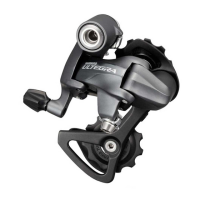
This document describes the Shimano ULTEGRA Rear Derailleur (10-speed), available in RD-6700 (Silver Version) and RD-6700-G (Glossy Grey Version), both with Short Cage (SS) and Long Cage (GS) options. It also provides information for the RD-5700 model.
The Shimano ULTEGRA Rear Derailleur is a crucial component in a bicycle's drivetrain, responsible for shifting the chain between different cogs on the cassette, thereby allowing the rider to change gears. This 10-speed derailleur is designed for precise and smooth gear changes, enhancing the riding experience. It works in conjunction with shifting levers, a cassette sprocket, and a chain to provide a wide range of gear ratios suitable for various terrains and riding styles. The derailleur's design ensures optimal performance when paired with recommended Shimano components, such as specific shifting levers, outer casings, and chains. The SS (Short Cage) and GS (Long Cage) options cater to different total capacities and largest sprocket sizes, allowing for customization based on the rider's needs and the bicycle's setup. The B-Axle Assembly, Stroke Adjusting Screws, Cable Adjusting Bolt Unit, and Pulley Set are integral parts that facilitate its precise operation and adjustability.
The derailleur's operation involves several key adjustments to ensure optimal shifting performance. The "Top adjustment" screw is used to align the guide pulley with the outer line of the smallest sprocket, preventing the chain from over-shifting off the smallest cog. Once the cable is connected and secured to the rear derailleur, initial slack is taken up, and the cable is re-secured with a specified tightening torque. The "Low adjustment" screw positions the guide pulley directly in line with the largest sprocket, preventing the chain from over-shifting off the largest cog.
A critical feature is the SIS (Shimano Index System) Adjustment, which fine-tunes the derailleur's indexing for crisp and accurate shifts. This involves operating the shifting lever to move the chain to the 2nd sprocket, then, while applying slight pressure to the lever, turning the crank arm. The outer cable adjusting barrel is then used to either tighten (clockwise) or loosen (counter-clockwise) the cable tension until the chain runs smoothly on the 2nd sprocket without touching the 3rd sprocket or making noise. The best setting is achieved when the shifting lever can be operated just enough to take up the play, and the chain touches the 3rd sprocket, making noise. From this point, the outer casing adjustment barrel is slightly tightened clockwise until the noise stops and the chain runs smoothly.
The B-tension adjustment screw is another vital feature, used to adjust the guide pulley's proximity to the cassette sprockets. With the chain on the smallest chainring and largest sprocket, the screw is adjusted so the guide pulley is as close as possible to the sprocket without touching it. This process is repeated with the chain on the smallest sprocket to ensure no contact.
The chain length is also crucial for proper function. For an 11-28T sprocket (SS type only), two links are added when the chain is on both the largest sprocket and the largest chainring. The CN-7901/6701/5701 chain has a forward and reverse side, which must be installed correctly for optimal performance. The side with a specific mark should face forward (outer side).
Regular maintenance is essential for the longevity and optimal performance of the rear derailleur. The manual emphasizes cleaning the chain regularly with an appropriate chain cleaner, explicitly warning against the use of alkali-based or acid-based solvents, such as rust cleaners, as they can cause the chain to break and lead to serious injury.
Periodically, the derailleur and all its moving parts (mechanism and pulleys) should be cleaned and lubricated. If gear shifting operations are not smooth, cleaning and lubrication are the first steps. If the amount of looseness in the links is too great to be adjusted, the derailleur should be replaced. Similarly, if abnormal noise results from looseness in a pulley, the pulley should be replaced.
The sprockets should also be washed with a neutral detergent and lubricated regularly. This practice, along with cleaning the chain, effectively extends the useful life of both sprockets and the chain. If the chain frequently comes off the sprockets during use, both the sprockets and the chain should be replaced.
When adjusting the chain length or replacing the chain, it is critical to use the specified reinforced connecting pin for narrow-type chains. Using unsuitable pins or tools can lead to insufficient connection force, causing the chain to break or fall off. The connecting pin must be aligned with the outer link surface and feel smooth and flush. If the chain length needs adjustment due to a change in sprocket teeth, the cut should be made at a different place than where the chain was previously joined with a reinforced connecting pin to avoid damaging the chain.
The manual also advises checking the chain tension and condition; a weak or damaged chain should be replaced to prevent breakage and injury. For smooth operation, using the specified outer casing and bottom bracket cable guide is recommended. The inner cable and the inside of the outer casing should be greased before use to ensure proper sliding. Internal cable routing in frames is discouraged due to its tendency to impair SIS shifting function by increasing cable resistance.
When installing the tension pulley, an arrow indicates the direction of rotation; it should point clockwise when viewed from the outer side of the derailleur. The end of the outer casing with the aluminum cap should be at the derailleur side.
Finally, the document strongly recommends using genuine Shimano replacement parts and lubricants for maximum performance and to ensure safety. It also advises consulting a professional bicycle dealer for any questions regarding installation, adjustment, maintenance, or operation.
 General
| Model | RD-6700 |
|---|---|
| Series | Ultegra |
| Speed Compatibility | 10-speed |
| Max Front Difference | 16T |
| Max Rear Sprocket | 28T |
| Min Rear Sprocket | 11T |
| Weight | 190g |
| Pulley Teeth | 11T |
| Material | Aluminum |
| Actuation Ratio | 1.7 |
| Total Capacity | 33T |


 To Next Page