Templates
Templates
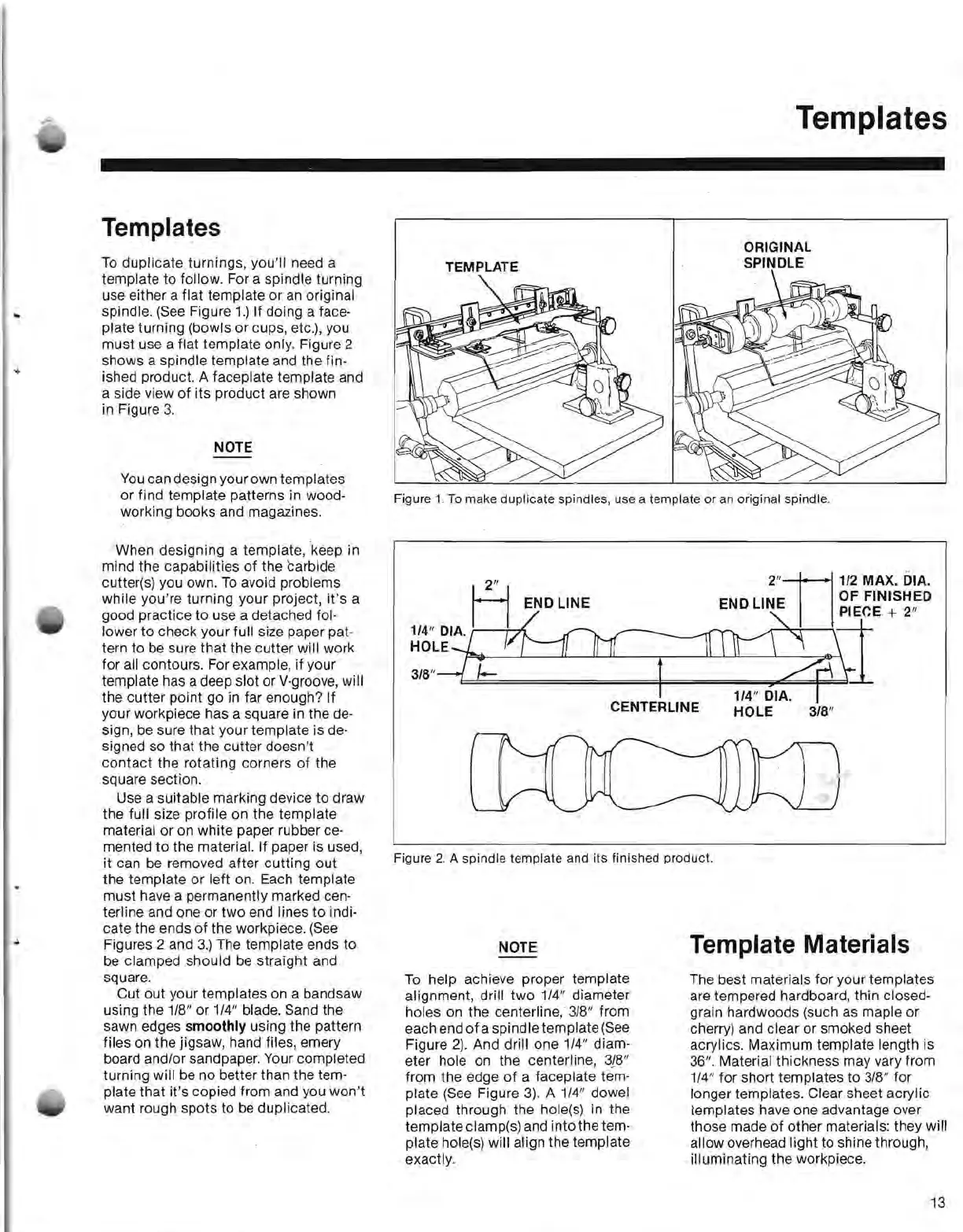
To
duplicate turnings, you'll need a
template to follow. For a spindle turning
use either a flat template or
an
original
spindle.
(See
Figure
1.)
If doing a face-
plate turning (bowls or cups, etc.), you
must use a flat template only. Figure 2
shows a spindle template and the fin-
ished product. A faceplate template and
a side view of its product are shown
in Figure
3.
NOTE
You
can design your own templates
or find template patterns
in
wood-
working books and magazines.
When designing a template, keep in
mind the capabilities
of
the carbide
cutter(s) you own.
To
avoid problems
while you '
re
turning your project,
it's
a
good practice to use a detached fol-
lower to check your full size paper pat-
tern to
be
sure that the cutter will work
for all contours. For example, if your
template has a deep slot or V-groove, will
the cutter point go in far enough? If
your workpiece has a square in the
de-
sign,
be
sure that your template is
de
-
Signed so that the cutter doesn't
contact the rotating corners of the
square section.
Use
a suitable marking device to draw
the full size profile on the template
material or on white paper rubber
ce-
mented
to
the material. If paper
is
used,
it can
be
removed after cutting out
the template or left on. Each template
must have a permanently marked
cen-
terline and one or
two
end lines to indi-
cate the ends
of
the workpiece.
(See
Figures 2 and
3.)
The template ends to
be
clamped should
be
straight and
square.
Cut out your templates
on
a band saw
using the
1/8" or 1/4" blade. Sand the
sawn edges
smoothly using the pattern
files
on
the jigsaw, hand files, emery
board andlor sandpaper.
Your
completed
turning will be no better than the tem-
plate that it's copied from and you won 't
want rough spots to
be
duplicated.
SPINDLE
ORIGINAL
Figure
1.
To
make duplicate spindles, use a template or
an
original spindle.
2"
2"
111/2
MAX_
DlA_
H END LINE END LINE OF FINISHED
~&~~~E+2'
3/8"
I-
~1
1/4"
DIA_
CENTERLINE HOLE 3/8"
Figure
2.
A spindle template and
its
finished product.
NOTE
Template Materials
To
help achieve proper template
The best ma.terials for your templates
alignment, drill two
1/4" diameter
are tempered hardboard, thin closed-
holes
on
the centerline, 3/8" from grain hardwoods (such
as
maple or
each end
of
a spindle template
(See
cherry) and clear or smoked sheet
Figure
2).
And drill one
1/4
" diam-
acrylics. Maximum template length is
eter hole on the centerline,
318
"
36
". Material thickness may vary from
from the edge
of
a faceplate tem-
1/4" for short templates to 3/8" for
plate
(See
Figure
3).
A
1/4
" dowel
longer templates. Clear sheet acrylic
placed through the hole(s)
in
the
templates have one advantage over
template clamp(s)
and
into the tem-
those made of other materials: they will
plate hole(s) will align the template
allow overhead light to shine through,
exactly.
illuminating the workpiece.
13


 To Next Page
 Loading...