The document is a user and operation guide for the Side-Power Stabilizer Systems, specifically version 2950-4, published in 2018. It provides comprehensive information for operators, installers, and distributors of the system, covering its layout, operation, settings, alarms, maintenance, and warranty.
Function Description
The Side-Power Stabilizer System is designed to enhance comfort on board by reducing boat roll. It utilizes fins that extend from the hull to counteract wave motion, providing stability both at anchor and while cruising. The system automatically adjusts fin positions based on sensed conditions to optimize stabilization.
Key components and their functions include:
- Actuators and Fins: These are typically located in the aft end of the living area (owner's stateroom, bathroom, wardrobe) and are responsible for moving the fins outside the hull to generate stabilizing forces. The actuators are designed to be quiet, allowing for installation in living spaces.
- Proportional Valves: One for each actuator, these valves control the hydraulic fluid flow to the actuators, enabling precise fin movement. They are placed in sound-proofed areas outside living spaces.
- Electrohydraulic Powerpack: Located in the engine room, this unit includes a tank, filtration, and cooling system, providing the hydraulic power necessary for fin operation.
- Controller/Driver for the Powerpack: Situated near the powerpack, often on a wall, this component contains a high-voltage VFD and controls the powerpack's operation. It must be kept dry.
- DC 24V Electric or Hydraulic Cooling Water Pump: If fitted, this pump is installed below the waterline, close to the powerpack, to cool the hydraulic system. It often requires venting after the boat has been on land.
- Main ECU (Electronic Control Unit) with Sensors: Placed centrally in the boat on a bulkhead, the ECU is the brain of the system, processing sensor data and controlling fin movements.
- Control Panel: Located on the yacht's dashboard(s), this panel allows the operator to monitor and control the stabilizer system.
The system operates in different modes:
- Cruising Mode: Stabilizers are active, providing stability at higher speeds.
- At Anchor Mode: Stabilizers are active to reduce roll when the boat is stationary or moving at very low speeds (below 3 knots).
- Standby: A temporary inactive state.
- Night Mode: Darkens the control panel screen for night use.
The system is equipped with internal monitoring functions for safe operation, including checks on valve electrical operation, hydraulic pressure, fluid levels, temperatures, and electronics. In case of an alarm, the system automatically centers and locks the fins and shuts down operation to prevent damage or unsafe conditions.
Important Technical Specifications
- Hydraulic Oil: Mineral-based hydraulic oil ISO VG 46 is recommended for refills.
- Operating Temperatures: The system is designed to operate with oil temperatures up to 75°C. Higher temperatures trigger alarms.
- Hydraulic Pressure: Normal operating pressure should be between 70 and 100 bar. Pressure below 25 bar indicates a hydraulic system failure.
- Fin Actuator Play Allowances:
- SPS 65/66: Maximum Shaft Radial Play: 0.10 mm; Maximum Shaft Axial Play: 0.20 mm.
- SPS 55/90/91/92/93: Maximum Shaft Radial Play: 0.15 mm; Maximum Shaft Axial Play: 0.30 mm.
- Filter Replacement: Pressure and return line filter elements should be replaced after initial startup/test period (latest 50 operating hours), then every 2000 operating hours or every 2nd year.
- Hydraulic Oil Replacement: Every 4000 operating hours or every 3rd year. For heavy-duty applications, annual oil sample analyses are recommended.
Usage Features
The control panel offers several features for user interaction:
- ON/OFF Button: Activates or deactivates the stabilizer system.
- At Anchor Enable Button: Activates "At Anchor" mode for stabilization at low speeds (requires ON to be active).
- Night Button: Darkens the screen for night use.
- MENU Button: Accesses additional choices and settings.
- Status Indicators: Background color (Green = running, Red = not running) and text (INIT, OFF, CRUISING, AT ANCHOR, SUSPENDED, HALTED, FINS NOT CENTRED) provide immediate system status.
- Fin Position Display: Shows the current position of the fins.
- Boat Angle Display: Shows the current angle of the boat.
- AC Powerpack Control: ON/OFF/AUTO buttons to manage the AC powerpack. AUTO mode allows the system to decide whether to run based on sensed pressure from engine-driven pumps.
- Fin Enable/Disable: Allows individual fins to be disabled, useful for technical problems or when moored close to an obstacle on one side.
- Cruising Gain Adjustment: Increases or decreases the stabilizer function in cruising mode (+ = more aggressive, - = less aggressive).
- At Anchor Gain Adjustment: Increases or decreases the stabilizer function in at anchor mode (+ = more aggressive, - = less aggressive).
- Settings Access: Provides access to system status, system information, startup, and setup pages.
- Alarm Monitoring: Displays active alarms and allows acknowledgment.
- Date/Time Setting: Allows setting the current date and time.
Important Operating Guidelines:
- Always ensure no leakages, correct hydraulic oil level, and running cooling pump before activating.
- Monitor system temperature and pressure from the panel.
- Ensure no submerged objects or people are near the fins when they start moving.
- One or both main engines, or an alternative hydraulic power source, must be running for operation.
- Keep the system active when running in planning or fast semi-planning mode, even on calm water, as fins contribute to directional and heel stability.
- If stabilizers are inactive, run at a maximum speed where the boat is not planning.
- Reverse the boat at minimal speed if fins are not in LOCKED position. Fins should automatically center and lock in reverse.
Maintenance Features
The manual outlines a comprehensive preventative maintenance schedule for the Hull Unit, Fins, Hydraulic Power Unit, and Control System, categorized by service level (Onboard, Shore Supported, Trained Personnel) and whether the vessel needs to be out of water (Dry) or can be in water (Wet).
General Maintenance Recommendations:
- Initial Check (First 100 hours or 1 week): Check hydraulic fittings, hoses for chaffing, cylinder rods and gland seals for damage, dirt indicator on return oil filter, fin play, and manually move fins to check bearings.
- Out-of-Water Service: Perform thorough cleaning and check of fin anodes.
- Axial and Radial Play Check: Periodically check shaft play using a dial indicator and micrometer.
- Fin Inspection: Inspect fin surfaces for damage during haul-out and repair with vinylester/epoxy.
- Hydraulics:
- Pressure Filters: Check pressure drop indicators every 6 months (above 40°C oil temp, with most flow demanding consumer active). Replace elements if indicators are in the red area.
- Valves and Manifolds: Inspect regularly for external damage. Apply water inhibitor (e.g., WD-40) after wash-down.
- Hydraulic Oil: Replace every 4000 operating hours or 3rd year. Check oil color every 6 months for water ingress/condensation (white or grey oil indicates a problem).
- Oil Quality Test: Test hydraulic oil quality by taking samples (recommended every 12 months or 1st year). Elevated brass particles indicate pump wear.
- Power Unit Motor: Manually rotate every 3 months or start to ensure proper lubrication if unused for long periods.
- Control System: Keep electrical parts and wiring clean, dry, and damage-free. Periodically check for mechanical damage or water build-up.
- Cooling Fan (VFD): Clean every 250 hours or 1/3 year.
- Emergency Stop Button: Test every 250 hours or 1/3 year.
The maintenance schedule is detailed in tables, indicating service intervals (e.g., 250h, 500h, 2000h, 4000h, 8000h, 12000h), whether the vessel needs to be out of water, and monthly/yearly intervals. Failure to follow these guidelines may void the warranty.

 Need help?
 General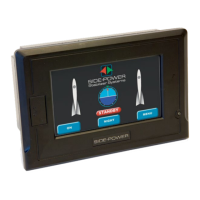

 To Next Page