Overload Relays
General data
4
Siemens · 2011
1) Exception: up to size S3, only stand-alone installation is possible.
2) Alternatively available for screw terminals.
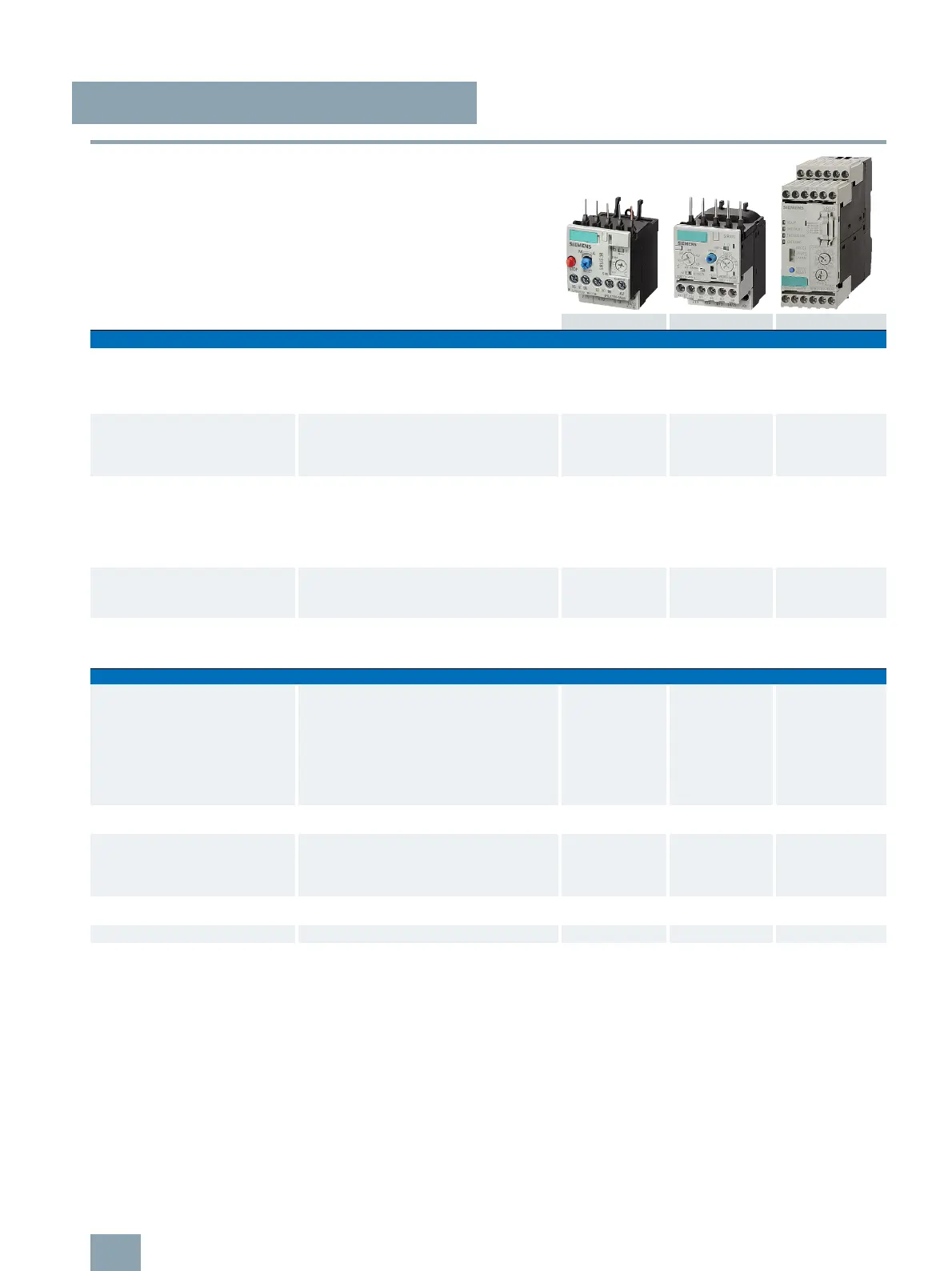
Features Benefits 3RU11 3RB20/3RB21 3RB22/3RB23
Design of load feeders
Short-circuit strength up to 100 kA
at 690 V
(in conjunction with the corresponding
fuses or the corresponding motor starter
protector)
• Provides optimum protection of the loads and ope-
rating personnel in the event of short-circuits due
to insulation faults or faulty switching operations
✔✔ ✔
Electrical and mechanical matching
to 3RT1 contactors
• Simplifies configuration
• Reduces wiring outlay and costs
• Enables stand-alone installation as well as space-
saving direct mounting
✔ ✔ ✔
1)
Straight-through transformers for
main circuit
2)
(in this case the cables are routed
through the feed-through openings of
the overload relay and connected
directly to the box terminals of the
contactor)
• Reduces the contact resistance (only one point of
contact)
• Saves wiring costs (easy, no need for tools, and
fast)
• Saves material costs
• Reduces installation costs
-- ✔
(S2 ... S6)
✔
(S00 ... S6)
Spring-type terminal connection sys-
tem for main circuit
2)
• Enables fast connections
• Permits vibration-resistant connections
• Enables maintenance-free connections
✔
(S00)
-- --
Spring-type terminal connection sys-
tem for auxiliary circuits
2)
• Enables fast connections
• Permits vibration-resistant connections
• Enables maintenance-free connections
✔✔ ✔
Other features
Temperature compensation • Allows the use of the relays at high temperatures
without derating
• Prevents premature tripping
• Allows compact installation of the control cabinet
without distance between the devices/load
feeders
• Simplifies configuration
• Enables space to be saved in the control cabinet
✔ ✔ ✔
Very high long-term stability • Provides safe protection for the loads even after
years of use in severe operating conditions
(✔) ✔✔
Wide setting ranges • Reduce the number of variants
• Minimize the engineering outlay and costs
• Minimize storage overhead, storage costs, tied-up
capital
-- ✔
(1:4)
✔
(1:10)
Trip class CLASS 5 • Enables solutions for very fast starting motors re-
quiring special protection (e. g. Ex motors)
-- ✔
(only 3RB21)
✔
Trip classes > CLASS 10 • Enables heavy starting solutions -- ✔ ✔
Low power loss • Reduces power consumption and energy costs
(up 98 % less power is used than for thermal over-
load relays).
• Minimizes temperature rises of the contactor and
control cabinet – in some cases this may eliminate
the need for controlgear cabinet cooling.
• Direct mounting to contactor saves space, even
for high motor currents (i. e. no heat decoupling is
required).
-- ✔✔



 To Next Page