
 Need help?
Do you have a question about the Siemens 3TL81 and is the answer not in the manual?
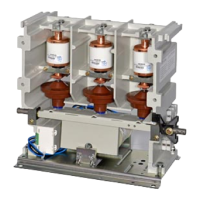
The Siemens 3TL81 high-voltage vacuum contactor is a switching device designed for high switching frequencies and unlimited ON duration in AC circuits. It is suitable for various applications, including three-phase motors, transformers, capacitors, and resistive loads, as well as for motor reversal duty. The contactor features a solenoid-operated mechanism that can be actuated by either AC or DC current.
The 3TL81 vacuum contactor is primarily used for making and breaking electrical connections in high-voltage systems. Its design, with a chopping current of only 0.6 A, makes it particularly well-suited for switching inductive loads. The contactor is built as a non-enclosed type with a degree of protection IP00 according to DIN/VDE 0470 Part 1 and IEC 144. It is designed for use in buildings with poor thermal insulation or low thermal capacity, whether heated or cooled, and can tolerate occasional condensation (approximately once a month for 2 hours).
The vacuum contactor requires short-circuit protection, as it is not designed to switch short-circuit currents. HV HRC fuses are recommended for this purpose. When coordinating HV HRC fuses with motor circuits, the fuse's time/current characteristic must be to the right of the motor starting current, and its rated current must exceed the motor's operating current. If two fuses are connected in parallel, their impedance values should be almost equal. The vacuum contactor must be switched off if the fuses blow, which requires a suitable device actuated by the striker pin of the HRC fuse. For "Class E2-Controller" applications, SIEMENS fuses of type 3GD1 150-UD (7.2 kV/250 A) or comparable alternatives are specified.
The contactor can be mounted vertically or horizontally using M10 stud bolts or M10 hex. hd. screws. It is crucial to avoid twisting the bottom plate of the contactor and to use spacer rings if the bottom plate does not rest squarely. Busbars and cable lugs should be installed off-load to prevent undue stress on the primary conducting paths. Conductors up to 30 mm width can be connected. For copper conductors, brush until bright and apply a thin film of vaseline. For aluminum conductors, the plated surface finish of the terminals must be removed before brushing and applying vaseline, unless they are galvanized or silver-plated. The contactor causes vibrations during switching, so it should not be mounted on vibration dampers. Earthing can be achieved via an M12 earthing screw with flat copper pieces, stranded copper conductor, or hot-dip galvanized steel straps, or by mounting on an earthed steel support frame. Auxiliary switches are connected directly and must not be used for activating mechanical latching or interrupting the closing command for the vacuum contactor; an external contactor relay must be used for these functions.
The vacuum contactor is maintenance-free until the end of its mechanical service life (1 million switching operations). For repair work, the contactor must be removed from the switchboard. Installation of spare parts and accessories must follow the relevant operating instructions. To maintain insulating capacity, insulating components and external contactor parts must be cleaned with a damp cloth using warm water and a mild liquid household detergent. All maintenance, repair, and conversion work must be carried out by specially trained personnel in accordance with operating instructions and safety regulations, including the "five safety rules" (DIN EN 50110, Part 1 + 2). Before starting any work, the power supply must be switched off. Windings and terminals must not be touched if the power supply is not disconnected, as non-observance can result in death or serious personal injury.
 General
| Brand | Siemens |
|---|---|
| Model | 3TL81 |
| Category | Industrial Equipment |
| Language | English |


 To Next Page