Need help?
Do you have a question about the Siemens 3TW7291-1A and is the answer not in the manual?
Refer Table A for recommended selection of 3TW72 starters.
Hazardous voltage can cause death or serious injury. Disconnect power before working on equipment.
Automatic Motor Restart. Can cause death, serious injury or property damage.
This product has been designed for environment A. Use of this product in environment B may cause unwanted electromagnetic disturbances.
Details on fixing the starter housing and connecting cables.
Instructions for starting and stopping the motor using push buttons.
Procedure for automatic reset of the overload relay after tripping.
Guidelines for cleaning, screw tightening, and replacing components.
This document describes the Siemens DOL Starter 3TW7291-1A, a device designed for dependable motor control. It emphasizes the importance of following instructions for selection, inspection, installation, commissioning, operation, and maintenance to ensure reliable service.
The Siemens DOL Starter (Direct-On-Line Starter) is primarily used for starting and stopping motors. It incorporates a contactor and a thermal overload relay to protect the motor from overcurrents. The starter features a "Self-reset" mechanism for the Raja+ DOL Starter, meaning that if an overload trip occurs, the relay will automatically reset after a specified time (approximately 4 minutes). This automatic reset functionality is a key feature, though a warning is provided against its use in situations where an unexpected automatic restart could cause injury or damage.
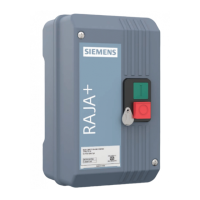
The starter is equipped with 'ON' (green) and 'OFF' (red) push buttons on its cover for manual operation. It also includes a mechanical latch on the 'OFF' push button, which can be used to prevent undesired 'ON' operation of the starter, enhancing safety. A nameplate provides essential information about the device.
Installation: The installation process begins by removing the front cover and fixing the starter housing vertically on a rigid, vibration-free surface. Rubber grommets for incoming and outgoing cable connections need to be removed. Connecting the cables involves selecting the correct size, removing approximately 10mm of insulation, passing the cable through a proper cable gland to prevent material ingress, and then firmly tightening the terminal screws (M4, with a torque of 80-110 Ncm).
Setting the overload relay scale is a critical step. The relay should be set to the motor's rated current as specified on its nameplate. To verify the setting, the contact carrier is pressed to start the motor, and the relay settings are gradually reduced until it trips. The relay is then set at a slightly higher value. After allowing approximately 4 minutes for the relay to reset automatically, the motor is restarted. If it does not trip, the setting is considered correct; otherwise, it should be adjusted slightly higher and rechecked. The red knob on the overload relay can be pressed to stop the motor. Finally, the front cover is fixed, with the instrument head screws tightened to a torque of 80 to 140 N-cm.
Operation: For ON/OFF operation, the mechanical latch should be rotated away from the 'OFF' push button. The starter is switched 'ON' by pressing the green push button (marked 'I') on the cover and switched 'OFF' by pressing the red push button (marked 'O').
Reset Operation: If the overload relay trips, it automatically resets after approximately 4 minutes.
Regular maintenance is crucial for the reliable functioning of the equipment. Key maintenance practices include:
The product is designed for environment A, but its use in environment B may cause electromagnetic disturbances, requiring mitigation measures. The reliable functioning of the equipment is ensured only with certified components, and commissioning and maintenance should be performed by qualified personnel.
Siemens products are designed to be environment-friendly and consist predominantly of recyclable materials. For disposal, disassembling and separating materials into ferrous types for recycling through authorized dealers is recommended. Plastics should also be segregated by type for recycling. Local customer care services are available for disposal-related questions.
 General
| Insulation voltage rated value | 690 V |
|---|---|
| Surge voltage resistance rated value | 6 kV |
| Protection class IP | IP20 |
| Number of poles | 3 |
| Product designation | 3TW7291-1A |
| Size of the circuit-breaker | 00 |
| Size of load feeder | 00 |
| Shock resistance | 15 g |
| Relative humidity during operation | 95% |
| Type | 3TW7291-1A |
| Rated operational voltage | 690 V AC |

 To Next Page