
 Need help?
Do you have a question about the Sierra Wireless AirLink XR80 and is the answer not in the manual?
Configure the router via its AirLink OS web interface.
Use ALMS for remote monitoring and configuration tasks.
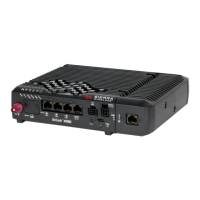
The AirLink® XR80 is a high-performance multi-network router designed for robust and reliable connectivity. It is engineered to provide seamless internet access and advanced networking capabilities, making it suitable for a wide range of applications, from mobile deployments to fixed installations. The router integrates various communication technologies, including cellular, Wi-Fi, and GNSS, to ensure comprehensive coverage and flexibility. Its design emphasizes ease of use, from initial setup to ongoing management, while incorporating features that enhance security and operational efficiency.
One of the primary functions of the XR80 is to act as a central hub for data communication, enabling devices to connect to the internet and to each other. It supports multiple cellular networks, allowing it to maintain connectivity even when one network is unavailable, thereby ensuring high availability for critical applications. The router also includes Wi-Fi capabilities, enabling local wireless connectivity for devices within its range. This dual functionality makes it versatile for environments requiring both wide-area and local-area network access. Furthermore, the integrated GNSS (Global Navigation Satellite System) functionality provides precise location data, which is crucial for asset tracking, fleet management, and location-based services.
The XR80 is designed for straightforward installation and configuration. Upon unboxing, users will find the router itself, an LPWA antenna, a locking DC power cable, a Quick Start Guide, and an XR Services guide. The Quick Start Guide focuses on the initial steps for quick router configuration and connection, while the XR Services guide details how to register the router with the AirLink Management Service (ALMS) and activate its subscription. This structured approach ensures that users can get their router up and running efficiently.
A key feature of the XR80 is its integration with the AirLink Management Service (ALMS). ALMS is a cloud-based platform that provides comprehensive tools for registering, configuring, and monitoring the router, whether it's a single device or part of a large fleet. A one-year subscription to ALMS is included with the purchase of the router, highlighting its importance for managing the device throughout its lifecycle. The initial setup process involves registering the router with ALMS, which allows for preconfiguration. Once powered on, the router automatically connects to ALMS, completes its registration, and applies any preconfigured settings, streamlining deployment.
The physical installation of the XR80 involves several steps. Users first need to install SIM cards into the designated slots. The router supports both internal cellular radio and XP cellular radio, each requiring a SIM card in a specific slot. The SIM card cover is secured with a Phillips screw, emphasizing the importance of a secure fit. It's important to note the position of the notched corners when inserting the SIM cards to ensure proper orientation. The LPWA radio, however, uses an embedded SIM with included connectivity, eliminating the need for an external SIM for this particular function. After SIM installation, color-coded cellular, Wi-Fi, and GNSS FAKRA-connector antennas are connected to the back panel, and the LPWA antenna is connected to its dedicated connector on the front panel.
Powering on the XR80 is achieved by providing 7–36 VDC to the DC Power connector. This can be done using the included DC power cable or an optional XR Series AC power adapter. The router is designed to be robust in various power environments, including vehicle installations where ignition sense is often required. If an AC adapter is not used, the ignition sense must be connected to the vehicle ignition or the positive terminal of the power supply, ensuring proper power management and protection. Once powered, the router's LPWA LED turns green and pulses to indicate activity, signifying that it is connecting to ALMS and applying its preconfiguration. A critical maintenance note is to avoid removing power during an LED 'chase' (all LEDs flashing in sequence), as this indicates a device update is in progress, and interrupting it could lead to issues.
Configuration of the XR80 can be performed either locally or remotely. For initial setup or custom configurations, users can connect a computer to any chassis Ethernet port and access the router's AirLink OS web interface. This local configuration involves opening a browser, navigating to https://airlink./ or 192.168.1.1, and logging in with the administrator name (admin) and the factory default password found on the router's label. The Dashboard screen then allows for various configuration changes. For security purposes, it is strongly recommended to change the default password as soon as possible. The label also includes a QR code that contains the password and the router's serial number, making it easy to retrieve this information.
For managing multiple XR80 routers or for ongoing monitoring and maintenance, ALMS provides a powerful remote configuration option. Users can log into their ALMS account via a web browser, navigate to the Dashboard, and select "Monitor > Systems" to view their registered devices. From there, they can select a specific router, access its system details, and click the "Configuration" button to make necessary changes. These changes are then applied to the router the next time it connects to ALMS. This remote management capability is particularly beneficial for large deployments, allowing administrators to manage and update their fleet efficiently without needing physical access to each device. ALMS also supports creating templates from a configured router, which can then be pushed to other routers in the fleet, further simplifying large-scale deployments.
The XR80's design also emphasizes expandability and modularity. The mention of an "optional XP cartridge" suggests that the router can be enhanced with additional capabilities or modules, allowing it to adapt to evolving requirements and technologies. This forward-thinking design ensures that the XR80 remains a relevant and capable solution over time.
In summary, the AirLink® XR80 is a sophisticated multi-network router that offers robust connectivity, flexible configuration options, and comprehensive management features through ALMS. Its ease of installation, combined with powerful remote management capabilities, makes it an ideal choice for demanding applications requiring reliable and secure communication. The emphasis on security, modularity, and continuous updates ensures that the XR80 is a durable and adaptable solution for modern networking challenges.
 General
| Maximum Upload Speed | 150 Mbps |
|---|---|
| USB Ports | 1 x USB 2.0 |
| GNSS | GPS, GLONASS, BeiDou, Galileo |
| Input Voltage | 9-36 VDC |
| Network Connectivity | Wi-Fi, Ethernet |
| Cellular Technology | LTE |
| LTE Bands | B1, B2, B3, B4, B5, B7, B8, B12, B13, B14, B20, B25, B26, B28, B66, B71 |
| Wi-Fi | 802.11a/b/g/n/ac |
| Ethernet Ports | 2 x Gigabit Ethernet |
| Operating Temperature | -30°C to +70°C |



 To Next Page