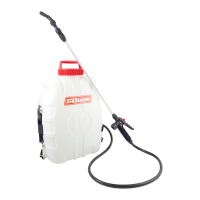
The Silvan WP12-1 is a 12-liter rechargeable backpack sprayer designed for applying agricultural chemicals to plants. This device is intended solely for this purpose and should not be used for any other applications. Operators are strongly advised to read and fully understand the instruction manual, all safety information on the sprayer, and any instructions for associated equipment or chemicals before use. Untrained individuals should never install or operate the sprayer.
Safety and Usage:
When operating the sprayer, it is crucial to prioritize safety. Never spray or pump flammable liquids. Always refer to the chemical manufacturer's label for correct use and safe handling instructions of chemicals before filling or using the sprayer. Recommended safety clothing and equipment must be worn when handling chemicals and operating the sprayer. All operators and associated personnel should be familiar with legal regulations and codes of practice concerning the safe use, storage, and disposal of spray chemicals.
Exercise caution to maintain proper stability, especially when carrying or operating the sprayer in hilly and uneven terrain, or on wet or loose ground. Wearing non-slip shoes is recommended. This sprayer places weight on the back and shoulders, as well as indirectly on the lower body. Individuals with physical conditions that may be aggravated by carrying weight on their back should not use this product.
Battery Charging:
The sprayer is powered by a 12.6V Lithium-Ion Battery Pack (Model No. YD-MT19H0125A from Silvan Australia Pty Ltd, with a maximum rated capacity of 2500mAh). The battery should be charged before first use. To charge, plug the HC211 battery charger into a standard 240 Volt power point. The indicator light on the charger will initially show GREEN. Slide the battery pack into the charger, and the indicator light will turn RED, indicating that charging is in progress. Once the battery is fully charged, the indicator light will turn GREEN again. Recharging time varies depending on the battery's state, with a completely discharged battery taking up to 6 hours to fully recharge. For general safety, always turn off the charger after recharging, especially if leaving it unattended. The battery charger should only be used in a dry environment and must not be exposed to rain. It is not intended for use by persons with reduced physical, sensory, or mental capabilities, or lack of experience and knowledge, unless they have been given supervision or instruction. Children should be supervised to ensure they do not play with the battery charger. This charger is specifically designed for rechargeable battery packs and should not be used to charge non-rechargeable battery packs. If the supply cord is damaged, it must be replaced by the manufacturer, its service agent, or similarly qualified persons to avoid hazards.
Assembly and Installation:
The gun assembly requires fitting the spray lance to the gun, ensuring the O-Ring is correctly in place. The 45-degree elbow and nozzle are then fitted to the tip of the lance, again verifying the O-ring's position.
The backpack sprayer comes with a padded shoulder strap. To install the shoulder straps, first clip the strap onto the base of the backpack on both sides. Then, raise the free end of the strap to the mounting area on the back and thread it through the slot from top to bottom. Finally, fit the supplied clip to hold the strap in place by notching the strap in the smaller groove.
Operation:
Before using the sprayer for the first time or adding chemicals, always check the operation and function of the sprayer with clean water. Ensure the battery is charged, the filters are clean, and all fittings, hoses, and gun connections are tight.
Partially fill the sprayer with clean water before adding any chemical. Using clean water helps prevent blockages and ensures proper chemical function. Add chemicals according to the directions on the chemical container, adhering to all safety and protective equipment recommendations. It is important not to use wet powders or chemicals that must remain suspended in solution and require agitation; only use chemicals or dyes that fully dissolve. If the sprayer has been used for herbicides, it must be thoroughly cleaned and the herbicide neutralized according to the manufacturer's directions before being used for insecticides or nutrients.
To install the battery pack, push in the lock tab, then slide the cover down to install the battery in the socket. To remove the battery, push in the lock tab on the battery itself to pull it out of the socket.
The pump has an on/off switch located on the left-hand side of the sprayer. The pump will automatically switch off when the spray lance is not in use, though this function does not work when the tank is empty. Always switch the pump off when leaving the sprayer unattended. The pump also features a light indicator to show the remaining battery usage.
The spray lance can be adjusted by loosening the nut, extending the lance to the desired length, and then retightening. The nozzle can also be adjusted by loosening and tightening it to achieve the desired spray stream (either a single stream or a cone stream).
Maintenance:
To prevent chemical contamination, always wear appropriate protective equipment, including gloves, when performing maintenance. Turn off the pump and depress the trigger on the spray lance to dissipate any pressure.
After spraying, drain any unused chemicals from the tank. Rinse the tank with clean water, then operate the sprayer with clean water to clean out the pump, hose, and spray lance. Never leave chemicals in the tank, as they can crystallize or form solids, leading to blockages in the pump, spray lines, nozzle, or filters. If heavy frosts are anticipated, run the sprayer until the pump and spray lines are dry to prevent water from freezing and damaging the sprayer. Dispose of unused chemicals and rinsing water in a manner that does not endanger people, animals, or the environment, in accordance with local regulations and the handling and disposal information provided by the chemical manufacturer.
The knapsack sprayer has three filters that require regular cleaning. Always use clean water and rinse out the sprayer after use to prevent filters from becoming clogged. These filters include a basket strainer under the lid, a filter in the spray gun handle (either Type 'A' fitted to the hose connection or Type 'B' inside the gun handle), and a suction foot filter inside the tank. To clean the gun handle filters, unscrew the hose connection for Type 'A' or use pointy nose pliers for Type 'B'. To clean the suction foot filter, remove it from the end of the hose inside the tank.
Troubleshooting:
If the sprayer has not been used for some time or has been left with chemicals, the pump valves may become stuck, causing the pump to run without pumping liquid. In such cases, a hand-operated vacuum pump can be used to prime the pump. First, empty the tank and spray hose of liquid. Ensure the power switch on the knapsack is off. Connect the hand pump as shown in the manual and lock the trigger on. Pump the handle to draw air and unstick the pump valves. Clean the vacuum pump after use.
Common issues and solutions include:
- Pump does not operate: Check if the battery is flat or if the charger has not been working.
- Pump operates but cycles or continues to run when the wand handle is released: This indicates a slow leak (check all connections) or that the tank is empty, or the suction line is not fully immersed.
- Pump operates with no flow rate or reduced flow: The pump will not prime unless the gun trigger is on. Check the filter, nozzles, and spray line for any blockages. If these steps do not resolve the issue, use the vacuum pump as described above to prime the pump.


 To Next Page
 General