SILVER Audio Processor 4Bmini User’s manual
Page 18/38
Audemat-Aztec SA – Audemat-Aztec INC
web: www.audemat-aztec.com - e-mail: contact@audemat-aztec.com
The multi-band limiters in the SILVER Audio Processor 4Bmini are of the dual time constant variety. There is an
attack and decay to handle the peaks and an attack and decay to handle the average level of limiting. Understanding
how the two time constants interact is imperative if you want to make major changes to how each bands limiter
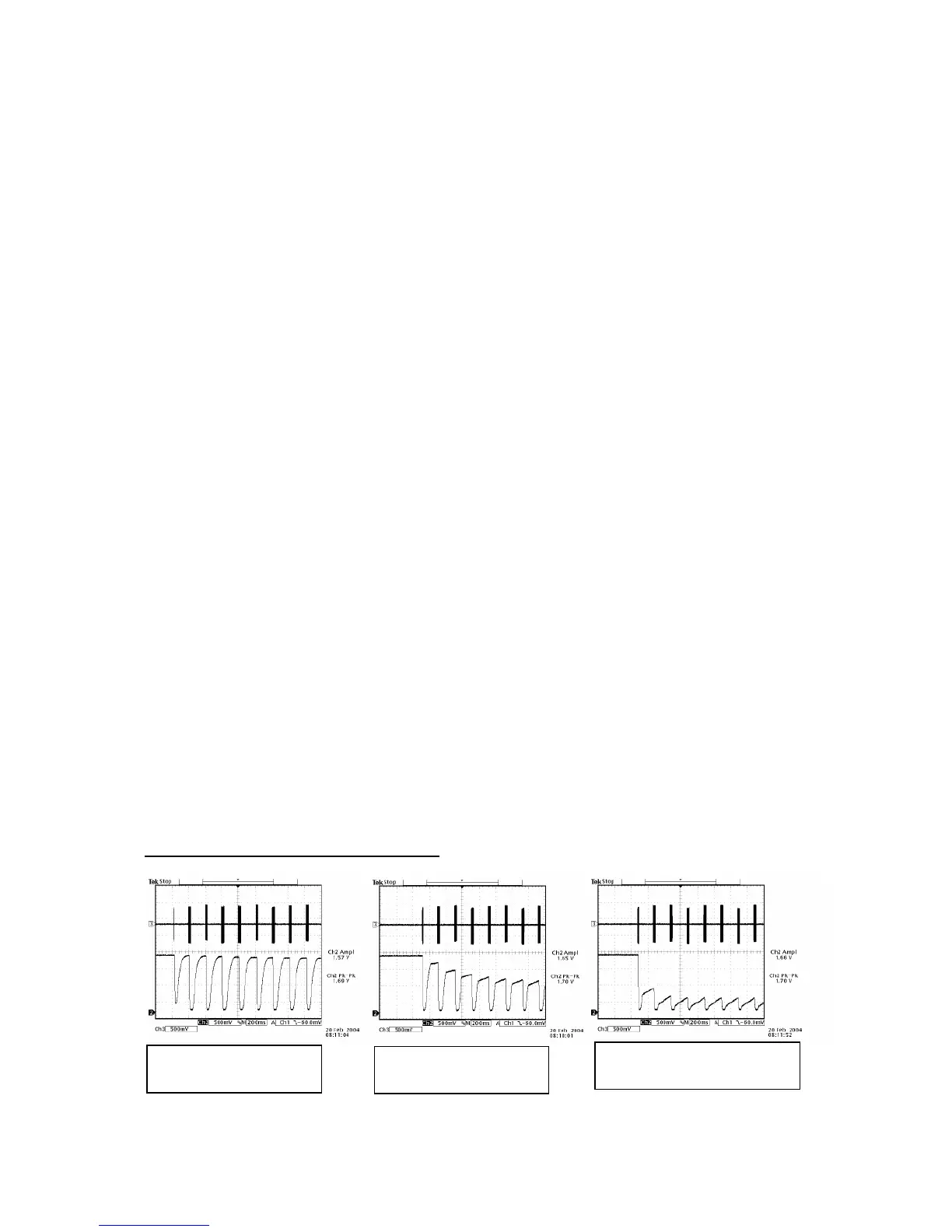
reacts. We have included some scope screen captures to illustrate things a little clearer. The peak and average
function can clearly be seen in the images.
Traditionally audio limiters have two time constants, an attack, the time is takes the limiter to respond to a signal
above the threshold and a decay or release which is the time is takes to respond to a drop in level. In a traditional
audio limiter the attack time is usually set to somewhere in the region of a few milliseconds and the decay time
considerably longer at somewhere in the hundreds of milliseconds. This is not the most optimum solution because
transients that last only a few milliseconds will reduce the level of the waveform for hundreds of milliseconds,
reducing loudness and creating audible pumping effects.
The solution is multiple time constants where one set of time constants can be set to handle the fast peaks and
another to handle the average level of limiting. Fast transients will release in a faster less noticeable way and won't
punch holes in the sound in a way that single time constant limiters can. The secondary slower time constant circuit
will not have much effect on the audio waveform when hit with a transient because the higher attack time, generally in
the hundreds of milliseconds will not allow a build up of energy. In the case of a sustained envelope of audio above
the threshold the multiple time constant will attack as normal with the peak time constant but the sustained energy will
also charge the secondary slower circuit. When the audio energy falls away and the circuit goes into release the peak
decay will dominate until it reaches a point where it hands over to the slower secondary time constant for a slower
rate of decay. The illustrations show this to good effect, where transients have a fast release but multiple or sustained
transients build up energy in the secondary circuit which acts as a platform for the peak to release to. The secondary
circuit's platform can be thought of as the average level of limiting. Having this fast peak responding circuit ride on top
of the average circuit creates many advantages, limiter transparency, less chance of pumping and greater loudness.
By setting the time constants appropriately we can have the multiple time constant based detectors work as peak
handling, average handling or the optimum setting of a balance of the two.
The peak attack time should be set to the desired attack time required from that limiter. The range is 1-10 which
corresponds to 1 to 200mS on an exponential scale. The peak decay time should be set to the desired peak decay
time required for transients. The range is 1-10 which corresponds to a decay time of 10 to 1000mS.
The average attack time is perhaps the most important control in the dual time constant detector as it sets the
balance between peak and average energy in the detector. With smaller numbers more energy is transferred into the
average circuit and a higher platform level is created so more time will be spent releasing at the slower average rate.
Higher numbers offer slower attack times for the averaging part of the detector and this has the effect of lowering the
average platform level and allowing the peak part of the circuit to dominate with its faster release times.
The average decay time can usually be viewed as the nominal release time of the detector, similar to a standard
single time constant limiters release time.
Limiter control signals response to tone bursts
Peak time constants dominating
control due to a very high setting
of average attack
Peak time constants dominating
to a lesser degree due to high
setting of average attack
Peak time constants dominating to a
much lesser degree due to a lower
setting of average attack


 To Next Page