SILVER Audio Processor 4Bmini User’s manual
Page 19/38
Audemat-Aztec SA – Audemat-Aztec INC
web: www.audemat-aztec.com - e-mail: contact@audemat-aztec.com
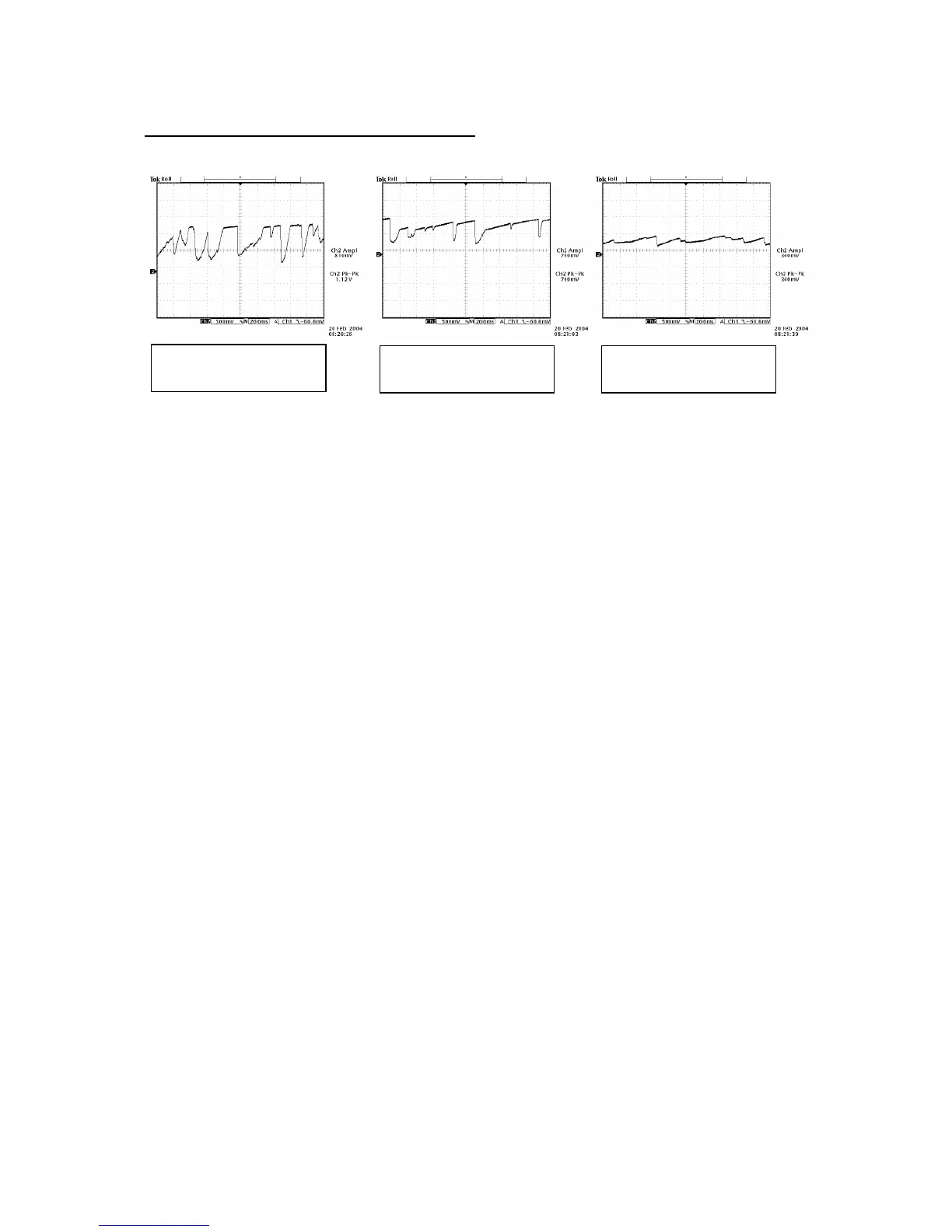
Limiter control signals response to program material
To recap, the peak attack time and average decay time play the same sort of role as that of a standard conventional
single time constant based limiter. The peak decay time sets the decay time for fast usually inaudible transients and
the average attack time sets the ratio of peak to average control and defines the position of the platform that the peak
circuit releases to.
The mixer
The post limiters mixer in the SILVER Audio Processor 4Bmini is not strictly a mixer but a band output level control
where small EQ changes can be made.
Be careful when making large EQ changes at this stage because there is no peak control prior to the clipping system.
It is easy to overload the clipping stages by setting these controls all to large positive values.
The control range for each band of +/- 3dB is purposely restricted for the above reasons.
Bass clipping
Most competent processors have a bass-clipper prior to the final clipper. The purpose of the bass-clipper is to keep
low frequency energy to a pre-determined level to allow for the summation of the other bands. Without the bass-
clipper the bass signal can push the mid and HF audio waveforms into the final clipper creating audible IM distortion,
the worst type of distortion. By restricting the bass to a certain level the mid and HF energy has its own reserved
space in the summated waveform and we reduce the likelihood of bass generated IM distortion.
The downside to bass clipping is you are restricting the bass to a lesser level than what it would be without it. The
upside is that moderate levels of bass clipping won't cause a large loss of bass loudness and should have minimal
audible artefacts.
When bass-clipper is being driven more aggressively you will start to notice generated distortion. This distortion can
be used to actually give the illusion of more bass, especially on smaller radios that are incapable of producing the
lower frequency fundamental bass waveform. This can be viewed as an upside of bass clipping. You need to decide
what level of bass clipping is acceptable to your format, both in creating room for summation from the other bands
and making the punch/distortion trade-off.
The final clipper
The final clipper, used in the FM processing path is a sophisticated highly over-sampled peak limiter that incorporates
distortion controlling techniques and has an embedded 15 kHz low-pass filter. This section of processing is the last
line of defence in the processing and is also the most critical part in the loudness/quality trade-off. While each of the
proceeding processing stages play a part in reducing the peak to average ratio of the audio waveform none has the
same effect on the peak to average ratio as the final clipper.
Peak time constants dominating
control due to a very high setting
of average attack
Peak time constants dominating
to a lesser degree due to a high
setting of average attack
Peak time constants dominating
to a much lesser degree due to a
lower setting of average attack


 To Next Page