page 6
INSTALLATION
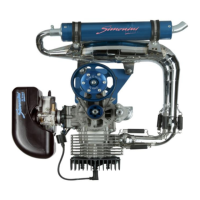
The MINI 3 engine must be fitted to the frame using its six elastic supports "silent
blocks", radially mounted: two placed on the head and four on the back of the
engine.
During the installation, some safety precautions must be made: remember that an
engine generates vibrations, even if very few, which can cause the loosening and/or
removal of screws or any other object. Therefore, to prevent any engine
components may cause damage to persons and/or property, make sure the engine
through a small steel cable. Components normally "made safe" are:
• The filter and the carburetor to the engine
• The springs and exhaust to the engine
• The engine itself to the frame, bypassing the silent blocks. In this case we will
use the "webbing" of synthetic fiber is particularly resistant to traction and tearing.
• The silent blocks and the silencer.
The mouth of the spherical muffler should be lubricated with grease resistant to
high temperatures (e.g. copper grease) before being implanted in the exhaust
manifold.
We recommend taking maximum care when carrying out these operations: in any
case, during the assembly phase the proper choices must be made by expert and
qualified personnel.
FUEL
The MINI 3 engine is designed to operate with a gasoline/oil mixture.
We recommend using oil-based semi-synthetic (for example, BARDAHL with API TC
specification) that, although inferior to a pure synthetic, remains mixed with
gasoline in the tank for a longer period. It grants good lubrication and longer life to
engine components.
During the running-in stage, use an oil percentage of 3.5% and then move to 3%
once the stage has been completed.
The gasoline must have an octane number that is not lower than 95, in order to
avoid pre-ignition phenomena.
Carefully mix the fuel oil in a tank is appropriate and it is better, once mixed, to use
it within a week. Do not use vegetable or animal oil. DO NOT MIX DIFFERENT TYPES
OF OIL. We do never recommend using Castrol TTS Oil. No guarantees by using this
oil will be applied.


 To Next Page