Need help?
Do you have a question about the Simplex P Series and is the answer not in the manual?
Connect hoses to pump and cylinder, use Teflon tape, and install pressure gauge.
Explanation of vented vs. non-vented reservoirs and the need to open the vent.
Specifics for vented reservoirs and how to open/close the vent.
Positioning requirements for vented and non-vented pumps.
Check fittings, oil level, handle extensions, and body position before operation.
How two-stage pumps shift from high flow to high pressure stages.
How to use the release valve to control pressure and flow in single-acting systems.
Operating the manual valve for advance and retract functions.
Operating the 4-way valve for advance, neutral, and retract functions.
Procedures to effectively remove air from the hydraulic system.
Function of the factory-set relief valve and warning against modification.
Regular oil checks, draining, refilling, and recommended fluid types.
Guidelines for filling vented and non-vented reservoirs correctly.
Steps for adding hydraulic oil and rechecking the level after air removal.
Importance of dust caps and preventing dirt ingress into oil lines.
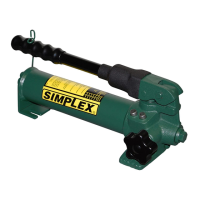
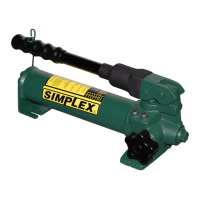
The Simplex P Series Hand Pumps are hydraulic devices designed for a variety of lifting and pressing applications. These pumps are integral to systems that require controlled hydraulic power, working in conjunction with hydraulic cylinders and tools. The manual emphasizes the importance of safe operating procedures and proper maintenance to ensure the longevity and reliable performance of the equipment.
The primary function of the Simplex P Series Hand Pumps is to generate hydraulic pressure to operate single-acting or double-acting hydraulic cylinders and tools. They achieve this by converting manual effort into hydraulic power, which is then transmitted through hoses to the connected equipment. The pumps are designed to provide a controlled flow of oil, allowing for precise advancement and retraction of cylinders.
Many models in the P Series are two-speed pumps, offering a dual-stage flow. In the first stage, under no-load conditions, the pump operates at a high flow rate for rapid advancement of the cylinder. Once the cylinder contacts the load, the pump automatically transitions to the second stage, which is designed for building pressure to lift or press the load. For certain models (P140, P143, P140D, P143D, P230, P230D, P300, P301, P300D, P301D, P461, and P461D), a momentary stop in pumping and raising the handle is required to shift to the high-pressure stage once the pressure reaches approximately 580 psi [40 bar]. This mechanism optimizes efficiency by providing quick initial movement and then powerful, controlled force for the main task.
All Simplex P Series Hand Pumps are equipped with a factory-set pressure relief valve. This critical safety feature prevents over-pressurization of the hydraulic system, safeguarding both the equipment and the operator from potential damage or injury. Users are explicitly warned against attempting to readjust, disable, or modify this valve.
The Simplex P Series Hand Pumps are designed for user-friendly operation, with clear instructions for hydraulic connections, pump venting, positioning, and general operation.
For hydraulic connections, users must remove shipping plugs from the outlet port(s) before operation to prevent oil expulsion. The pumps feature 3/8" NPTF threaded ports, and proper application of Teflon tape or thread sealant is crucial to prevent damage to the hydraulic system. Pressure gauges are recommended for installation in-line from the pump to enhance safety and control. Connecting hoses correctly is vital: single-acting cylinders require one hose from the pump outlet port to the cylinder advance/retract port, while double-acting cylinders use two hoses, connecting the pump's advance port (A) to the cylinder's advance port, and the pump's retract port (B) to the cylinder's retract port.
Pump venting is a key operational aspect, depending on the reservoir type. Pumps with vented reservoirs (e.g., P82A, P230, P230D, P301, P301D, P461, P461D) are equipped with a vent screw or petcock that must be opened for proper operation and closed for transport. If the vent is blocked or closed, the pump will not function correctly. Non-vented reservoirs do not require manual venting.
Pump positioning is also important. Pumps with vented reservoirs must be operated in a horizontal position only. Non-vented reservoirs offer more flexibility and can be operated horizontally or vertically. When operating a non-vented pump vertically, the pump head should face downwards, and the handle upwards, to prevent air intake and ensure proper pressure build-up.
Before using the pump, it is essential to check all system fittings and connections for tightness and leaks, and to verify the oil level in the reservoir. Users are advised to avoid adding extensions to the pump handle, as this can lead to unstable operation. During operation, maintaining a safe distance from the cylinder and workpiece is crucial. For high-pressure operations, short strokes are recommended to reduce handle effort, with maximum leverage achieved in the last 5° of the stroke.
For single-acting applications with a release valve (e.g., P20, P22, P30, P32, P41, P41A, P42, P71, P71V, P72, P82, P82A, P140, P143, P300, P301), the release valve must be closed hand-tight only before operating the pump handle to deliver hydraulic power. Opening the release valve (counter-clockwise) releases pressure and allows oil to flow back to the reservoir, controlling the speed of cylinder retraction.
For single-acting applications with a 3-way, 2-position manual valve (P230, P461), the valve lever is shifted to the "advance" position to deliver hydraulic power. Shifting it to the "retract" position releases pressure and controls oil flow back to the reservoir.
Double-acting applications with a 4-way, 3-position manual valve (P140D, P143D, P230D, P300D, P301D, P461D) use a lever to select between "advance," "neutral" (both ports blocked), and "retract" positions, providing precise control over double-acting cylinders.
Air removal from the hydraulic system is a critical step to ensure smooth and responsive cylinder movement. This involves loosening the oil fill plug (for non-vented reservoirs) or vent screw/petcock (for vented reservoirs), closing the release valve or moving the control valve lever to the advance position, positioning the hand pump higher than the cylinder, and cycling the cylinder through its full range of motion until all air is expelled.
Regular maintenance is crucial for the optimal performance and longevity of Simplex P Series Hand Pumps. Key maintenance aspects include hydraulic reservoir care and keeping oil lines clean.
The hydraulic oil level should be checked regularly. The oil should be drained and refilled with genuine Simplex hydraulic oil or a comparable high-quality ISO 32 hydraulic oil every 12 months. In dirty environments, more frequent oil changes are recommended. The use of any other fluid can damage seals and equipment, voiding the product warranty.
Proper oil filling procedures are detailed: non-vented reservoirs should never be completely filled, as an air gap is necessary for proper function. Vented reservoirs can be filled up to the bottom of the oil fill hole, but a small air gap is still recommended for optimum venting. Specific models (P230, P230D, P461, P461D) should be filled to within 1 inch [25 mm] of the top plate. When adding oil, cylinders should be fully retracted to prevent overfilling the reservoir. After adding oil, the oil fill plug must be reinstalled, and air should be removed from the system if necessary.
Maintaining clean oil lines is paramount. When coupler halves are disconnected, dust caps should always be installed to prevent dirt from entering the system. Foreign matter can cause pump, cylinder, or valve failure, highlighting the importance of meticulous cleanliness.
Troubleshooting guidance is provided for common issues such as the cylinder not advancing or advancing but not holding pressure. Solutions range from checking oil levels and release valve positions to tightening couplers, removing air, and inspecting for leaks or internal pump damage. In cases of internal leakage or cylinder damage, servicing by a qualified hydraulic technician is recommended.
 General
| Series | P Series |
|---|---|
| Manufacturer | Simplex |
| Housing Material | Cast Iron |
| Power Options | Electric |
| Hose Size | 2-6 inches |

 To Next Page